
You implement a multi-agent market-research workflow. Competitor pricing scrape, social sentiment analysis, and regulatory news retrieval are independent. A synthesis agent must wait for all three. Which orchestration approach best optimizes task duration?
Select an answer to reveal the explanation.
Short Explanation
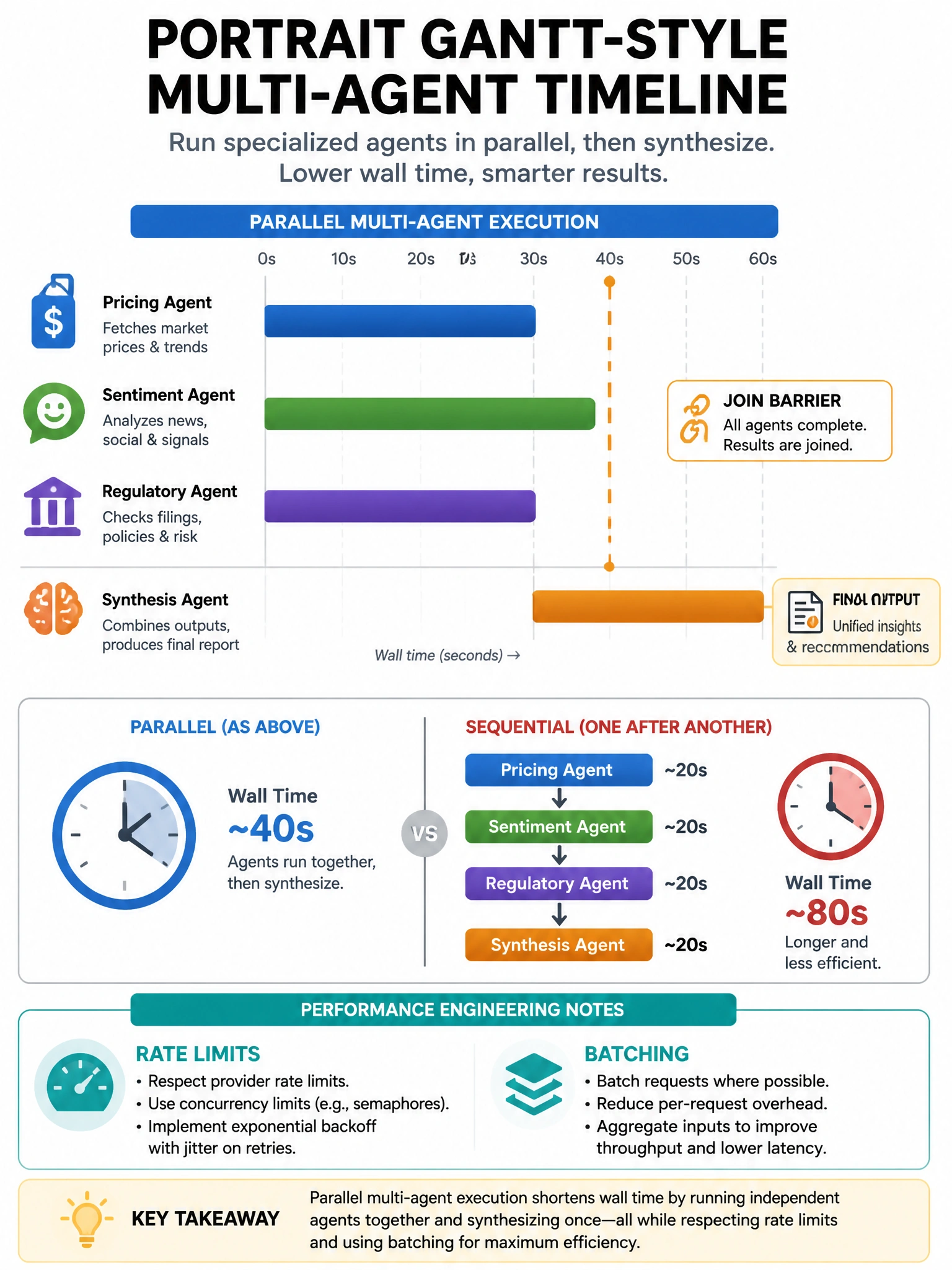
A is correct: independent work should run concurrently, then join before synthesis. That is parallelism for task-duration optimization—an evaluate/develop crossover the exam cares about. Sequential pipelines leave latency on the table. Synthesizing on empty inputs produces garbage. Unbounded spawn ignores rate limits and cost control. Implement parallel branches with clear join semantics, timeouts, and partial-failure policy.
Full Explanation
A is correct because multi-agent orchestration should use parallel patterns for independent subtasks and control concurrent execution, then sequence dependent steps (synthesis) after completion. This reduces end-to-end duration versus pure sequential execution. B is incorrect: unnecessary sequencing increases latency. C is incorrect: synthesis without inputs yields low-quality or empty analysis. D is incorrect: uncontrolled spawning risks rate limits, cost spikes, and instability. Pair parallelism with timeouts, cancellation, and aggregation rules for slow or failed branches.