
A product team is assigning models to agents in a multi-agent software delivery assistant. Tasks include: (1) high-stakes architecture critique requiring deep reasoning, (2) bulk classification of thousands of low-risk backlog items, and (3) fast intent routing in the orchestrator. Which model-matching strategy is most appropriate?
Select an answer to reveal the explanation.
Short Explanation
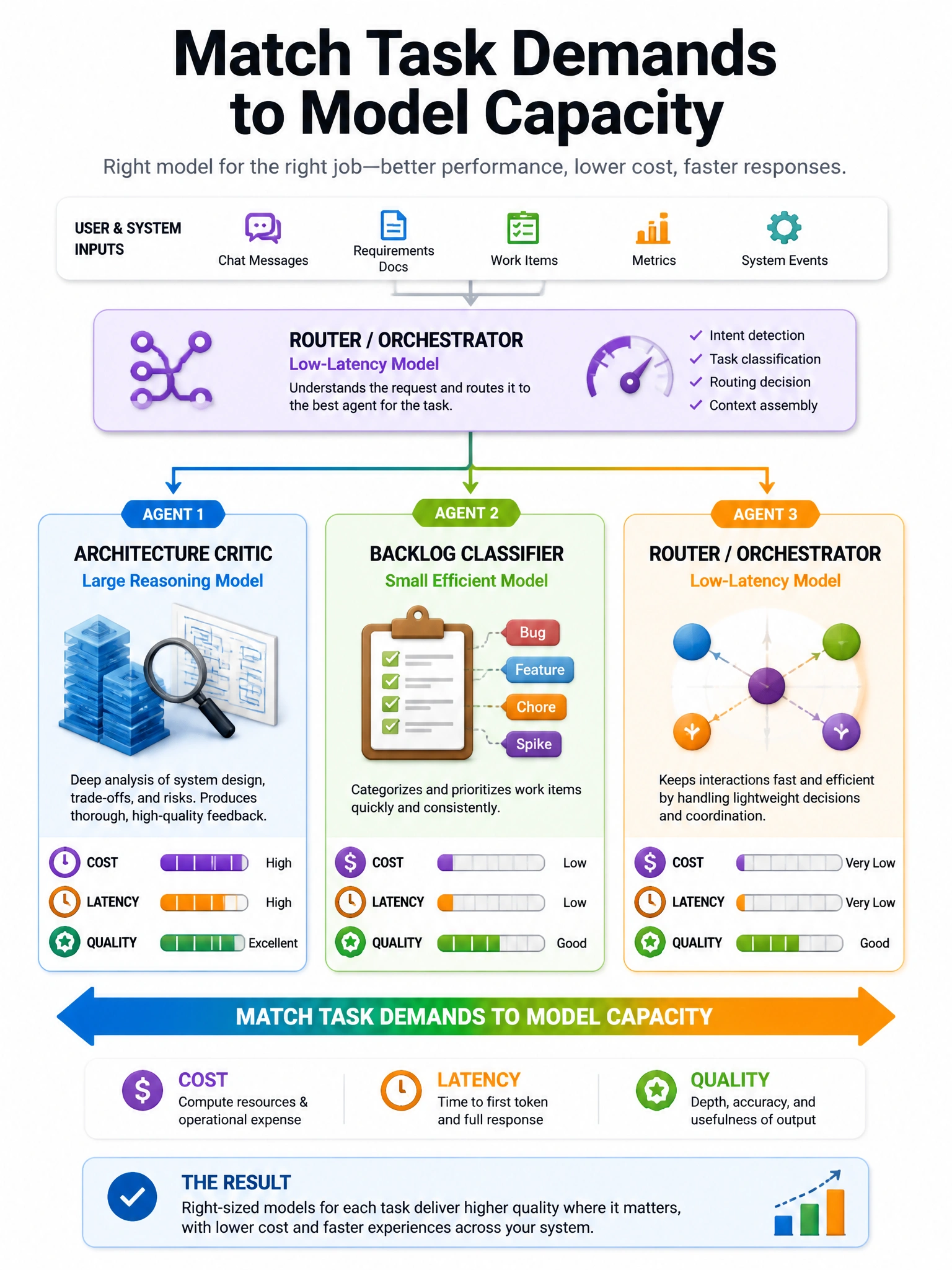
B is textbook “match task demands to model family capacities.” Architecture critique needs deeper reasoning; bulk low-risk classification should use a smaller, cheaper model; orchestrator routing needs speed and stability more than essay-quality prose. That mix improves cost, latency, and reliability. A burns budget and adds latency where quality gains are marginal. C underpowers high-stakes critique. D creates nondeterministic ops nightmares. In multi-agent design, model choice is an architectural decision per agent/task class—not a single global default.
Full Explanation
B is correct because architects must match task demands to model family capacities across the multi-agent system. Different agents have different reasoning depth, latency, and cost envelopes. A is incorrect: uniform frontier models waste tokens on simple routing/classification and can harm latency SLOs. C is incorrect: tiny on-device models may fail high-stakes architecture critique quality requirements. D is incorrect: random model switching undermines evaluation baselines, caching, and incident analysis. Document per-agent model SKUs, fallbacks, and quality gates in the logical architecture.