
Contoso Insurance is designing a multi-agent system in Microsoft Foundry to process complex commercial claims. Business goals include document intake, fraud risk scoring, policy coverage matching, reserve estimation, and adjuster handoff. The solution architect must decompose these goals into agents and workflows. Which design approach best matches production multi-agent architecture practices?
Select an answer to reveal the explanation.
Short Explanation
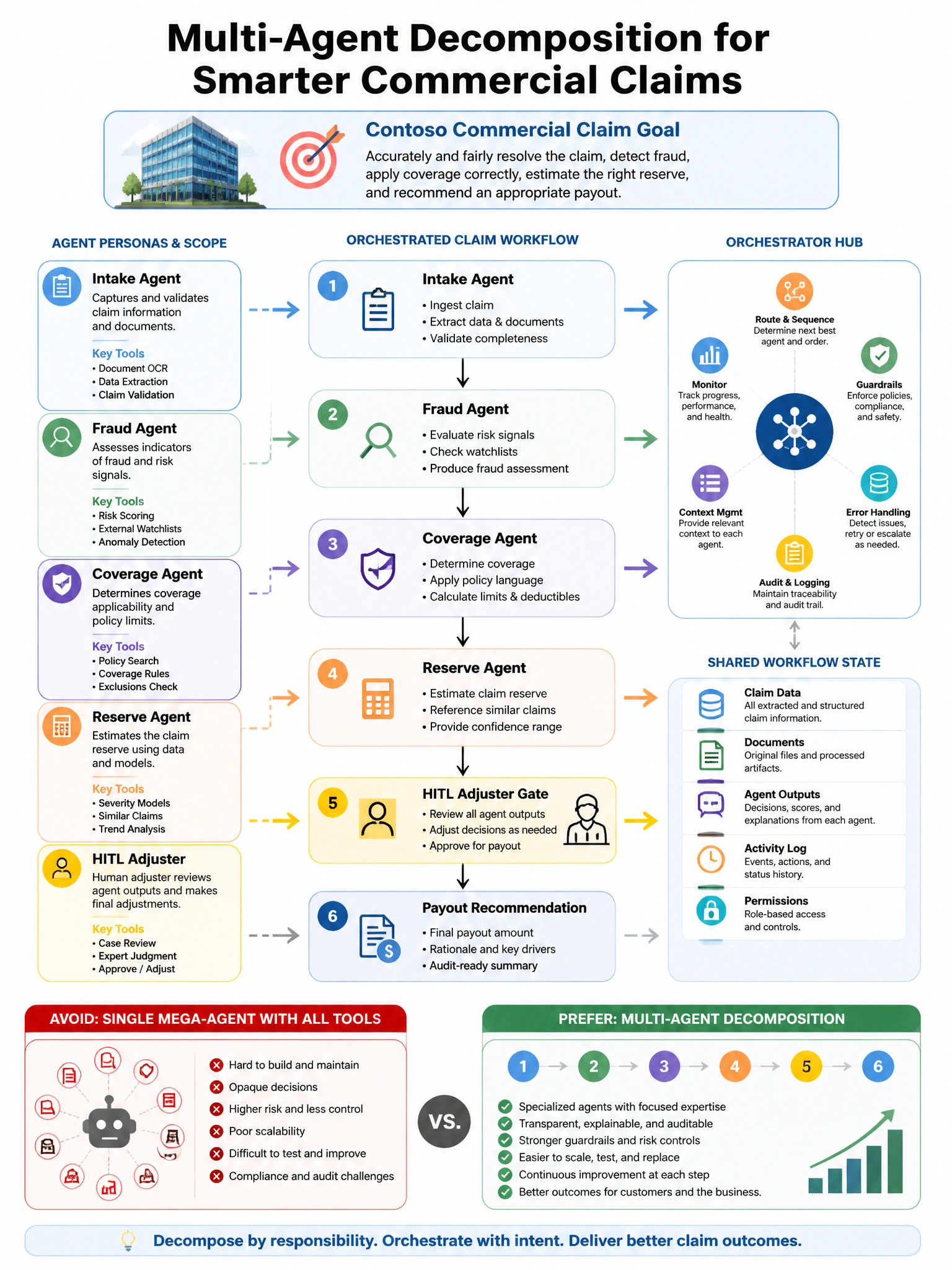
Answer A is the right call. Multi-agent design on AI-500 starts with decomposing business goals into scoped agents, tools, and workflows—not one mega-agent. Contoso’s claim stages map cleanly to specialist agents (intake, fraud, coverage, reserves) with an orchestrator coordinating handoffs and a human gate before money moves. That keeps autonomy bounded, failures isolatable, and Responsible AI controls explicit. B fails because a single agent with every tool becomes a security and reliability risk—hard to audit, easy to over-permission. C is just disconnected apps, not a multi-agent system: no shared state, no control loop, no reproducible workflow. D throws away tools and structure; a prompt alone cannot enforce process, permissions, or HITL. Design personas, scopes, and control loops first, then wire protocols and memory.
Full Explanation
A is correct because expert multi-agent architecture decomposes objectives into workflows, agents, subagents, tools, and human-in-the-loop control points. Specialist agents with clear scopes and an orchestrated handoff path match the claims lifecycle and support auditability, least privilege, and failure isolation in Microsoft Foundry-style solutions. B is incorrect: a single generalist agent with unbounded tools violates scope and permission boundaries and makes behavioral guidelines and tool authentication harder to enforce. C is incorrect: independent chatbots without orchestration, shared state, or defined protocols do not constitute a coordinated multi-agent solution. D is incorrect: prompt-only designs cannot implement tool scopes, durable workflow state, or reliable human approval gates required for regulated payout recommendations. Exam focus: decompose goals → agents + tools + control loops, not monolith prompts.