
Enterprise policy requires multi-agent solutions to move through Development, Test, Acceptance, and Production with infrastructure-as-code and a documented rollback. Which design meets this?
Select an answer to reveal the explanation.
Short Explanation
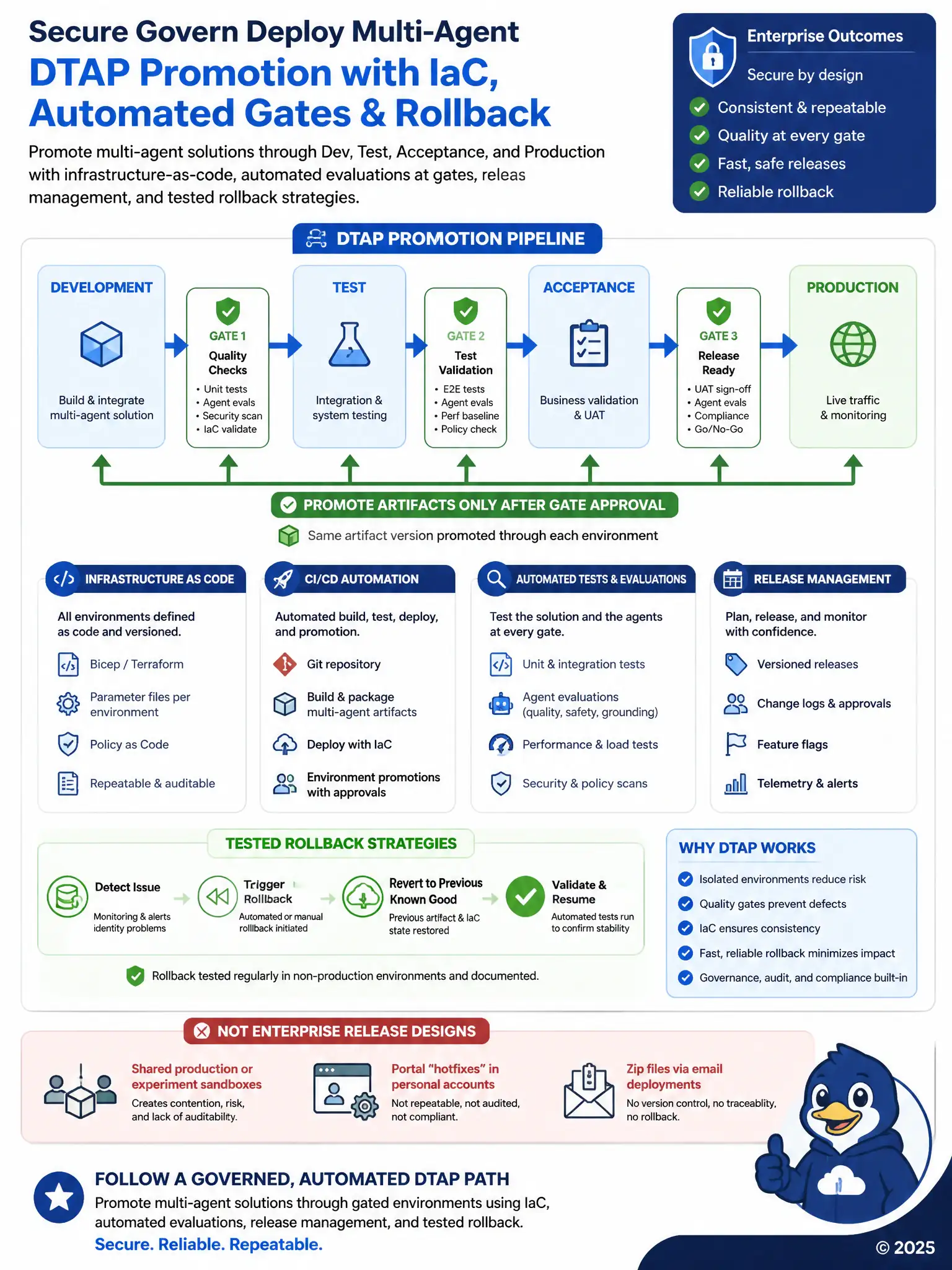
Use a DTAP-style multi-environment promotion with IaC, automated tests/evaluations at gates, release management, and a tested rollback. That gives you isolated promotion, auditability, and a documented way back. Shared live/experiment environments, portal hotfixes under personal accounts, and emailed zip files aren't enterprise release designs.
Full Explanation
Correct design: DTAP or equivalent multi-environment promotion with IaC deployments, automated tests/evaluations at gates, release management, and tested rollback strategies. Specify CI/CD and multi-environment releases for multi-agent systems: IaC for Azure resources, automated unit/integration/regression tests and evaluations, controlled promotion DTAP-style, and rehearsed rollback (previous prompt/graph/model deployment). Include agent-specific artifacts (prompts, MCP server versions, evaluation baselines) in the release package.
The single shared environment used simultaneously for experiments and live customers is incorrect: mixing experimental agents with live traffic violates isolation and change control. Production-first coding with hotfixes typed into the portal under personal accounts is incorrect: unaudited portal edits under personal identities break governance. Emailing zip files of Python scripts as the only release process is incorrect: ad-hoc script zips lack repeatability, review, and infrastructure consistency.