
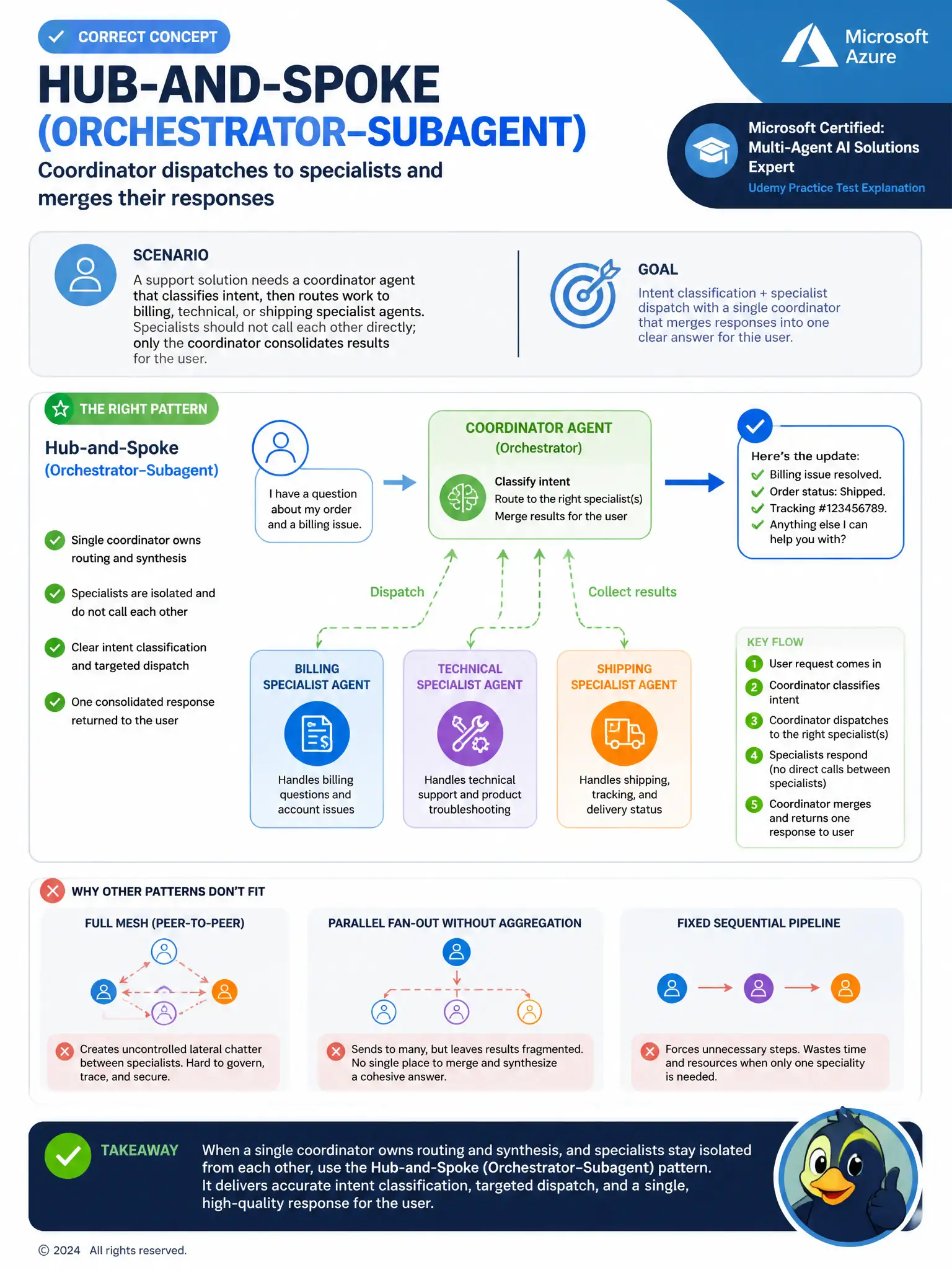
A support solution needs a coordinator agent that classifies intent, then routes work to billing, technical, or shipping specialist agents. Specialists should not call each other directly; only the coordinator consolidates results for the user. Which multi-agent orchestration pattern should you implement?
Select an answer to reveal the explanation.
Short Explanation
When one coordinator classifies intent and sends work to isolated specialists, you want hub-and-spoke or orchestrator-subagent orchestration. You don't let specialists talk to each other; the coordinator merges one clean answer for the user.
Full Explanation
The correct pattern is hub-and-spoke, also described as orchestrator-subagent. Multi-agent orchestration patterns on AI-500 include hub-and-spoke, sequential, parallel, peer-to-peer, and orchestrator-subagent. The described control flow—central classification, exclusive coordinator mediation, specialist isolation, and consolidated user response—is classic hub-and-spoke / orchestrator-subagent.
A fully mesh peer-to-peer pattern with every agent free to message every other agent is wrong because it allows direct specialist-to-specialist communication, which the requirement forbids and which complicates governance and tracing.
An unordered parallel fan-out with no aggregator is wrong because unordered parallel work without a merge step does not produce a single coordinated answer.
A sequential pipeline that always runs billing then technical then shipping for every ticket is wrong because always running every specialty is inefficient and ignores intent-based routing.
Implementation notes: use Agent Framework or LangGraph to encode the hub graph, preserve correlation IDs across spoke calls, and keep tool scopes per specialist.