
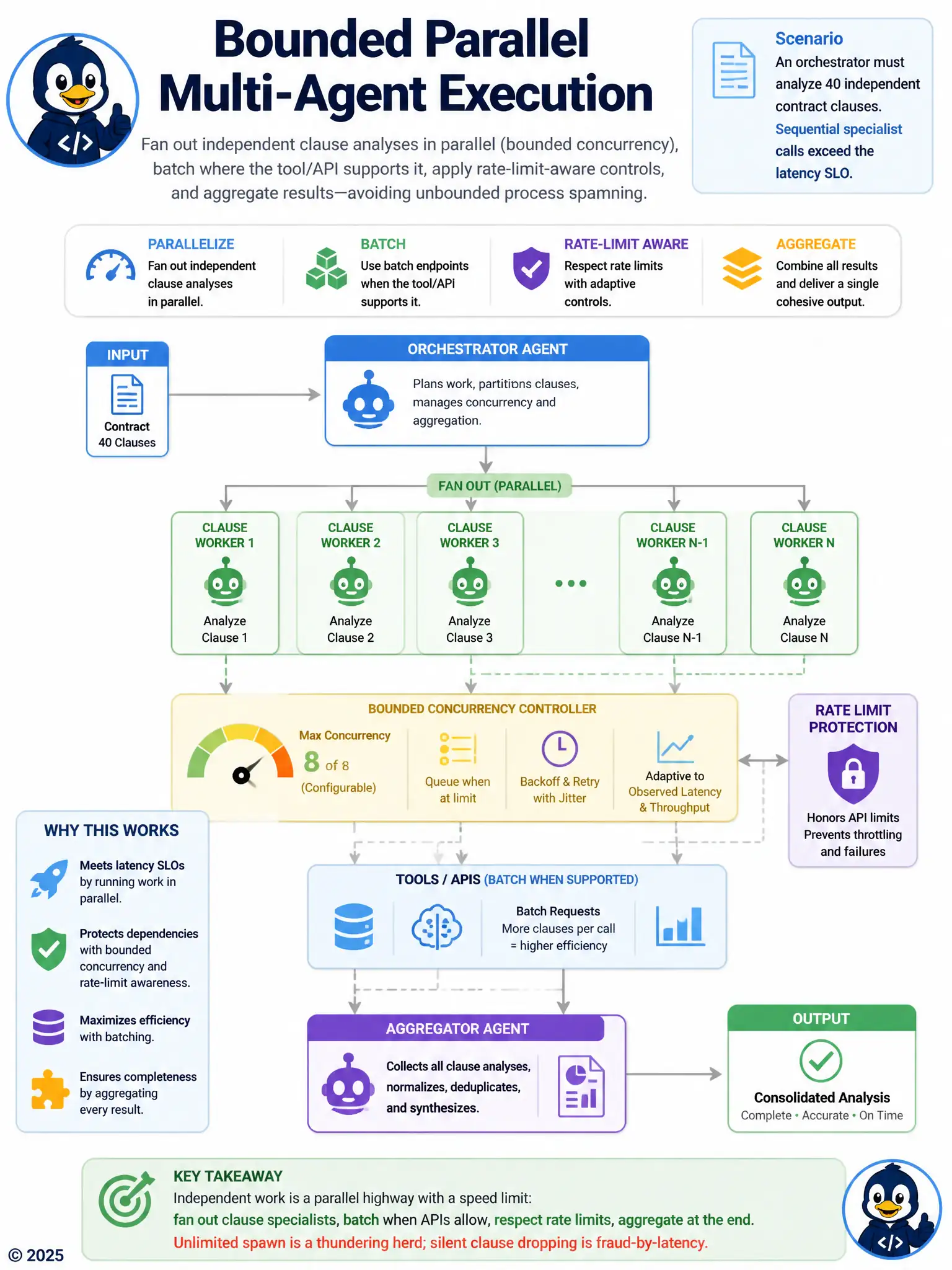
An orchestrator must analyze 40 independent contract clauses. Sequential specialist calls exceed the latency SLO. How should you implement scaling of multi-agent execution?
Select an answer to reveal the explanation.
Short Explanation
You fan out independent clause analyses in parallel with bounded concurrency, batch when APIs allow, respect rate limits, and aggregate results. Unlimited spawning is a thundering herd, and silently dropping clauses is fraud-by-latency.
Full Explanation
Implementing multi-agent solutions includes scaling and control of spawning, batching, and concurrent execution, and optimizing task duration with parallelism and rate limits. The correct approach applies parallel fan-out with bounds, batching, rate-limit awareness, and aggregation while avoiding unbounded process spawning that could overwhelm dependencies. Spawning unlimited agent processes with no concurrency cap until the cluster fails risks cascading failure. Always processing clauses one-by-one forever even when they are independent fails the latency SLO without need. Dropping 30 clauses randomly to meet the latency SLO without telling the user violates correctness and transparency. Exam tip: Parallelism answers should mention bounded concurrency and rate limits, not infinite spawn.