
A regulated enterprise requires that multi-agent workloads in Azure cannot reach the public internet for tool APIs hosted on Azure App Service and Azure OpenAI. Agents still need private connectivity to those endpoints and to Key Vault. Which network design best meets the requirement?
Select an answer to reveal the explanation.
Short Explanation
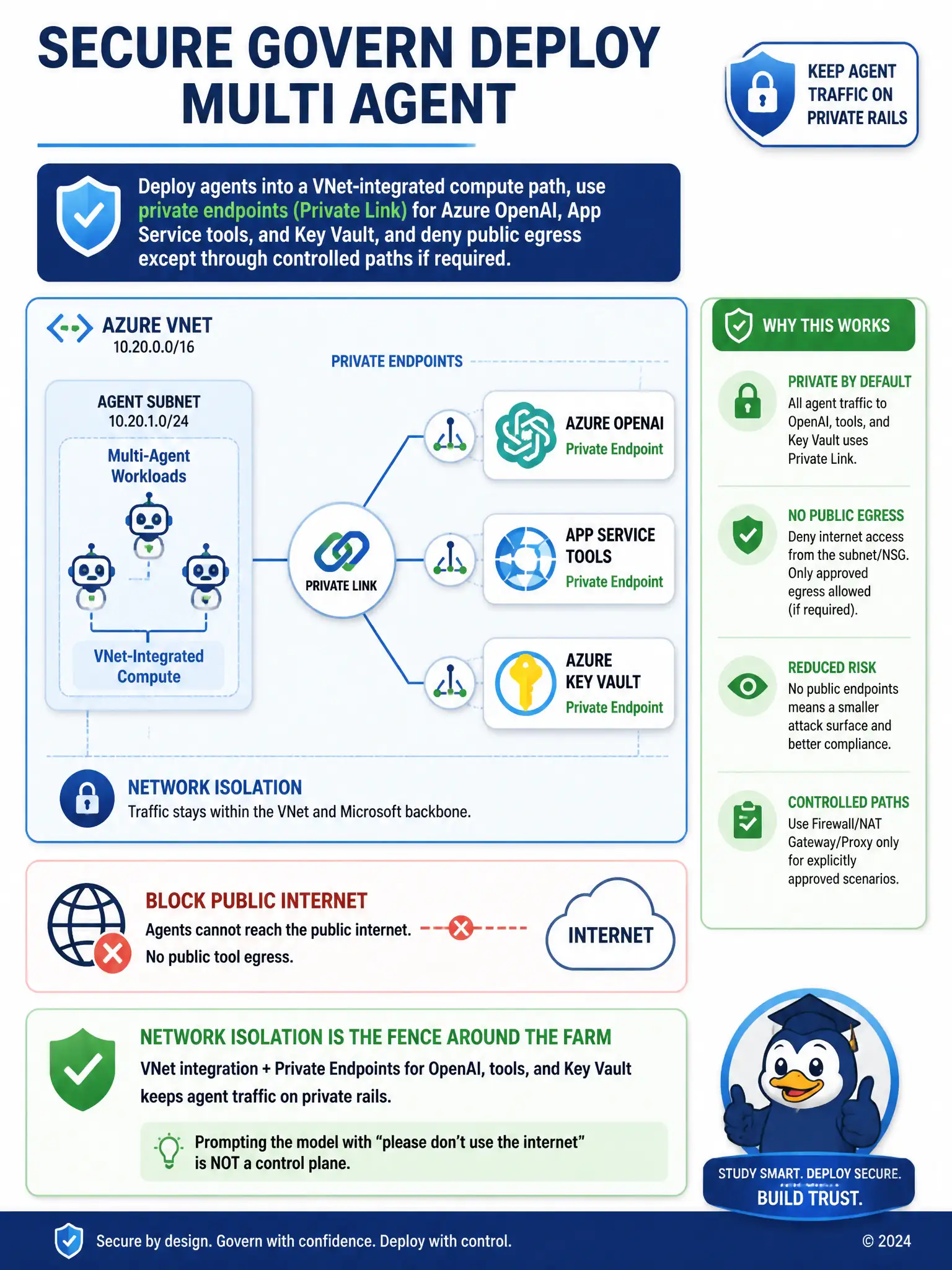
You need to fence the farm with VNet integration and private endpoints for Azure OpenAI, App Service tools, and Key Vault. API keys or prompt-only rules won't stop traffic from leaving the private rails.
Full Explanation
Secure multi-agent deployments must specify network boundaries along with identity controls. The VNet-integrated compute path with private endpoints or private link for Azure OpenAI, App Service-hosted tools, and Key Vault, while denying public egress except through controlled paths if required, is correct because it enforces private connectivity and reduces public exposure, aligning with Zero Trust network design for regulated workloads.
The design that places agents on a public App Service plan and relies solely on API keys without network controls is incorrect because public compute with only API keys provides no network boundary and increases attack surface.
The design that allows all outbound 0.0.0.0/0 from the agent subnet and uses only prompt-level instructions not to call public URLs is incorrect because unrestricted egress plus prompt-only restrictions is not enforceable network isolation.
The design that exposes every tool API on the public internet with IP allowlists that include 0.0.0.0/0 for simplicity is incorrect because public tools with a wide-open allowlist defeat isolation goals.
Exam tip: Pair identity least privilege with network isolation (VNet + private endpoints) when scenarios mention regulated or no-public-internet requirements.