
Finance reports that one business unit’s multi-agent experiment consumed the majority of the shared Azure OpenAI quota, starving production agents in other units. Leadership wants usage visibility by team, hard allocations, and chargeback. Which monitoring and management strategy addresses this?
Select an answer to reveal the explanation.
Short Explanation
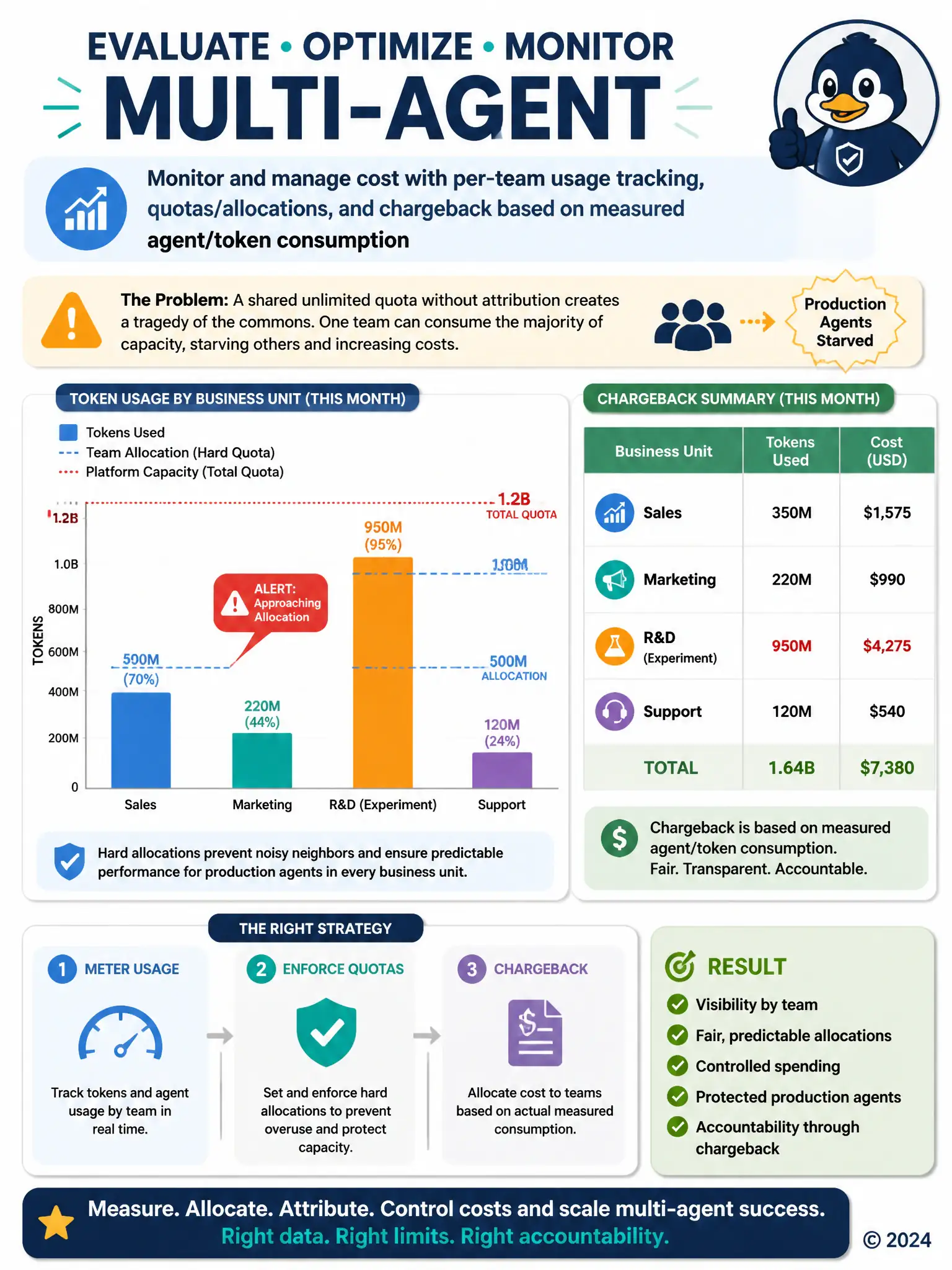
Shared unlimited quota without attribution creates a tragedy of the commons. You need per-team usage tracking, quotas/allocations, and chargeback based on measured agent/token consumption. Hiding metrics, anonymous shared keys, and random billing don't control or fairly allocate cost.
Full Explanation
The correct strategy is to monitor and manage cost with per-team usage tracking, quotas/allocations, and chargeback based on measured agent/token consumption. Designing cost monitoring for multi-agent solutions includes usage, quotas, allocations, and chargebacks so platform capacity is governed fairly across teams and production is protected from experimental overconsumption. Hiding all cost metrics from teams is incorrect because it prevents responsible optimization and governance. Allowing unrestricted model usage with a single shared key and no attribution is incorrect because it maximizes contention and eliminates accountability. Billing costs randomly to departments at year end without usage data is incorrect because chargeback without measured usage is arbitrary and does not change real-time quota behavior. Exam focus: multi-agent platforms need quota and chargeback models, not only raw spend dashboards.