
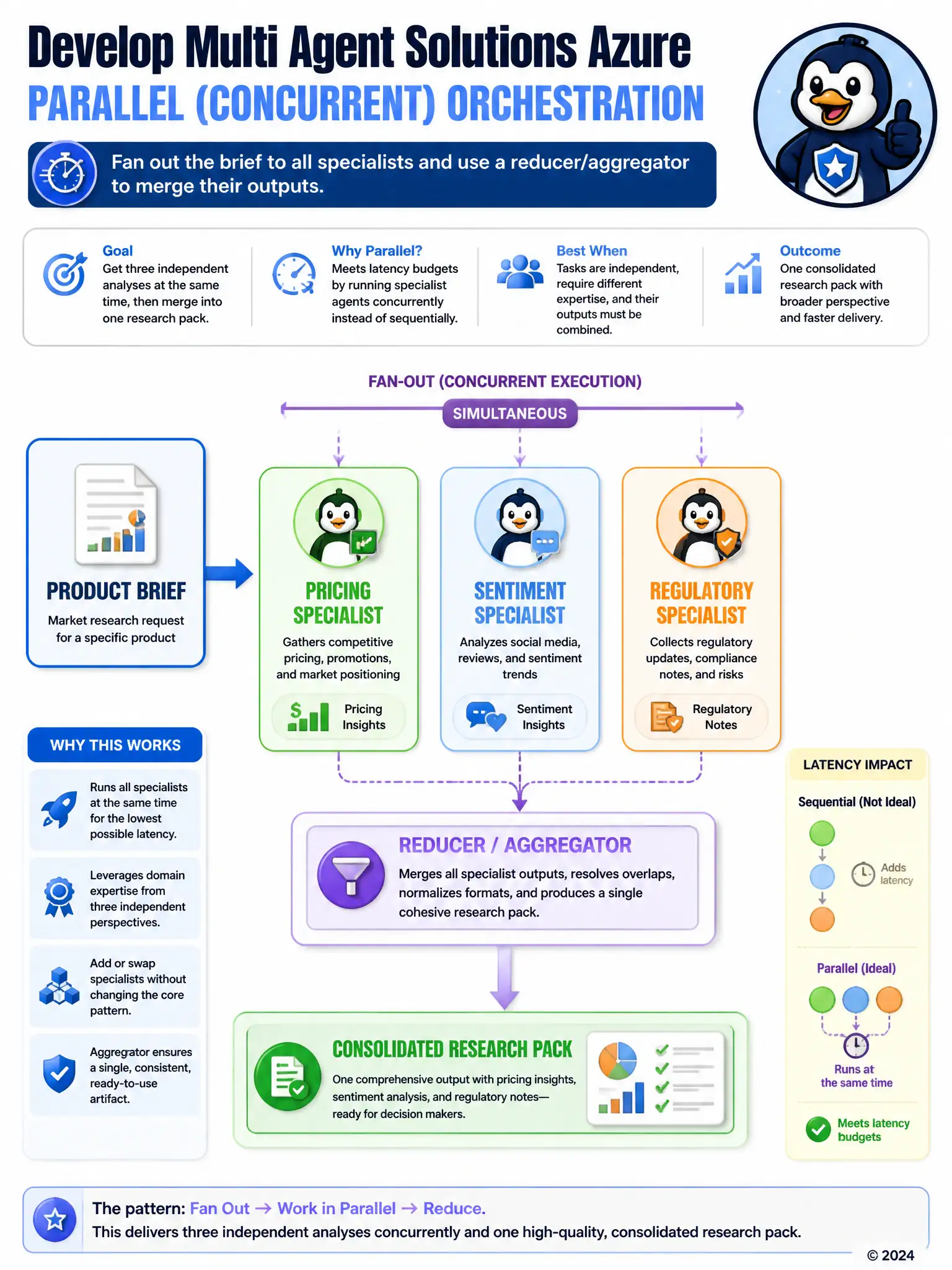
A market-research multi-agent system must, for each product brief, simultaneously gather competitive pricing, social sentiment, and regulatory notes from three independent specialist agents, then produce one consolidated research pack. Latency budgets require that the three specialists run at the same time rather than waiting on each other. Which orchestration pattern should the team implement?
Select an answer to reveal the explanation.
Short Explanation
You need three independent analyses at the same time, then one merged pack. That's classic parallel (concurrent) orchestration: fan out, work in parallel, reduce. The parallel fan-out plus aggregator option is the one that fits.
Full Explanation
The correct pattern is parallel (concurrent) orchestration that fans the brief to all three specialists and uses a reducer/aggregator to merge their outputs. Multi-agent orchestration patterns include parallel (concurrent) execution when independent specialist work can proceed simultaneously and a reducer merges results. This matches simultaneous pricing, sentiment, and regulatory collection with a consolidated research pack and a latency budget that forbids sequential waiting.
Sequential orchestration that always runs pricing, then sentiment, then regulatory in a fixed chain is incorrect because it serializes specialists, increasing end-to-end duration without adding dependency value when tasks are independent.
Handoff orchestration that transfers exclusive control to only one specialist for the entire brief is incorrect because it transfers exclusive ownership to a single agent and does not collect multi-specialist outputs for the same brief.
Peer-to-peer free chat with no completion criteria so specialists negotiate indefinitely is incorrect because unmanaged peer-to-peer chat without termination and aggregation strategies risks unbounded conversation and fails to guarantee a single consolidated deliverable.
Exam focus: match independence + latency to parallel orchestration with explicit aggregation.