
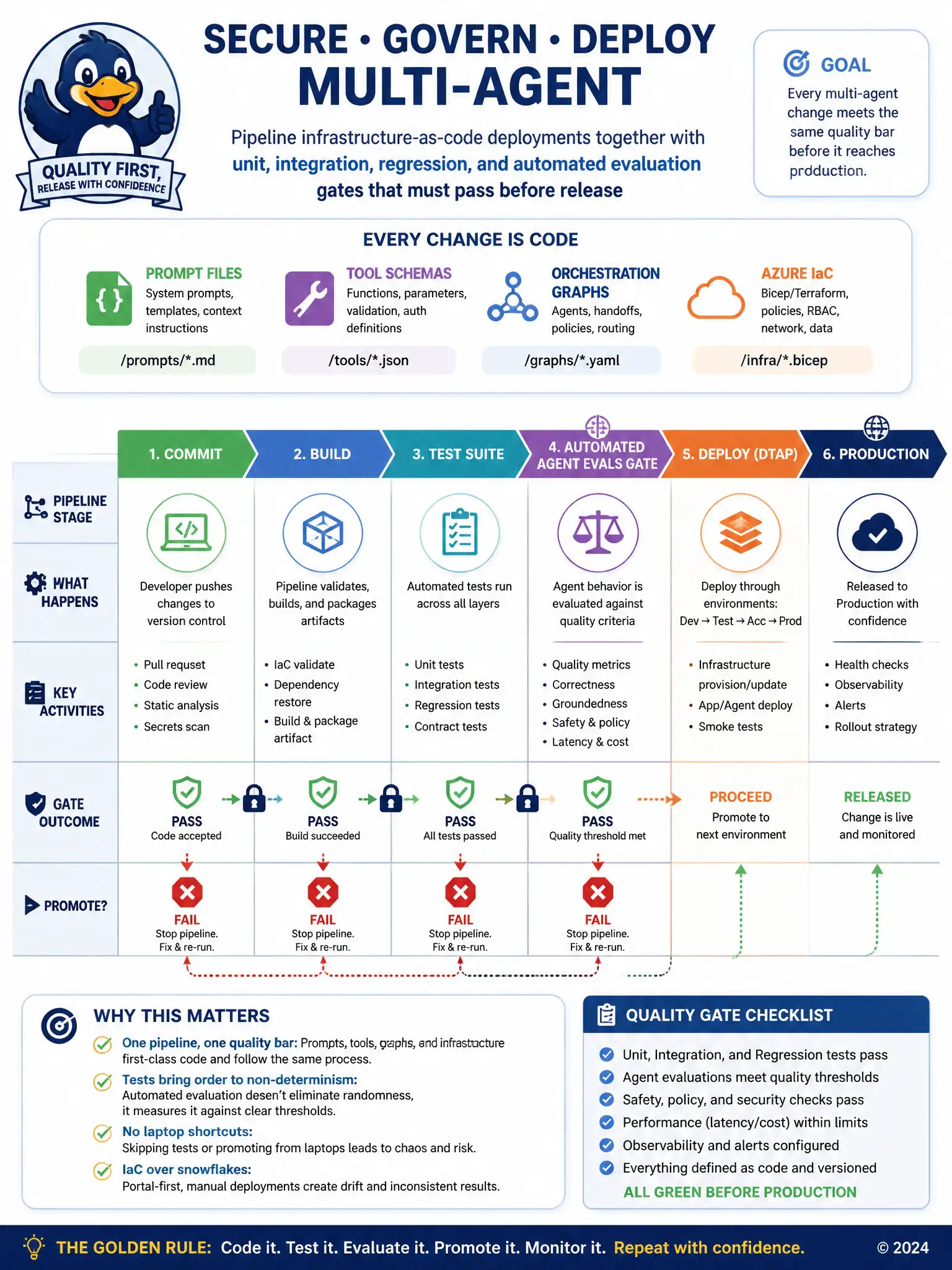
A platform team wants every multi-agent change—prompt files, tool schemas, orchestration graphs, and Azure infrastructure—to follow the same quality bar before production. Which CI/CD requirement set best fits AI-500 deployment guidance?
Select an answer to reveal the explanation.
Short Explanation
You need one pipeline that treats prompts, tools, graphs, and Azure infrastructure as code, with unit, integration, regression, and automated evaluation gates before prod. Skipping tests from laptops is chaos. Non-determinism means you design evals carefully, not that you ban tests, and portal-first manual snowflakes fight infrastructure-as-code.
Full Explanation
The pipeline that deploys infrastructure-as-code with unit, integration, regression, and automated evaluation gates before release is correct. AI-500 deployment guidance requires CI/CD for integration and release, including infrastructure-as-code and testing strategies such as unit, regression, integration, and automated evaluations. Gating prompts, tools, orchestration graphs, and Azure infrastructure on those checks enforces a consistent quality bar.
Allowing production deploys from developer workstations when unit tests are skipped bypasses review, reproducibility, and safety gates.
Banning automated tests because agents are non-deterministic is wrong; non-determinism motivates statistical and rubric-based automated evaluations, not abandoning testing.
Deploying infrastructure manually in the portal, then copying settings into code later is wrong because manual portal configuration diverges from code and undermines repeatable infrastructure-as-code releases.