
A pharmaceutical multi-agent system must never recommend off-label drug uses or invent clinical claims. Generic toxicity filters catch insults but miss domain violations. How should the team design guardrails and validation?
Select an answer to reveal the explanation.
Short Explanation
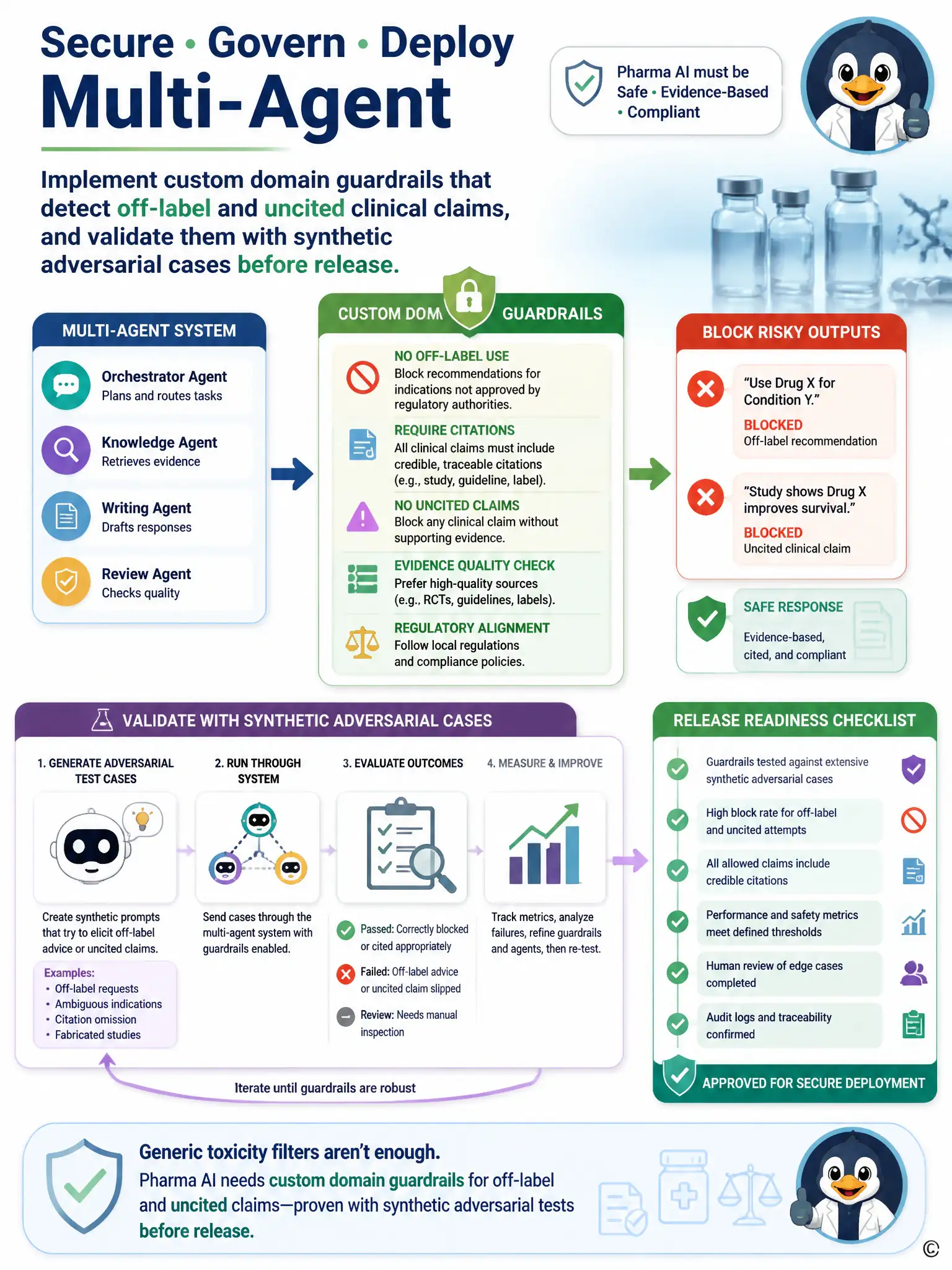
Pharma needs custom domain guardrails for off-label and uncited claims, proven with synthetic adversarial tests—not just generic toxicity filters. You can't rely on base-model safety alone; it's too coarse. Letting users override twice isn't a control, and Latin translations aren't a compliance strategy.
Full Explanation
The correct approach is to implement custom domain guardrails that detect off-label and uncited clinical claims, and validate them with synthetic adversarial cases before release. Skills include custom guardrails for domain-specific constraints and guardrail testing with synthetic data. Generic toxicity filters do not encode pharmaceutical labeling rules; explicit detectors plus synthetic adversarial validation close that gap before release. Relying only on the base model's general safety training without extra policy layers is incorrect because general safety training does not reliably enforce specialized regulatory content policies. Allowing off-label recommendations if the user insists twice is incorrect because user insistence must not bypass clinical safety policies. Translating all answers into Latin so regulators cannot easily audit them is incorrect because obfuscation hinders audit and does not enforce correct medical content.