
A team must ship a risky orchestrator prompt change that alters how three specialist agents are sequenced. Automated evals look good in staging. They need a production release method that limits blast radius if live behavior diverges. Which release methodology best fits?
Select an answer to reveal the explanation.
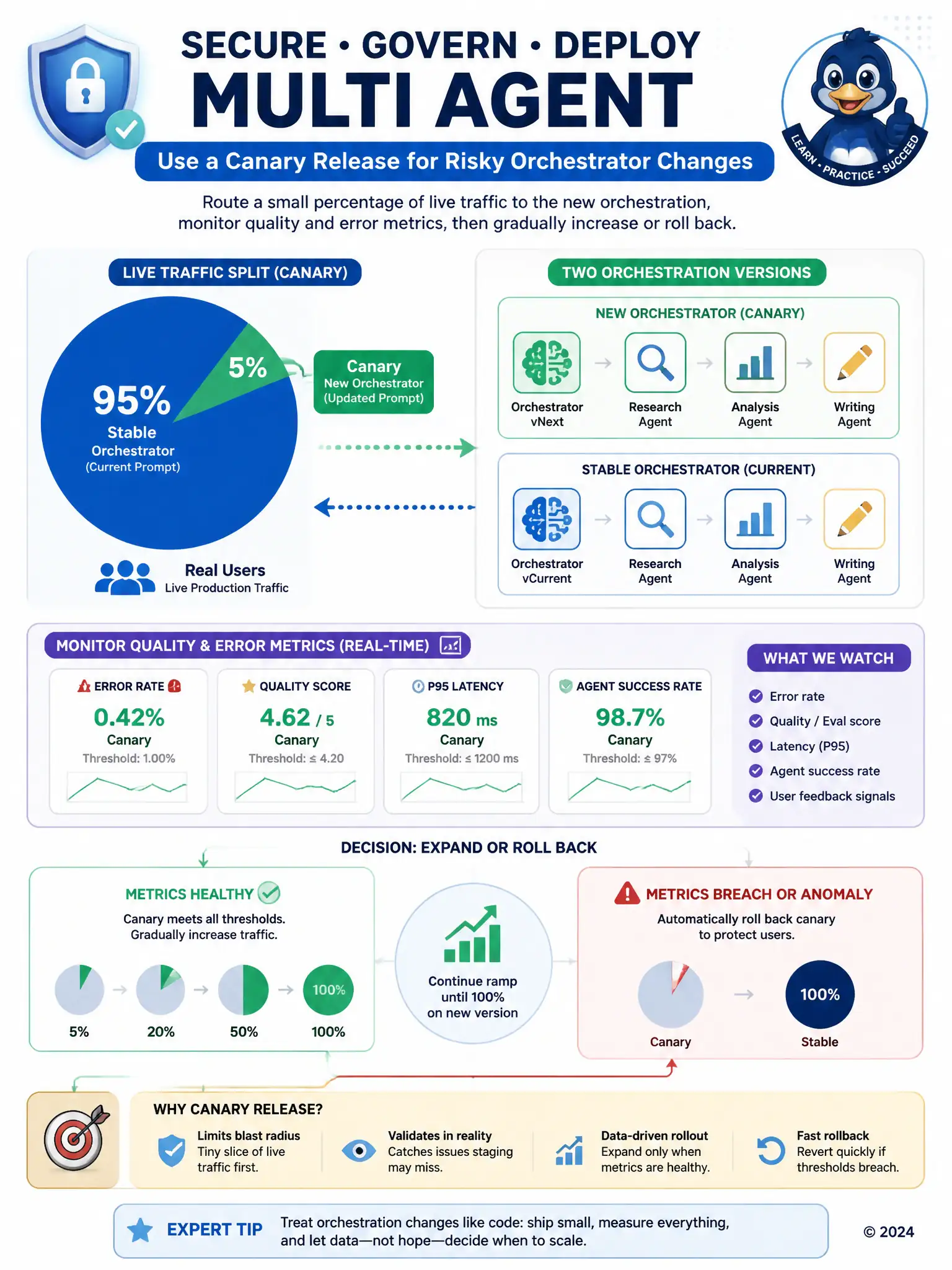
Short Explanation
You want a canary release here. It sends a tiny slice of live traffic to the new orchestration, lets you watch quality and error metrics, then expands or rolls back if behavior diverges. A midnight full swap just makes the blast radius bigger.
Full Explanation
The canary release approach is correct. Deploy skills for multi-agent solutions include canary and related progressive releases with monitoring and rollback. Routing a small live percentage validates staging evals under real traffic while containing damage if sequencing behavior diverges.
The simultaneous full replacement approach is incorrect because it offers no limited blast radius and complicates rapid rollback decisions.
The email-a-zip manual regional install approach is incorrect because manual regional installs are slow, inconsistent, and poorly suited to Microsoft Foundry and Azure multi-agent release management.
The disable-monitoring approach is incorrect because releases are when monitoring and alerts are most critical, not optional noise.