
Your team prefers graph-based control flow with explicit nodes, edges, and conditional branching for a multi-agent claims pipeline on Azure. Microsoft Agent Framework is available, but the engineers already prototyped complex cycles in LangGraph. Which implementation choice best matches the requirement for advanced graph orchestration?
Select an answer to reveal the explanation.
Short Explanation
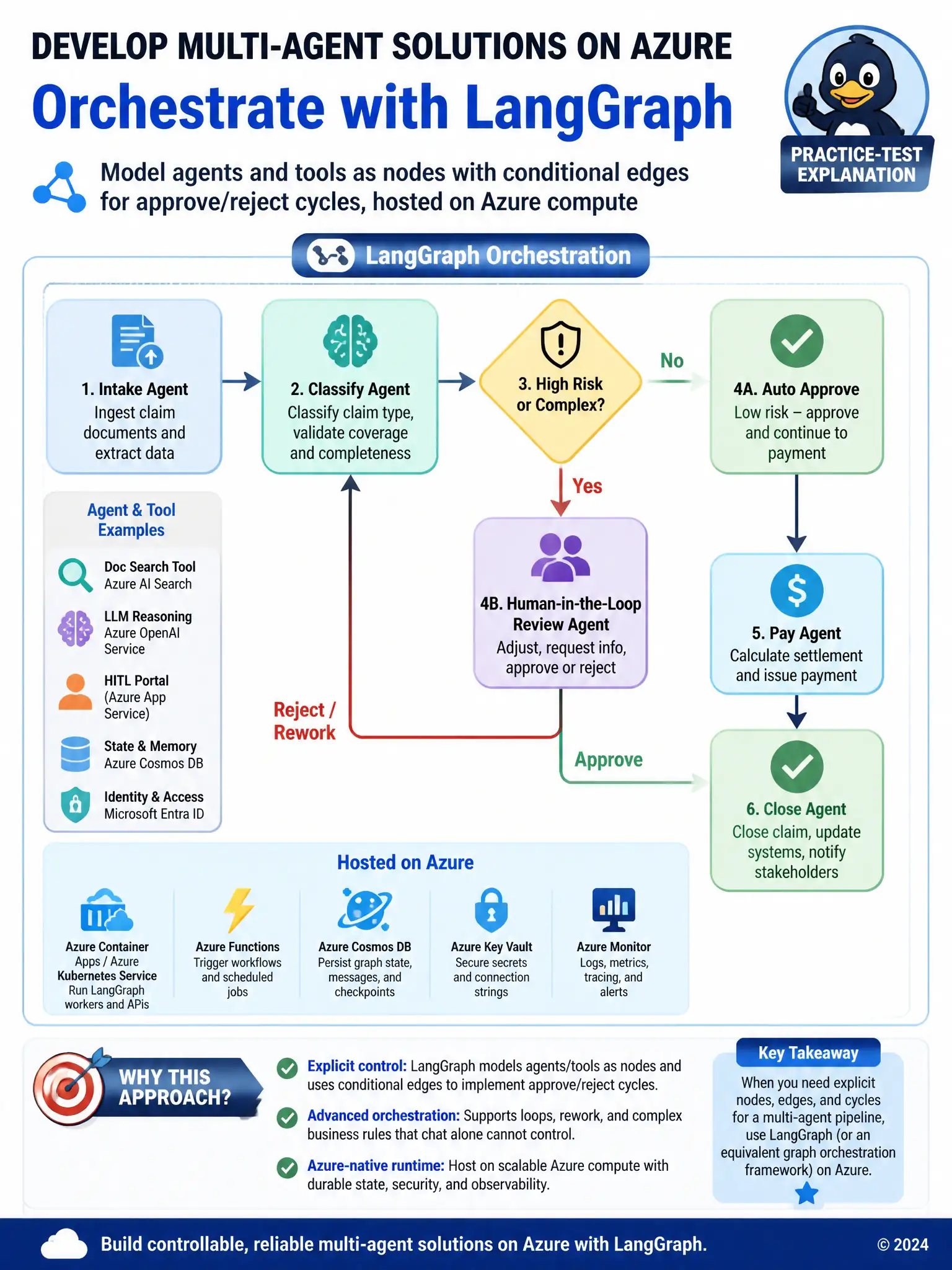
When you need explicit nodes, edges, and cycles, use a graph orchestration framework. LangGraph fits your prototype and is an accepted multi-agent orchestration approach alongside Agent Framework patterns. Host it on Azure with proper state.
Full Explanation
AI-500 includes implementing multi-agent orchestration frameworks such as Agent Framework, LangChain, and LangGraph. Implementing orchestration with LangGraph, or equivalent graph orchestration in supported frameworks, by modeling agents and tools as nodes with conditional edges for approve/reject cycles and hosting it on Azure compute, matches advanced graph orchestration. It gives graph-native control flow, conditional branching, and cycles appropriate to claims approve/reject loops.
The single unstructured chat session approach lacks determinism and testability for regulated claims steps. The nested Excel macros approach is not a scalable multi-agent platform. The fire-and-forget Event Grid topics approach provides messaging without agent reasoning or state semantics. Teams may still standardize on Microsoft Agent Framework where it meets needs; the point is matching graph requirements to a graph-capable orchestrator. Exam tip: Framework choice should follow control-flow complexity and team capability.