
You implement orchestration for a due-diligence multi-agent workflow: financial analysis, legal review, and market research can run independently, then a partner agent synthesizes findings. Which orchestration pattern should you implement?
Select an answer to reveal the explanation.
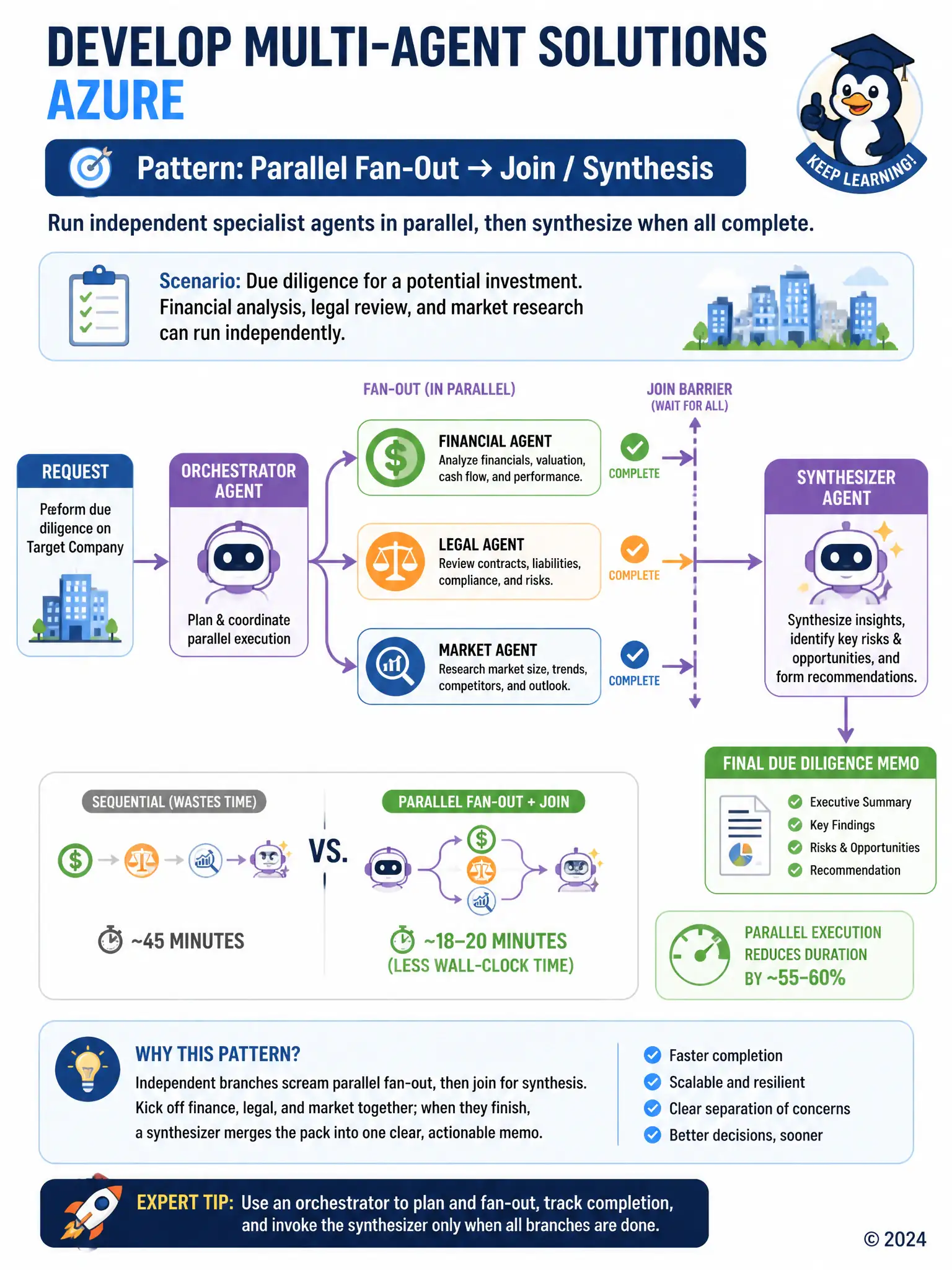
Short Explanation
When finance, legal, and market research are independent, you fan them out in parallel and join the results for synthesis. You kick off all three together, then let a synthesizer merge the pack when they’re done.
Full Explanation
Multi-agent orchestration patterns include parallel, sequential, hub-and-spoke, peer-to-peer, and orchestrator-subagent. The correct pattern uses parallel execution for independent workstreams plus a join/synthesis stage. The strict sequential chain that forces finance to finish before legal starts adds unnecessary latency when there is no data dependency. The peer-to-peer free-for-all with no synthesis step and no completion barrier lacks aggregation and quality control. The hub-and-spoke pattern where every specialist must call every other specialist for each sentence over-connects agents and increases cost/noise. In Azure/Agent Framework or LangGraph, model this as concurrent nodes with a barrier before the synthesize node. Exam tip: Choose parallel when tasks are independent; sequential when outputs feed inputs.