
In a multi-agent research workflow on Azure, the Researcher agent accumulates long web-tool traces that must be handed to a Writer agent without exceeding context limits or losing key citations. Which context management design should you implement?
Select an answer to reveal the explanation.
Short Explanation
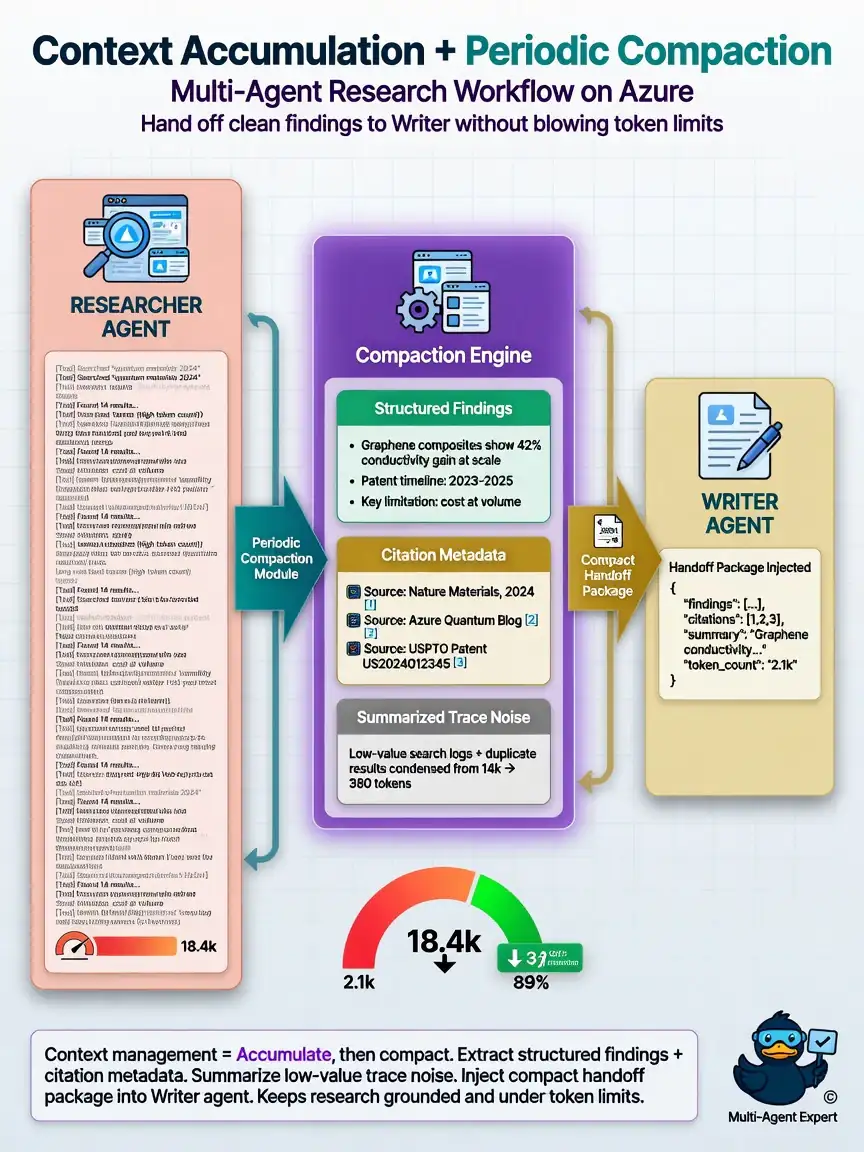
You need to accumulate context, then compact it. Pull out findings and citation metadata, summarize noisy trace, and hand a compact package to the Writer. That keeps citations and avoids blowing the window.
Full Explanation
AI-500 covers context accumulation, retrieval, injection, and compaction for single- and multi-agent systems. Implementing context accumulation with periodic compaction preserves decision-critical content, such as findings and citations, while controlling token growth through compaction and a structured handoff. Passing the entire raw tool trace every turn with no summarization, truncation, or structured extraction leads to context overflow and degraded attention on critical facts. Dropping all citations to save tokens and letting the Writer invent sources harms groundedness and enables hallucination of sources. Resetting both agents' context completely after every tool call discards useful intermediate state required for multi-step research quality. Implementation notes: maintain a working memory object with claims, URLs, and confidence, compress tool stdout, and pass an explicit inter-agent message schema rather than free-form chat dumps. Exam tip: Compaction keeps signal; it is not the same as deleting memory.