
A multi-agent engineering team at Contoso wants consistent local development for Microsoft Agent Framework projects, including shared Python dependencies, VS Code extensions, CLI tooling, and checked-in AI coding instructions for agent patterns. Which technology-component specification best supports the SDLC?
Select an answer to reveal the explanation.
Short Explanation
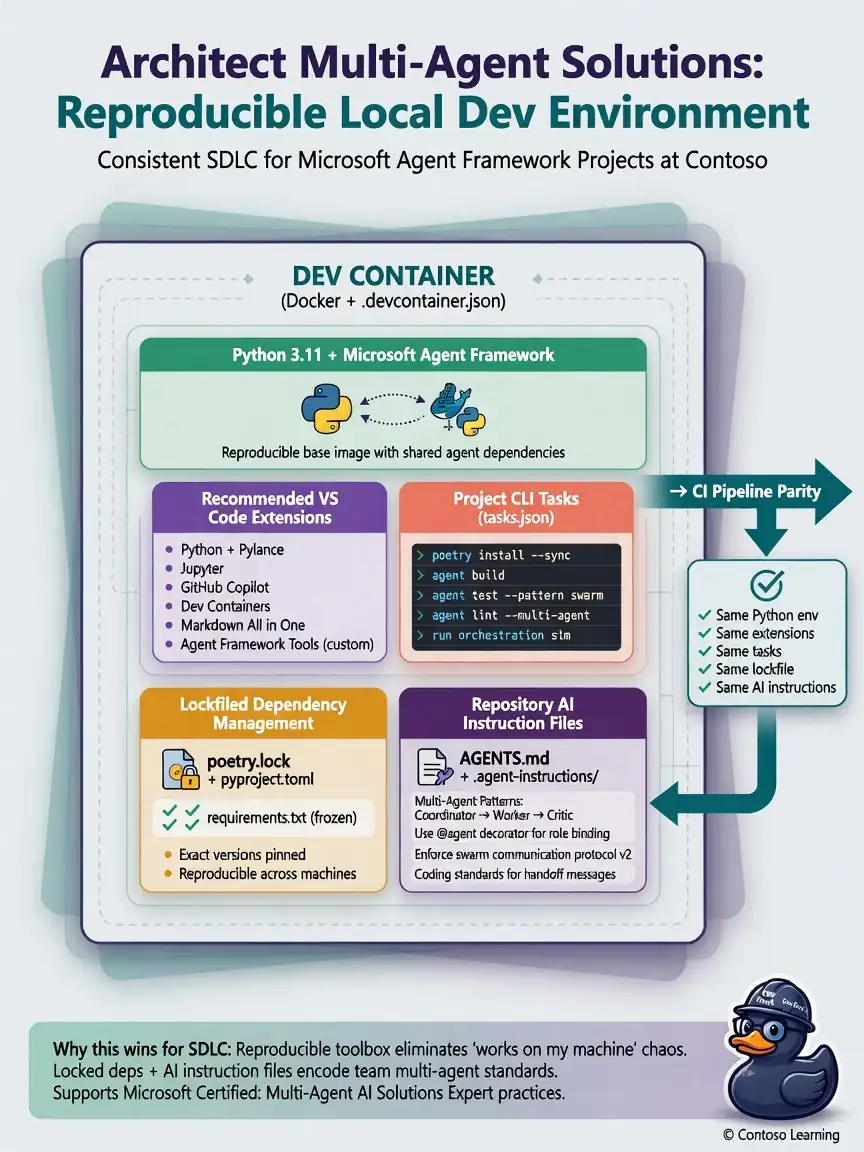
You need a reproducible toolbox for the SDLC. Use dev containers, recommended VS Code extensions, CLI tasks, locked dependencies, and AI instruction files that encode your multi-agent coding standards. Don't let random installs, portal-only edits, or secrets in instructions wreck it.
Full Explanation
AI-500 expects SDLC tooling: dev containers, VS Code extensions, CLI, dependency management, and AI instructions. This combines dev containers or equivalent reproducible environments, recommended VS Code extensions, project CLI tasks, lockfiled dependency management, and repo AI instruction files encoding multi-agent coding standards into a coherent baseline.
Allowing each developer to install random package versions with no repository standards undermines reproducibility and CI parity.
Banning all local development and requiring production-only portal edits rejects modern software practice and prevents automated testing and code review.
Storing secrets and production connection strings in AI instructions markdown risks credential leakage into prompts, logs, and repos.
Exam tip: keep AI instructions in-repo for patterns and policies, never secrets.