
Adventure Works is designing memory for a multi-agent project planning suite: a Planner agent, a Risk agent, and a Scheduler agent collaborate on long-running programs spanning weeks. Users expect same-session continuity, shared team decisions during a sprint, and recall of prior project outcomes months later with strict tenant isolation. Which multi-tier state design should the architect specify?
Select an answer to reveal the explanation.
Short Explanation
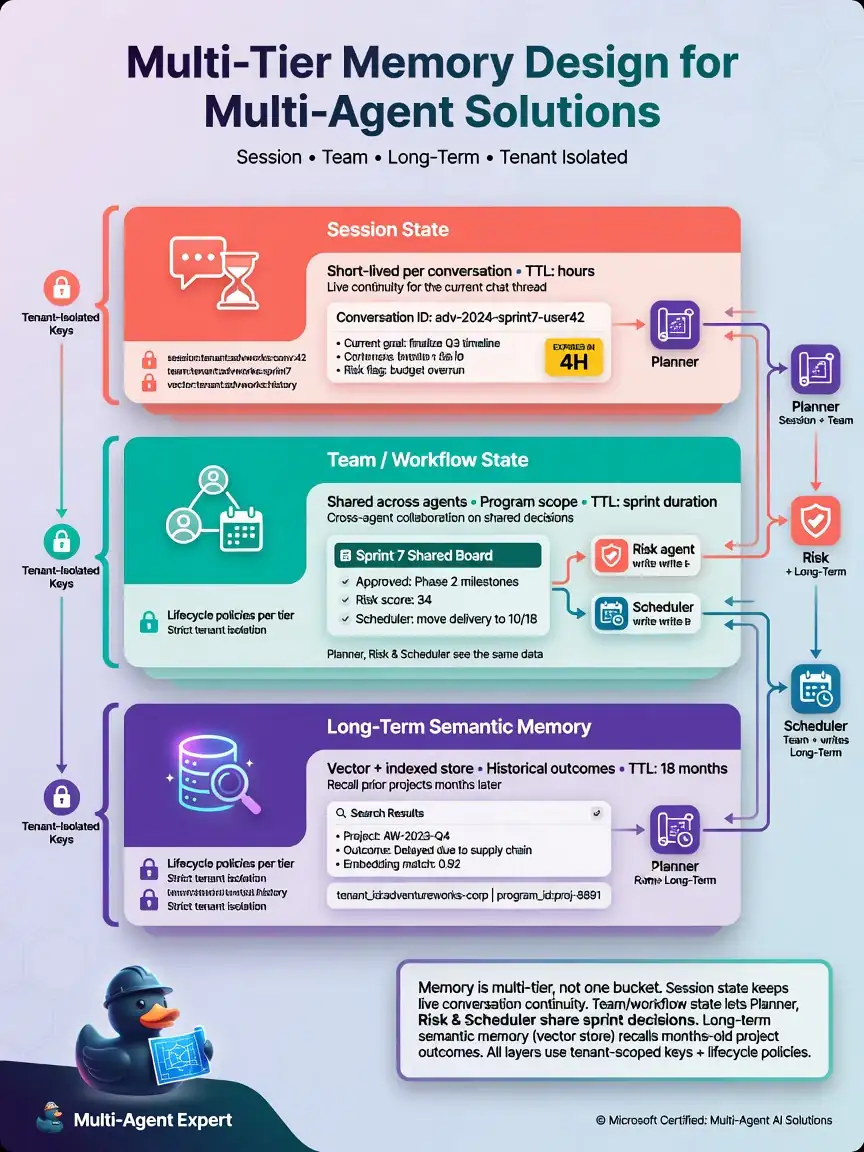
Memory is multi-tier, not one bucket. You need session state for the live conversation, shared team/workflow state so Planner, Risk, and Scheduler see the same sprint decisions, and long-term semantic memory for months-old outcomes — all tenant-scoped with lifecycle rules. The single global Redis key smashes isolation, context-window-only forgets across sessions and agents, and cookies plus email isn’t an enterprise multi-agent state architecture.
Full Explanation
The correct design uses three tiers: short-lived session state per conversation, shared team/workflow state for cross-agent collaboration within a program, and long-term semantic memory in a vector or indexed store for historical outcomes, each with lifecycle policies and tenant-isolated keys. This supports same-session continuity, lets Planner, Risk, and Scheduler see the same sprint decisions, and preserves months-old project outcomes while enforcing tenant isolation.
A single global Redis key with no tenant prefix fails tenant isolation and mixes transient chat with durable enterprise knowledge in one unbounded store. Relying only on the model context window and never persisting state outside the current prompt cannot support weeks of multi-agent collaboration or cross-session recall. Browser cookies plus email threads are operationally fragile, non-queryable at scale, and unsuitable for controlled semantic recall or compliance lifecycle.
Design notes: session state may live in conversation stores with short TTL; team state may be workflow or program-scoped documents; long-term memory typically uses embeddings plus metadata filters such as tenant, project, and ACL. Clear write rules prevent agents from polluting shared memory with unverified drafts. Exam tip: if the stem mentions session continuity, team collaboration, and months-later recall, choose the three-tier memory answer.