
Your DTAP pipeline promotes multi-agent configs (prompts, tool allowlists, model deployment references) as versioned artifacts. A production canary shows elevated tool-failure rates after promotion. What rollback design should already be in place?
Select an answer to reveal the explanation.
Short Explanation
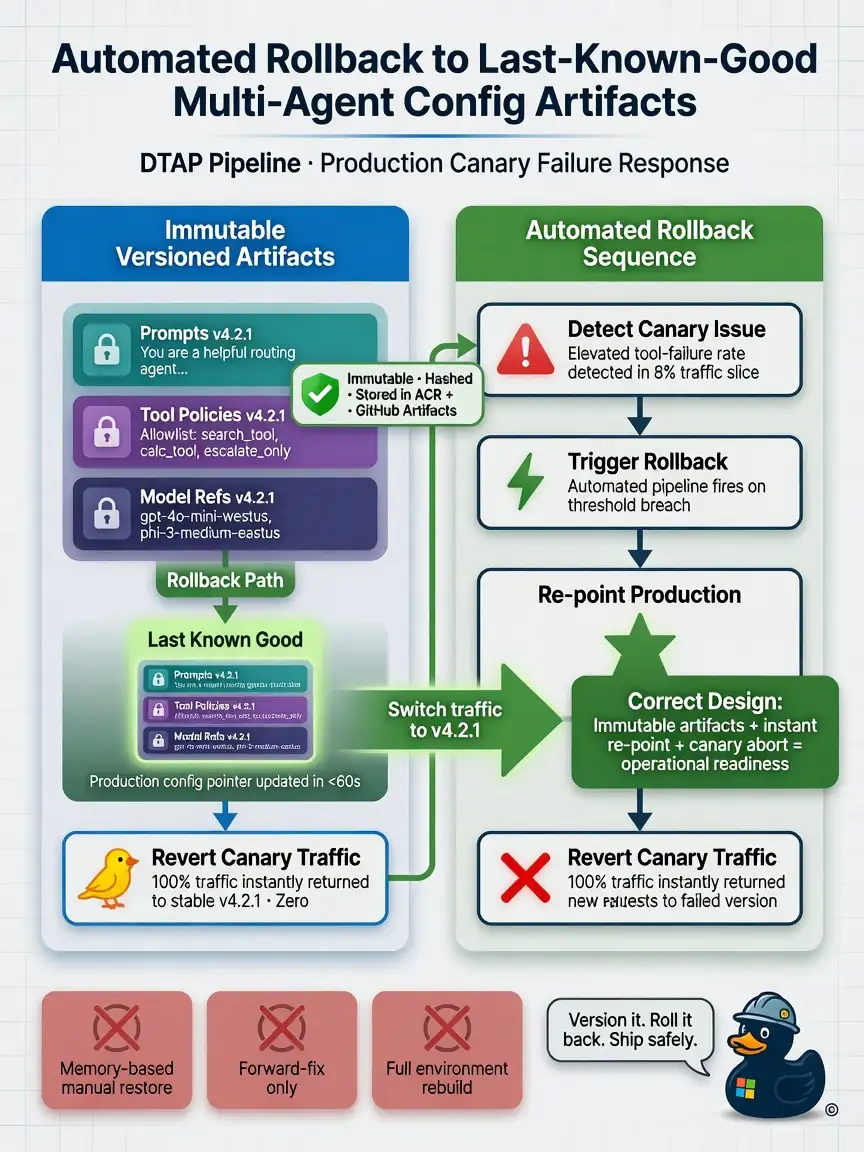
You need immutable, versioned agent configs and an automated rollback path that flips production back to the last known good set and pulls canary traffic out immediately. If you can't re-point quickly, you're not ready for a canary failure.
Full Explanation
Correct answer — keep immutable versioned artifacts for prompts, tool policies, and model references, plus an automated rollback path that re-points production to the last known good artifact set and reverts canary traffic immediately. Multi-environment strategies include rollback, release management, and rollout control. Versioned immutable artifacts for prompts, tool allowlists, and model references enable automated re-point to last known good and immediate canary reversion when tool failures spike. Why manually recreating previous prompts from memory without version control is wrong: Memory-based restore is error-prone and slow under incident pressure. Why forward-fix only is wrong: Refusing rollback increases customer impact when canaries fail. Why deleting the production environment and rebuilding from scratch for every incident is wrong: Full environment rebuild is excessive when config re-point suffices. Exam tip: Immutable agent config artifacts plus automated last-known-good rollback.