
Debugging a failed multi-agent run requires reconstructing which orchestrator decision led to which tool call and model response across services. Today logs are disconnected per component. What should you implement in Foundry-oriented observability?
Select an answer to reveal the explanation.
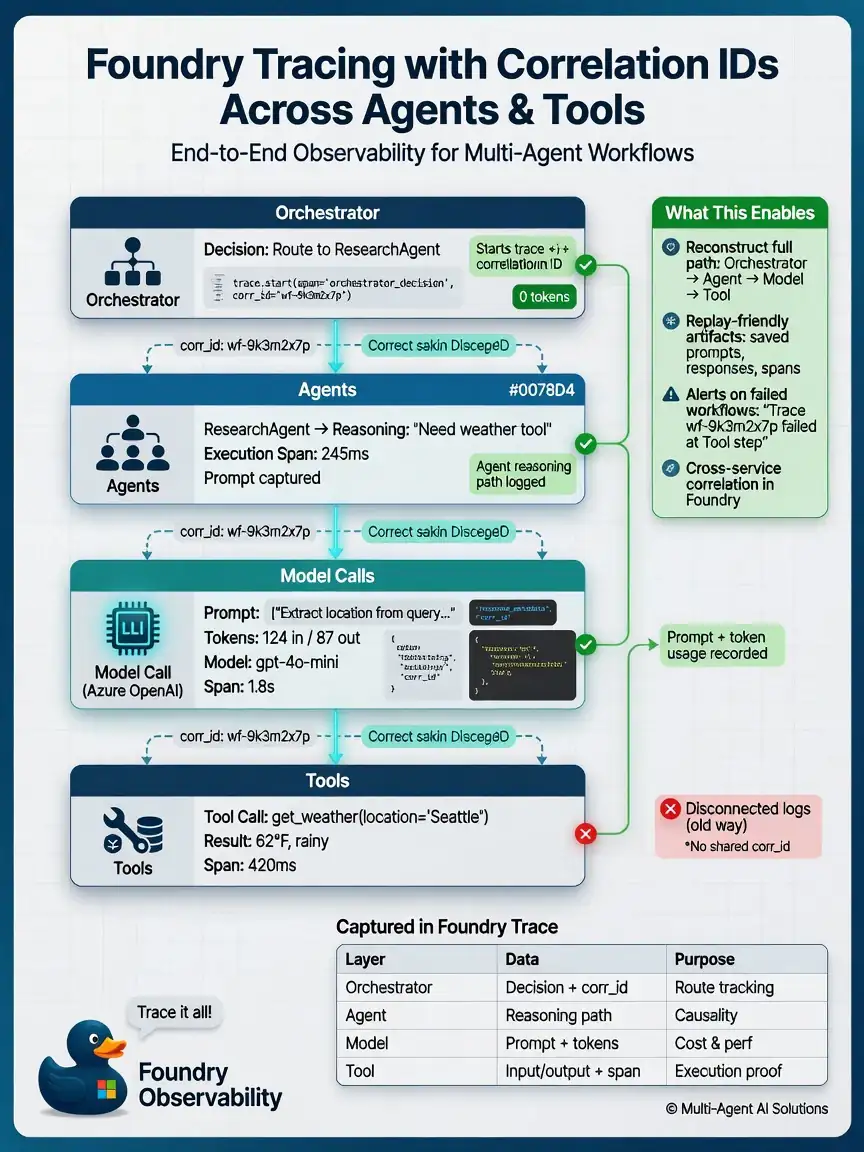
Short Explanation
You need end-to-end tracing with correlation IDs across orchestrator, agents, model calls, and tools. Capture prompts, token usage, execution spans, replay-friendly artifacts, and alerts so you can stitch the whole run together. Final-string-only logs, unstructured prints, and load-balancer probes won't explain agent failures.
Full Explanation
The correct implementation is end-to-end tracing with correlation IDs across orchestrator, agents, model calls, and tools, capturing prompts/token usage and execution spans, plus replay-friendly artifacts and alerts on failed workflows. Foundry tracing guidance covers tokens, prompts, correlation IDs, alerting, and execution tracking; cross-service correlation and structured agent-path logging, with replay-friendly capture where needed, let you reconstruct multi-agent failures end to end.
The approach that logs only final user-visible strings is wrong because it omits tool calls, model steps, and causation. The approach that uses unstructured free-text prints with no shared request identifier is wrong because multi-component logs cannot be joined. The approach that traces only the load balancer health probe is wrong because infrastructure probe health does not surface agent reasoning or tool failures.
Exam tip: Use correlation IDs and spans for orchestrator, agents, models, and tools.