
You want continuous improvement for a multi-agent support solution: large volumes of traces, limited expert time, and a need to catch semantic regressions between weekly releases. Which approach best fits?
Select an answer to reveal the explanation.
Short Explanation
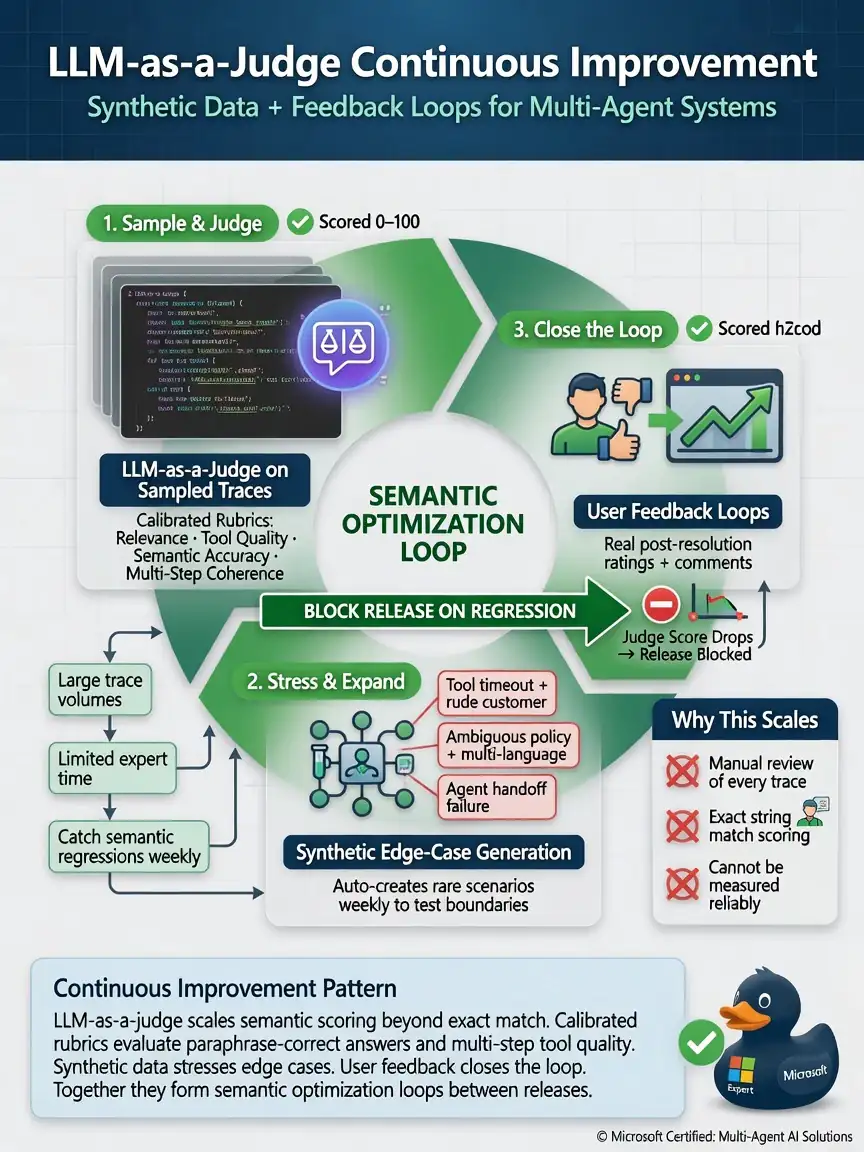
You want a continuous-improvement loop that scales: use an LLM-as-a-judge framework on sampled traces with calibrated rubrics, add synthetic edge-case generation and user feedback loops, and block releases when judge scores regress. Reading every trace doesn't scale, and exact string match misses paraphrases and multi-step tool quality.
Full Explanation
Continuous improvement for multi-agent solutions includes LLM-as-a-judge frameworks, synthetic data generation, semantic optimization loops, and user feedback loops. Combining calibrated judges on sampled traces with synthetic edge cases and feedback, then gating releases on regressions, matches high-volume production reality. LLM-as-a-judge scales semantic scoring beyond exact match; synthetic data stresses edge cases; user feedback closes the loop. Calibrate judges, sample wisely, and gate releases on regressions. Manual exhaustive trace review does not scale and delays detection. Shipping without evaluation is wrong because multi-agent quality is measurable with layered automatic and human-assisted evals. Exact string match against one golden sentence is too brittle for generative, multi-step agent outputs; it misses paraphrase-correct answers and multi-step tool quality. Exam tip: LLM-as-judge + synthetic data + feedback = continuous semantic improvement.