
A new multi-agent squad is forming across three time zones. Developers currently install conflicting Python packages locally, lack shared AI coding instructions, and onboarding takes weeks. You must specify developer tools and environments that support a healthy SDLC. What should you propose?
Select an answer to reveal the explanation.
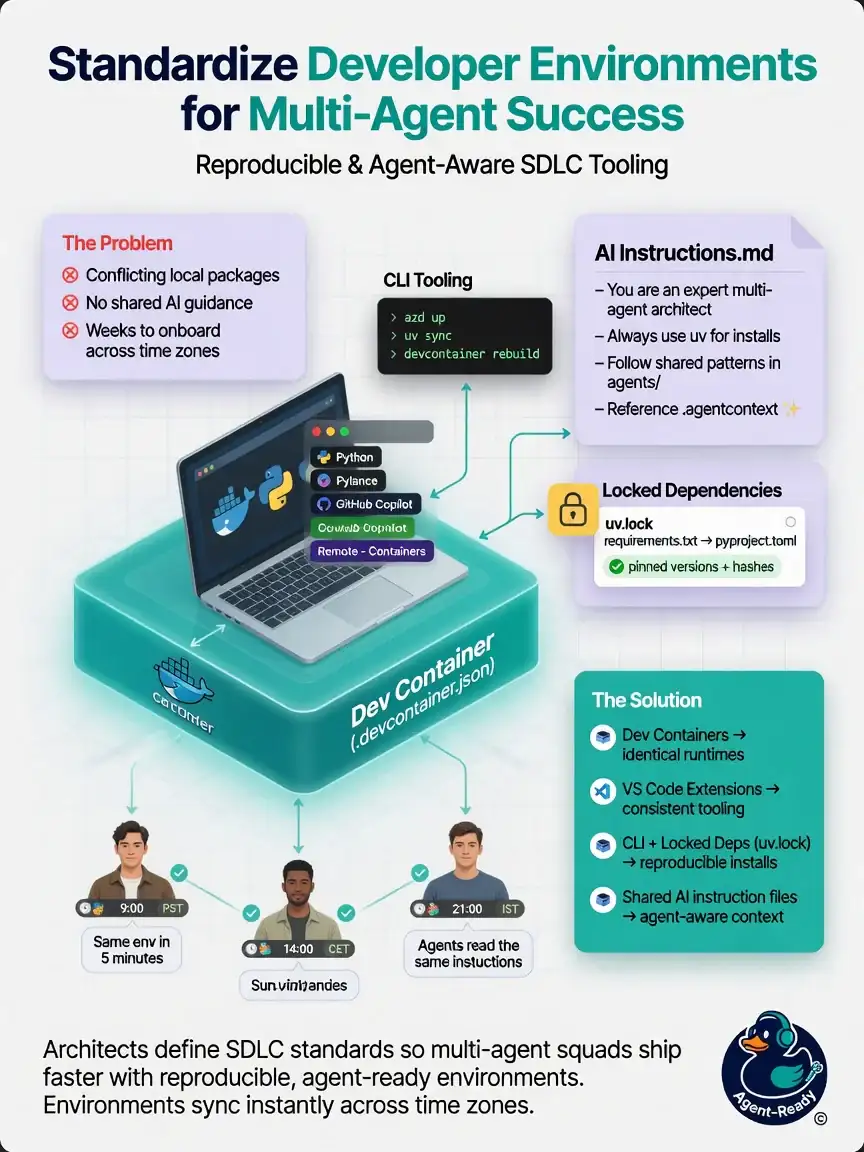
Short Explanation
You need reproducible, agent-aware environments, so standardize on dev containers, VS Code or compatible extensions, CLI tooling, locked dependency management, and shared AI instruction files. That fixes conflicting packages, missing shared instructions, and slow onboarding. Portal-only development, unpinned packages, and secrets in READMEs are bad ideas.
Full Explanation
The skills measured include specifying developer tools and environments to support the SDLC: dev containers, VS Code or compatible extensions, CLI tooling, dependency management, and shared AI instructions. Multi-agent stacks such as Agent Framework, LangGraph, and MCP SDKs are sensitive to version skew, so containers and lockfiles stabilize onboarding. Shared AI instruction files, such as repository guidance for coding agents, improve consistency of generated scaffolding. The standardized approach is correct because it makes environments reproducible, agent-aware, and easier to onboard. Forbidding editors and requiring production portal-only configuration removes the productive inner loop. Allowing random unpinned package versions without a lockfile causes “works on my machine” failures. Storing secrets and production connection strings in personal README files on laptops violates secrets management. Combine this with IaC and CI so local and pipeline environments converge.