
You must reduce prompt injection and unsafe tool use in a multi-agent Foundry deployment. Security asks for defense in depth across the agent pipeline. Which guardrail strategy is most appropriate?
Select an answer to reveal the explanation.
Short Explanation
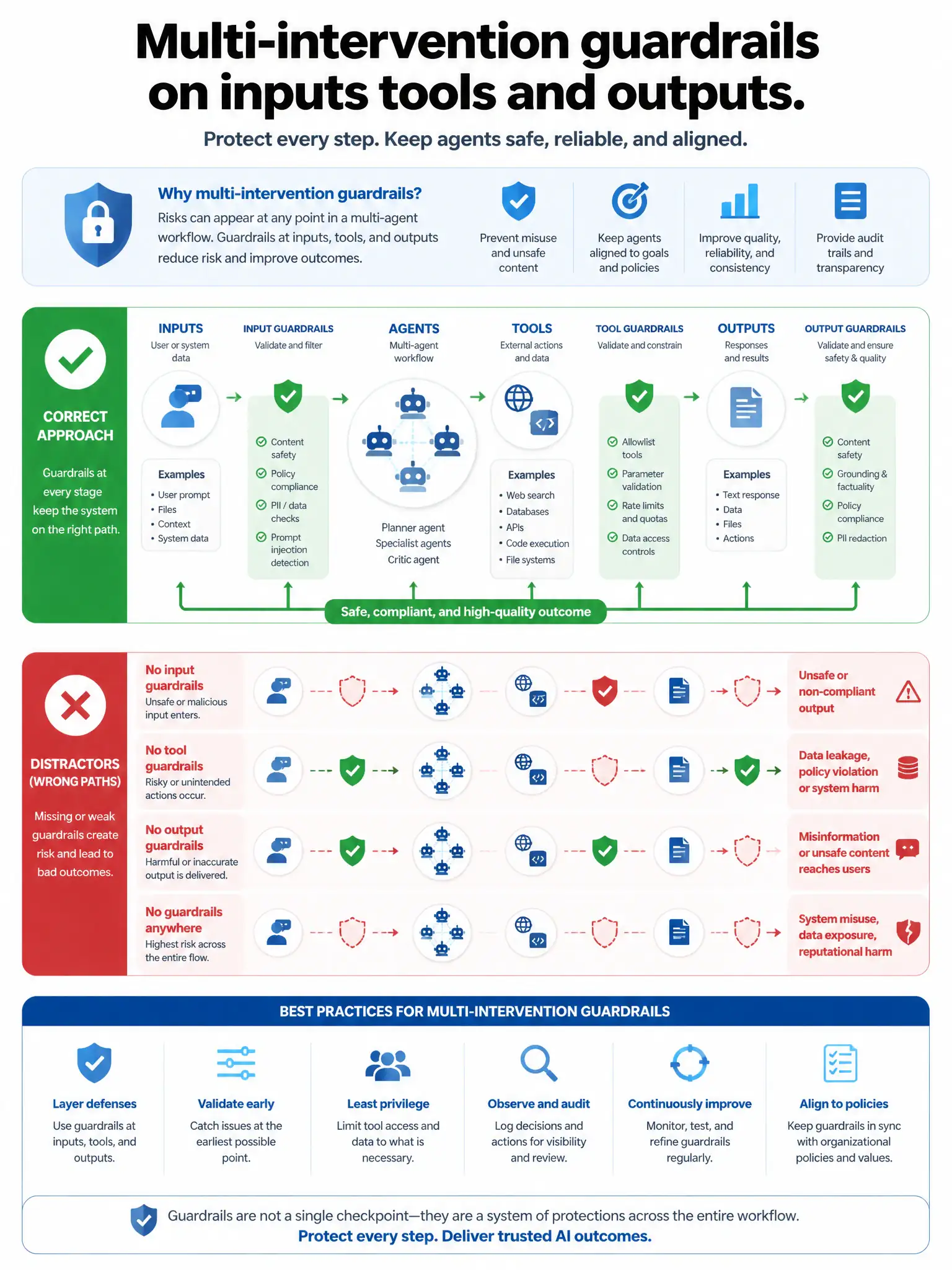
You need guardrails at every hop—user inputs, tool calls, tool responses, and outputs—plus domain rules and synthetic attack tests. Single output filtering won't stop injections that hit tools mid-pipeline, and disabling guardrails or waiting for user reports isn't defense in depth.
Full Explanation
Correct answer: Implement a multi-intervention guardrail strategy covering user inputs, tool calls, tool responses, and final outputs, with domain-specific rules and tests including synthetic attacks.
Guardrail design for multi-agent solutions uses multi-intervention coverage: user inputs, tool calls, tool responses, and outputs, with custom domain constraints and validation including synthetic attack data.
Why the single output filter approach is wrong: Output-only filtering leaves input and tool stages unprotected.
Why the disable-all-guardrails approach is wrong: Disabling guardrails increases injection and unsafe tool risk.
Why the rely-on-user-reports approach is wrong: After-the-fact user reports are not preventive controls.
Exam tip: Guard every stage—input, tools, tool results, output—not just the final message.