
Debugging a failed multi-agent run is hard because prompts, token counts, and tool calls are scattered without a single timeline. What should you implement in Microsoft Foundry?
Select an answer to reveal the explanation.
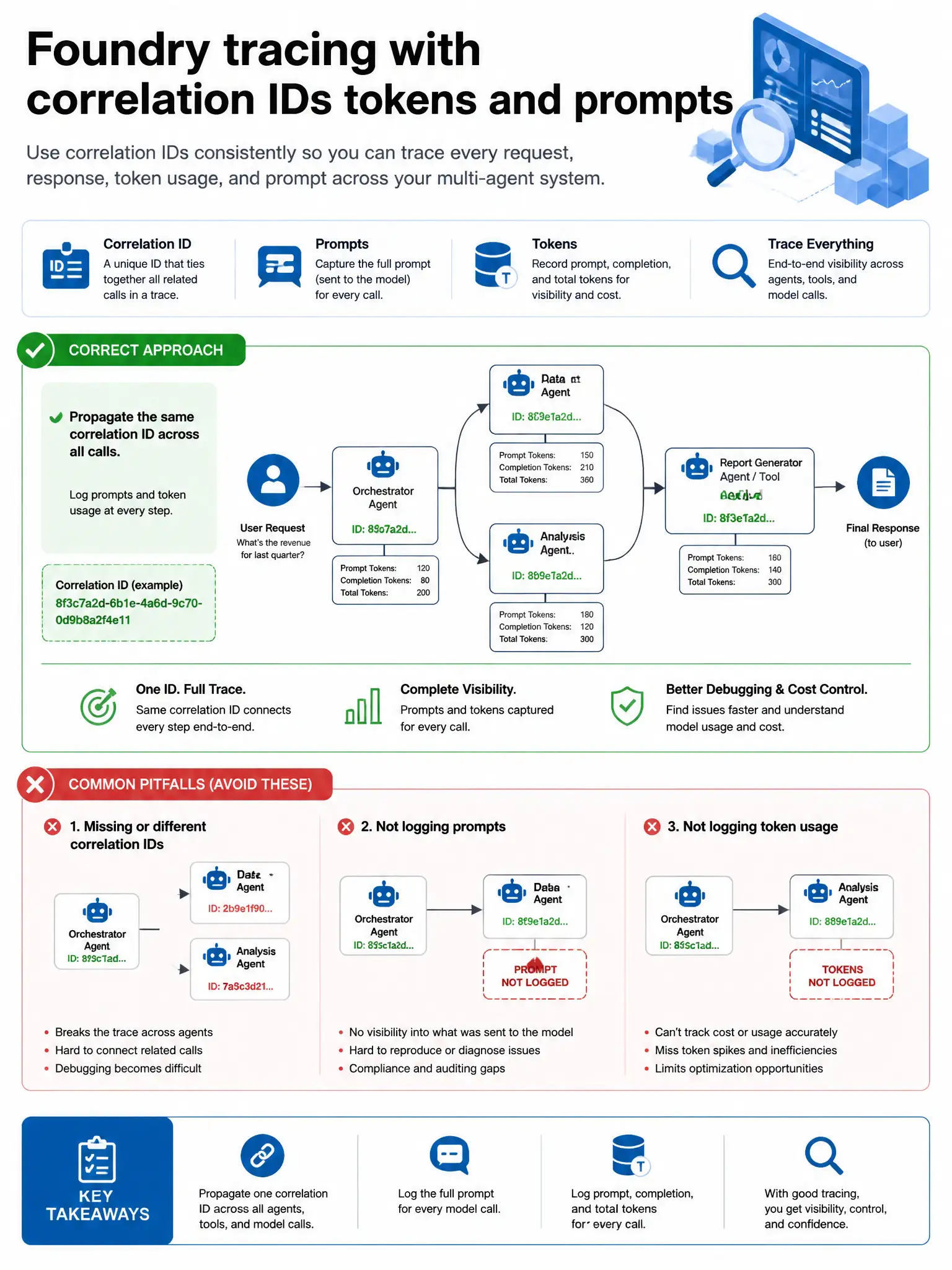
Short Explanation
You need Foundry tracing that captures tokens, prompts per policy, correlation IDs, alerting, and execution tracking so you can replay a multi-agent run end to end. Disabling tracing, watching only HTTP status codes, or keeping traces in browser localStorage won't give you the timeline you need. Correlate orchestrator and specialist spans with one correlation ID per workflow.
Full Explanation
The correct approach is Foundry tracing that captures tokens, prompts per policy, correlation IDs across agents, alerting, and execution tracking for end-to-end replayable timelines. This gives one correlated timeline of reasoning, tools, and token usage so a failed multi-agent run can be reconstructed. Disabling all tracing to improve performance is wrong because no traces make production debugging impractical. Tracing only final HTTP status codes without prompts or tokens is wrong because HTTP codes omit prompt and tool reasoning detail. Storing traces exclusively in end-user browser localStorage is wrong because client localStorage is not a durable observability backend. Exam caveat: Correlation IDs stitch multi-agent hops into one trace.