
Your multi-agent batch job finishes too slowly. Profiling shows sequential specialist calls and frequent 429s from the model endpoint. What optimization should you apply first?
Select an answer to reveal the explanation.
Short Explanation
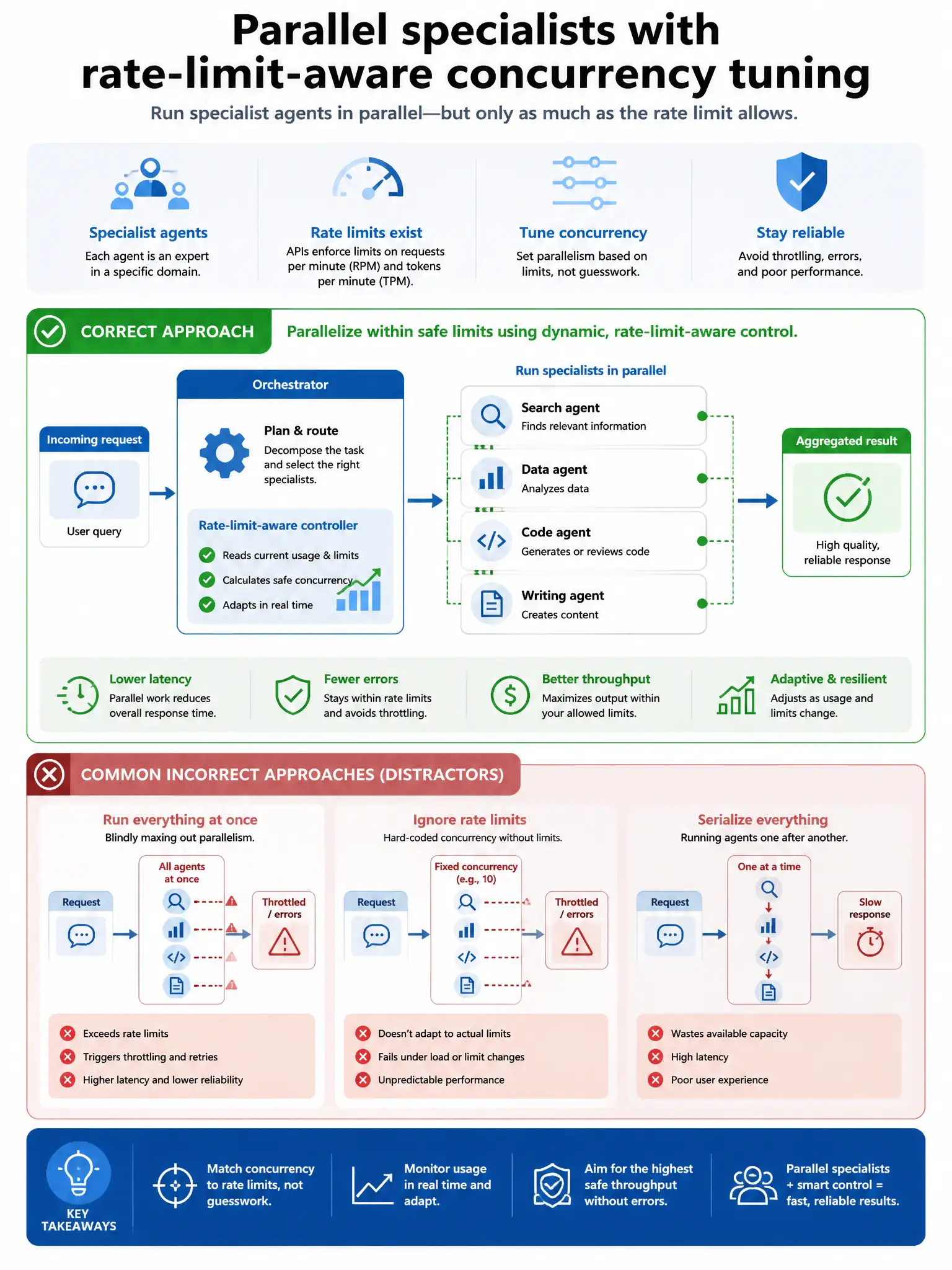
You need to fan out independent specialists while keeping concurrency within rate limits through batching and backoff. That cuts wall-clock time without making 429s worse. Adding more sequential work, ignoring limits, or blindly raising concurrency only makes the job slower, throttled, or runaway.
Full Explanation
Optimizing task duration includes parallelism and rate-limit-aware concurrency control. Fan out independent specialists, batch where useful, and apply backoff so throughput rises without chronic 429 failures. Adding more sequential agents to the critical path is wrong because it lengthens latency. Removing all rate-limit handling so requests stampede the endpoint is wrong because it increases throttling and retries. Increasing max concurrent tool loops without measuring queue risk is wrong because unmeasured concurrency can cause runaway loops and cost. Exam caveat: Parallelism without rate-limit design is incomplete optimization.