
A finance multi-agent system can draft wire instructions but policy forbids sending wires above a threshold without human approval. How should you implement human-in-the-loop?
Select an answer to reveal the explanation.
Short Explanation
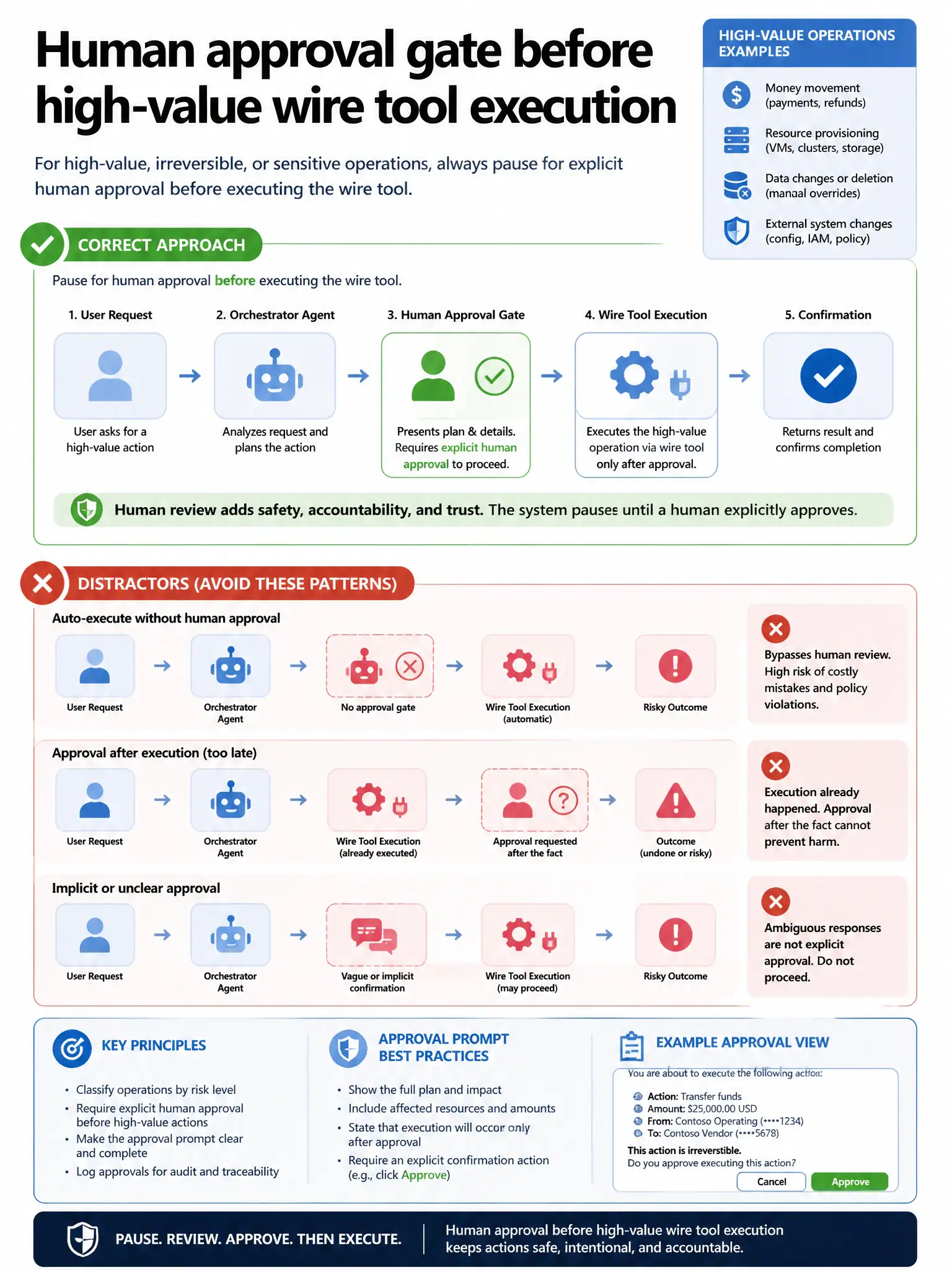
You need to gate high-value wire tool calls behind an approval workflow that blocks execution until a human approves or rejects it. That's the real human-in-the-loop control for irreversible money movement.
Full Explanation
Correct answer: Gate high-value wire tool calls behind an approval workflow with human override and explicit edge-case handling; block execution until approved or rejected. Human-in-the-loop processes include approval workflows, overrides, and edge-case handling. High-risk tools, such as wire transfers above a threshold, must be gated so execution cannot proceed without a recorded human decision. Letting the agent send all wires and emailing a summary afterward for passive review does not prevent unauthorized high-value transfers. Hiding the wire tool from the interface but leaving it callable if the model guesses the function name is not a control. Storing approvals only in chat memory without an auditable workflow system lacks durable auditability and reliable enforcement. Exam tip: human-in-the-loop must interpose before irreversible tool side effects.