
Finance flags rising spend on a multi-agent Azure solution. Engineering must monitor reliability and cost: token burn, loop storms, tool-call fan-out, and workflow failures—with actionable alerts. Which strategy best addresses this?
Select an answer to reveal the explanation.
Short Explanation
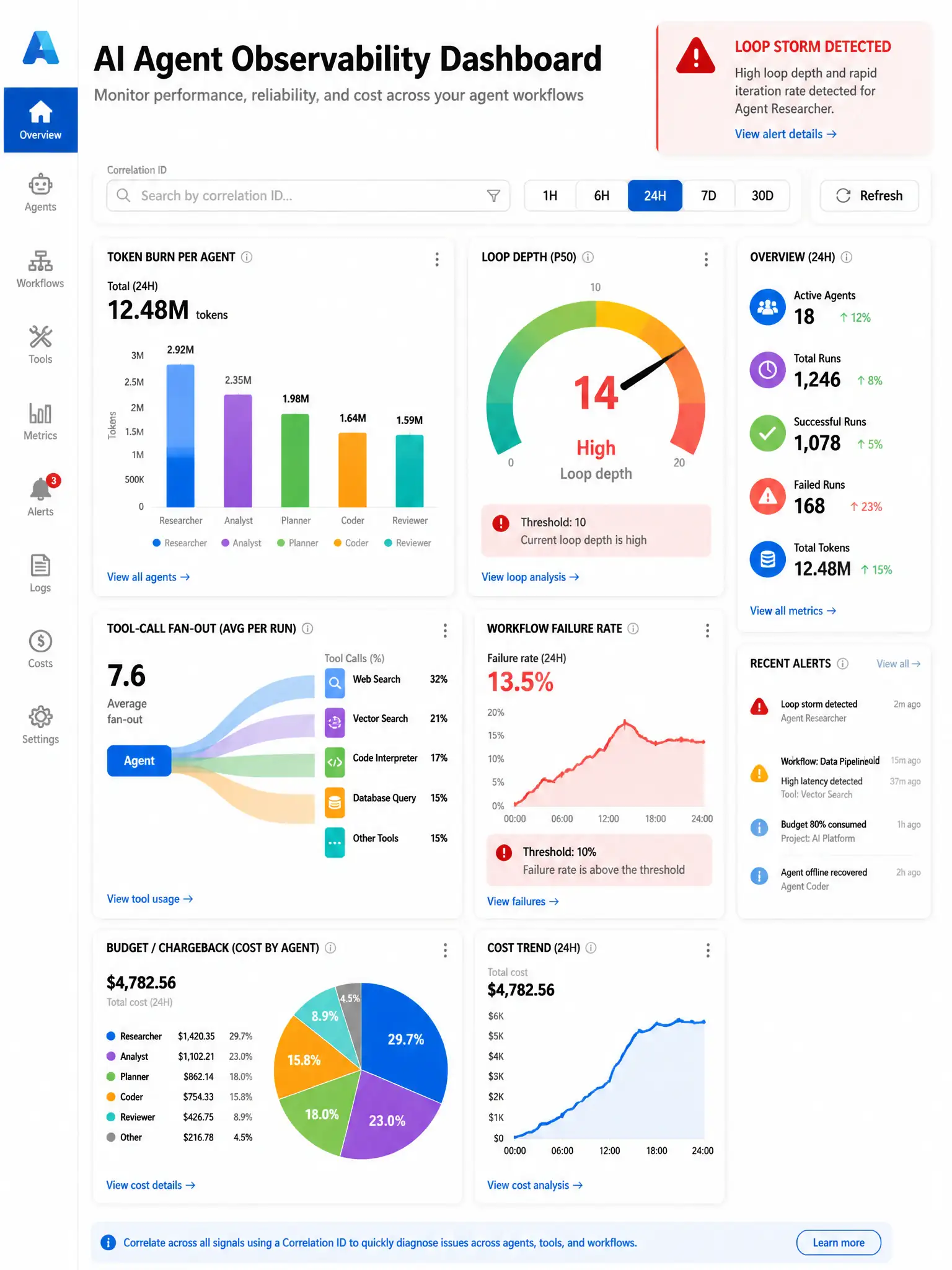
You need full observability and guardrails: trace tokens, prompts, correlation IDs, and execution in Foundry; watch agent health and workflow failures; cap loops and tool calls; and control spend with quotas, allocations, and chargebacks. Disabling telemetry, letting loops run, or tracking only VM uptime leaves you blind or exposed.
Full Explanation
The correct strategy is the full monitoring package: Foundry/platform tracing for tokens, prompts, correlation IDs, alerting, and execution; agent health and workflow failure monitoring; loop controls and tool-call limits; and cost management with usage quotas, allocations, and chargebacks. This matches evaluate/monitor skills: reliability monitoring, availability/performance/SLA adherence, token usage optimization via limits, loop controls, and tool-call controls; and cost management via usage, quotas, allocations, and chargebacks. Disabling telemetry and using only the monthly bill is wrong: visibility is too coarse and late. Allowing unlimited loops when users say “continue” is wrong: uncontrolled loops drive cost and failure. Tracking only VM uptime and ignoring token metrics is wrong: infrastructure uptime alone does not explain LLM spend or agent quality. Create alerts on token spikes, repeated tool failures, and workflow error budgets.