
A transit authority needs to customize a foundation model for agency acronyms and stop names without full-weight retraining. Which method best fits?
Select an answer to reveal the explanation.
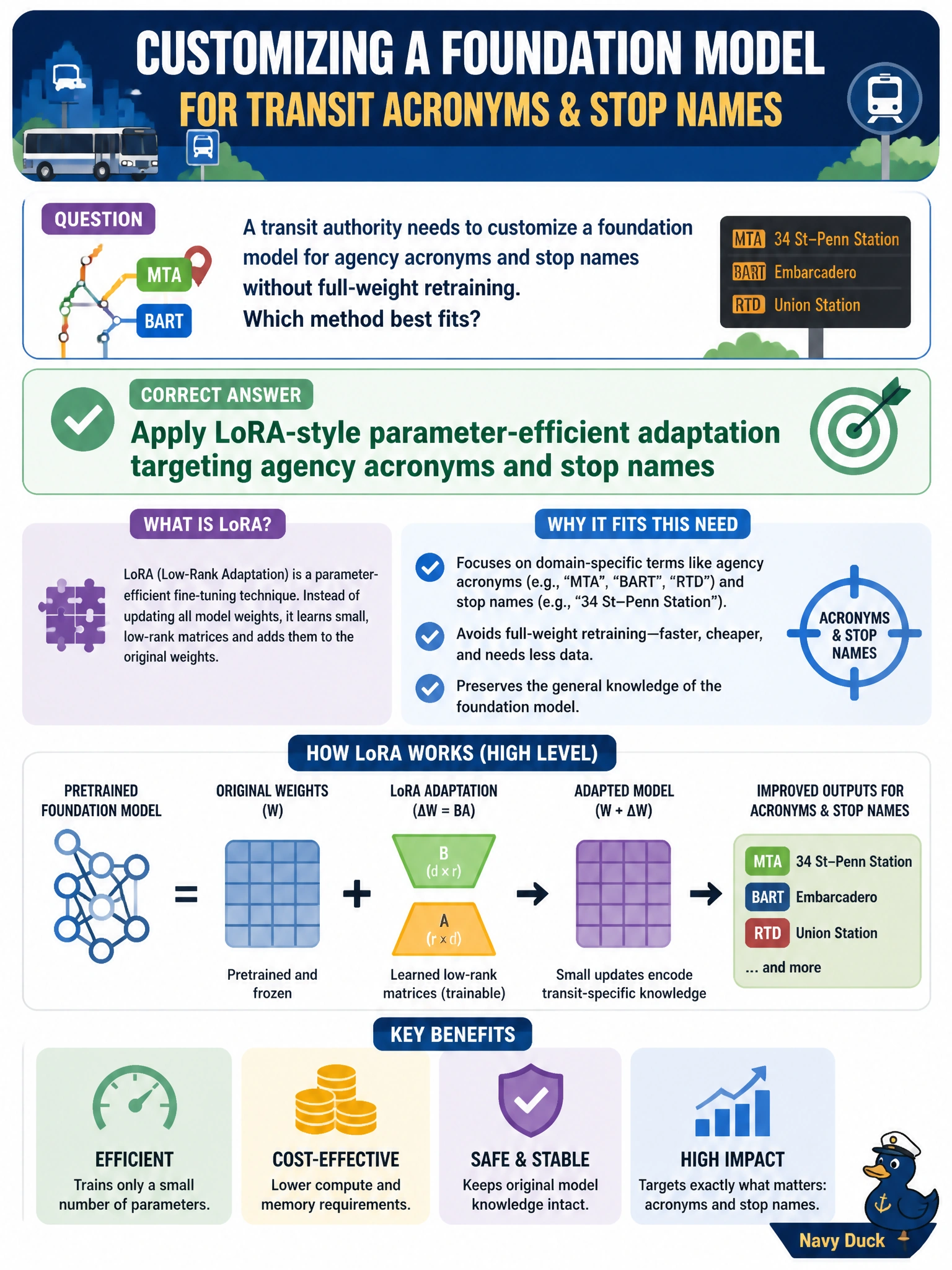
Short Explanation
Agency acronyms and stop names are a local dialect the base model never rode. LoRA-style adapters teach that dialect without retraining the whole bus. IA3-style scalers trained on generic news won't teach you the agency's acronyms and stops.
Full Explanation
Applying LoRA-style parameter-efficient adaptation targeting agency acronyms and stop names best fits a transit authority that must customize a foundation model without full-weight retraining. LoRA adapters inject domain vocabulary and phrasing for rider-facing acronyms and stop names while freezing most base parameters, controlling cost and reducing catastrophic overwrite of general language ability. That matches the stem’s customization-without-full-retrain requirement.
Attaching IA3-style scaling adapters trained on generic news keeps a parameter-efficient form but fails the domain requirement, because generic news data does not teach agency acronyms and stop names. Injecting frozen soft prompts from a customer-support chatbot reuses prompts learned for a different domain without training on transit vocabulary, so frozen vectors cannot teach agency acronyms and stop names the way the stem’s customization goal requires. Enabling retrieval-grounded prompts over timetable PDFs supplies timetable facts at inference time but leaves model weights unadapted, which can help ground a lookup but does not customize the model’s own generation of agency acronyms and stop names.
Exam caveat: LoRA/PEFT answers recur when stems forbid full retraining but require domain vocabulary customization—transit, permits tone, and similar civic cases. Do not confuse PEFT with RAG-only glossary injection when the question explicitly asks for customization method on the model.
Operational check: build adapter training data rich in agency acronyms and stop names, evaluate rider FAQ accuracy and hallucination on stop references, compare GPU cost to full fine-tune, and deploy versioned adapters with a rollback to the base-plus-prior-adapter pair.
Prefer to study offline? Printable PDF study book + test engine ($7.50, unofficial). These questions stay free here.