
A school-district policy bot fails on multi-part parent questions that a single naive top-k query cannot cover. What retrieval strategy change fits best?
Select an answer to reveal the explanation.
Short Explanation
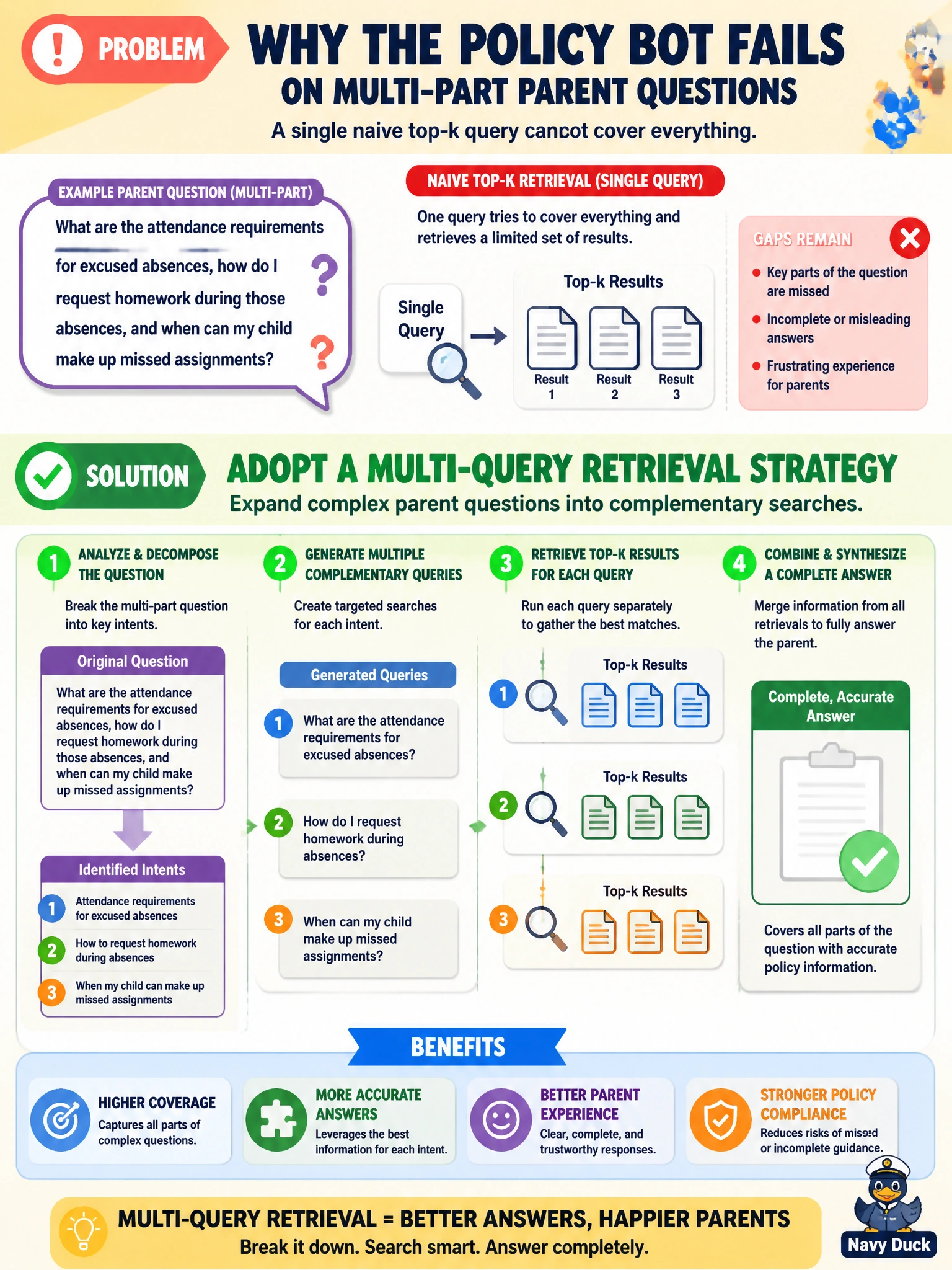
Complex parent questions are like asking for lunch, homework, and bus rules in one breath — one search won't cover it for you. Multi-query retrieval splits that into complementary hunts across the policy corpus. Better matching, reranking, or bigger chunks on that same single search still won't go looking for the parts it missed.
Full Explanation
Adopting a multi-query retrieval strategy that expands complex parent questions into complementary searches best fits a school-district policy bot that fails on multi-part parent questions a single naive top-k query cannot cover. Multi-query expansion decomposes or paraphrases one complex ask—lunch rules, homework policy, and bus eligibility in one message—into several targeted retrievals whose results are pooled before generation. That raises coverage across handbook sections without inventing policy or discarding parent detail.
Enabling hybrid dense plus sparse search over district handbook sections using targeted metadata filters fails because hybrid search improves how well one query is matched — keyword plus semantic — but it is still one retrieval pass per question, so a compound parent question with several intents still only gets one combined search rather than a dedicated search per sub-topic. Adding cross-encoder reranking to reorder the initial top-k retrieved handbook passages by relevance fails because reranking can only reorder what the single original retrieval already found; if that one pass never surfaced a sub-topic because the query embedding averaged several intents together, reranking has nothing relevant on that sub-topic to promote. Configuring parent-document retrieval to return larger surrounding handbook chunks for retrieved matches fails because bigger surrounding context helps explain whatever was already matched, but it still does not trigger a search for the other intents inside the parent's question that the single retrieval never went looking for.
Exam caveat: multi-query is an advanced retrieval pattern for complex or multi-aspect prompts; it is not the same as hybrid dense/sparse fusion, reranking an existing top-k, or returning bigger chunks around an existing match. Prefer it when the stem highlights multi-part civic questions and naive single-pass retrieval failure.
Operational check: craft parent questions with two or more distinct policy intents, compare section coverage and groundedness for a single retrieval pass versus multi-query expansion, cap expansion fan-out for cost, and verify merged contexts still cite the correct handbook clauses for each sub-intent.
Prefer to study offline? Printable PDF study book + test engine ($7.50, unofficial). These questions stay free here.