
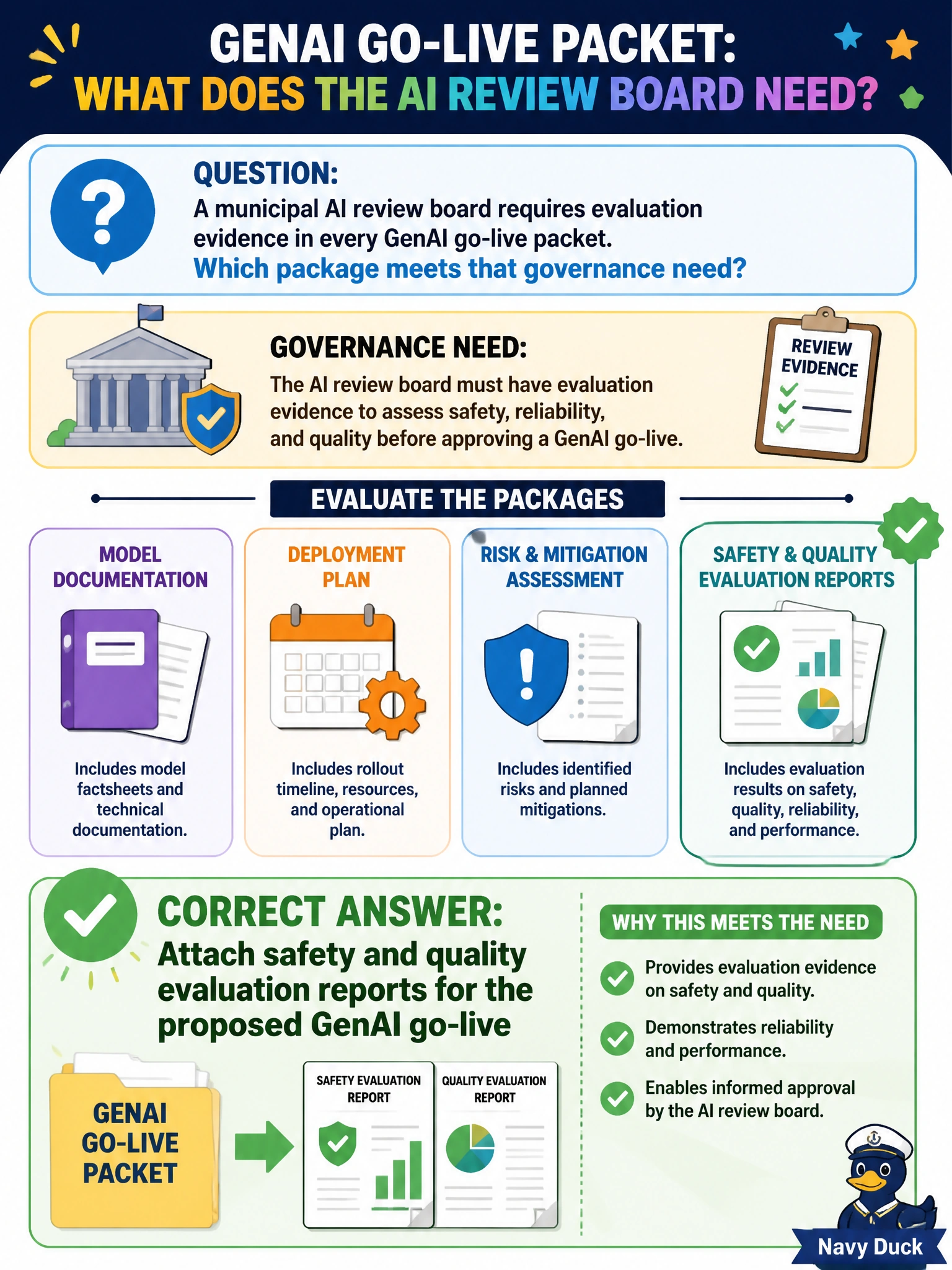
A municipal AI review board requires evaluation evidence in every GenAI go-live packet. Which package meets that governance need?
Select an answer to reveal the explanation.
Short Explanation
Review boards want proof, not vibes. Bundle safety and quality eval reports with the go-live packet so leadership can see the evidence.
Full Explanation
Attaching safety and quality evaluation reports for the proposed GenAI go-live is correct because municipal AI review boards typically require documented evidence that risk, safety, and answer quality were measured before production. A complete go-live packet for civic GenAI should include the evaluation scope, metrics (safety, groundedness, relevance, and any domain SLOs), thresholds, results, residual risks, and owners. That package lets the board accept or reject launch on evidence rather than on product enthusiasm. Attaching safety and quality evaluation reports for the prior pilot deployment fails because those results measure an earlier pilot scope and configuration; they do not provide measured safety and quality results for this specific proposed go-live, and the board needs evidence of outcomes for the system as proposed to launch. Attaching safety and quality evaluation reports for the draft prompt templates fails because testing draft prompts in isolation does not evaluate the end-to-end proposed go-live with its data, retrieval, controls, and civic use case, and therefore does not show whether this go-live meets the city’s risk thresholds for safe, grounded answers. Attaching safety and quality evaluation reports for the base pretrained model fails because evaluations of the underlying base model do not evaluate the specific deployed system, its prompts, data, or civic use case, and therefore do not demonstrate that this go-live meets the city’s risk threshold. Exam caveat: governance evidence for GenAI go-live means evaluation reports (quality + safety/risk) for the proposed go-live, not prior pilot deployment reports, draft prompt template reports, or base-model evaluation reports. Boards gate on measured outcomes against thresholds.
Operational check: assemble safety and quality reports from Foundry or equivalent eval runs, map results to the city’s risk thresholds, record exceptions and compensating controls, attach the packet to the AI review-board agenda, and proceed to production only after formal acceptance of the evidence.
Prefer to study offline? Printable PDF study book + test engine ($7.50, unofficial). These questions stay free here.