
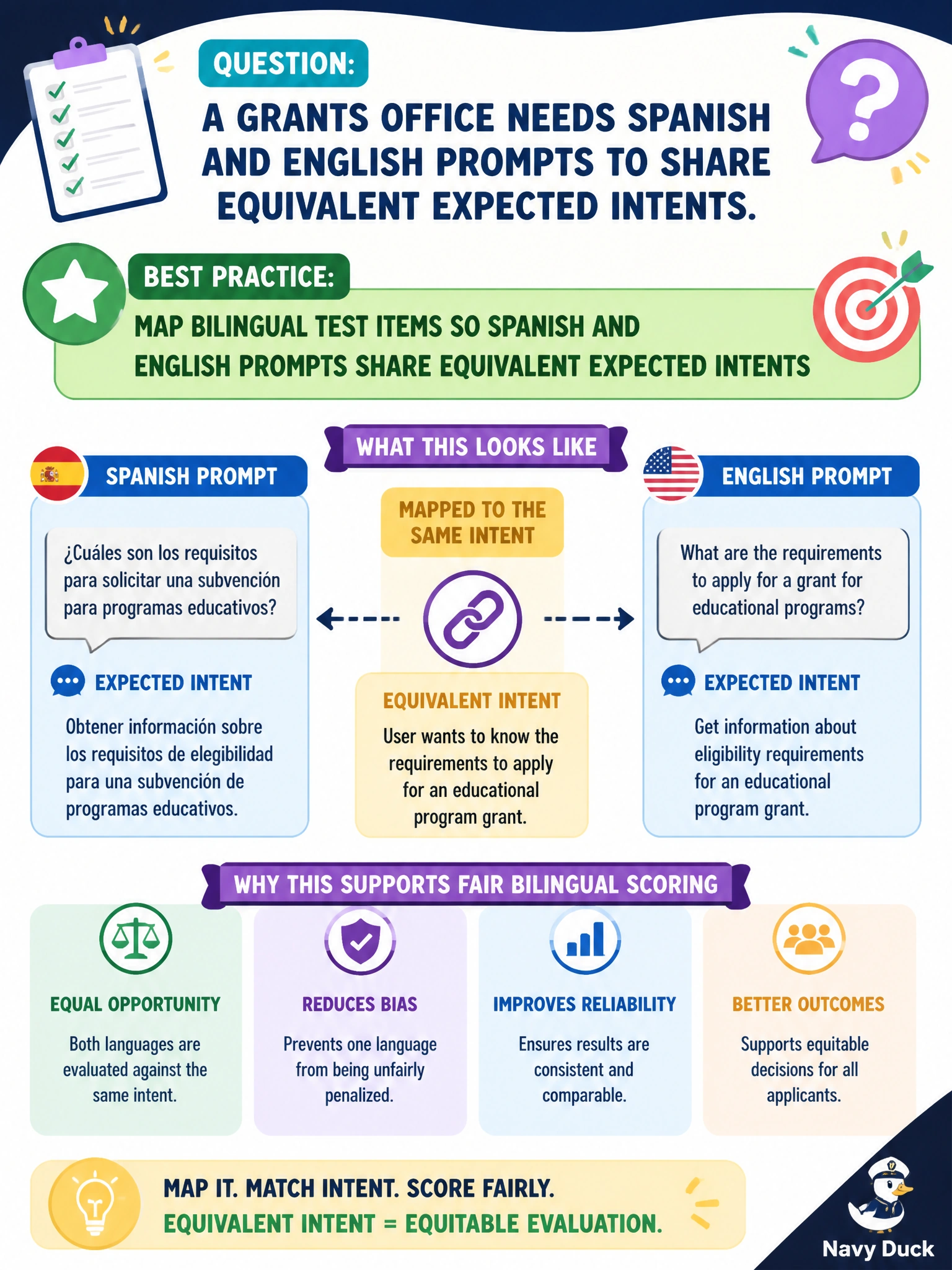
A grants office needs Spanish and English prompts to share equivalent expected intents in the evaluation set. What dataset practice supports fair bilingual scoring?
Select an answer to reveal the explanation.
Short Explanation
Bilingual eval only works if Spanish and English items aim at the same intent. Map them as pairs so scoring stays fair across languages.
Full Explanation
Mapping bilingual test items so Spanish and English prompts share equivalent expected intents is correct because fair multilingual evaluation requires comparable gold targets across languages. A grants office serving Spanish- and English-speaking applicants must score whether the bot recognizes the same intent—eligibility question, document checklist, deadline inquiry—regardless of language. Explicit bilingual mapping pairs stems and expected intents so scoring measures capability parity rather than English-only coverage dressed up as a multilingual program.
Aligning test items so Spanish and English prompts share equivalent expected intents for length fails to ensure fair bilingual scoring because matching surface length does not guarantee equivalent expected intents; two prompts can be the same length while still targeting different grants intents, so scoring would not measure whether the bot recognizes the same behavior across languages. Adapting test items so Spanish and English prompts share equivalent expected intents via local idiom produces superficial “coverage” because chasing natural idiomatic phrasing can shift the expected intent away from the English counterpart, so scoring may treat non-equivalent items as if they tested the same grants behavior. Scaling test items so Spanish and English prompts share equivalent expected intents per language still fails because a per-language scale cannot show whether the two languages are even measuring the same underlying intent; without a shared mapping, a Spanish item and its English counterpart can look equally scaled while testing different things entirely.
Exam caveat: multilingual GenAI eval is not “translate some prompts and hope.” Map equivalent expected intents (and ideally gold answers) across languages so relevance, groundedness, and safety scores are comparable for Spanish and English civic journeys.
Operational check: build paired Spanish–English items for each grants intent, have bilingual reviewers confirm intent equivalence, score both languages with the same rubrics, track parity gaps (for example Spanish relevance lagging English), and block go-live for bilingual channels until mapped coverage and parity meet the grants office’s threshold.
Prefer to study offline? Printable PDF study book + test engine ($7.50, unofficial). These questions stay free here.