
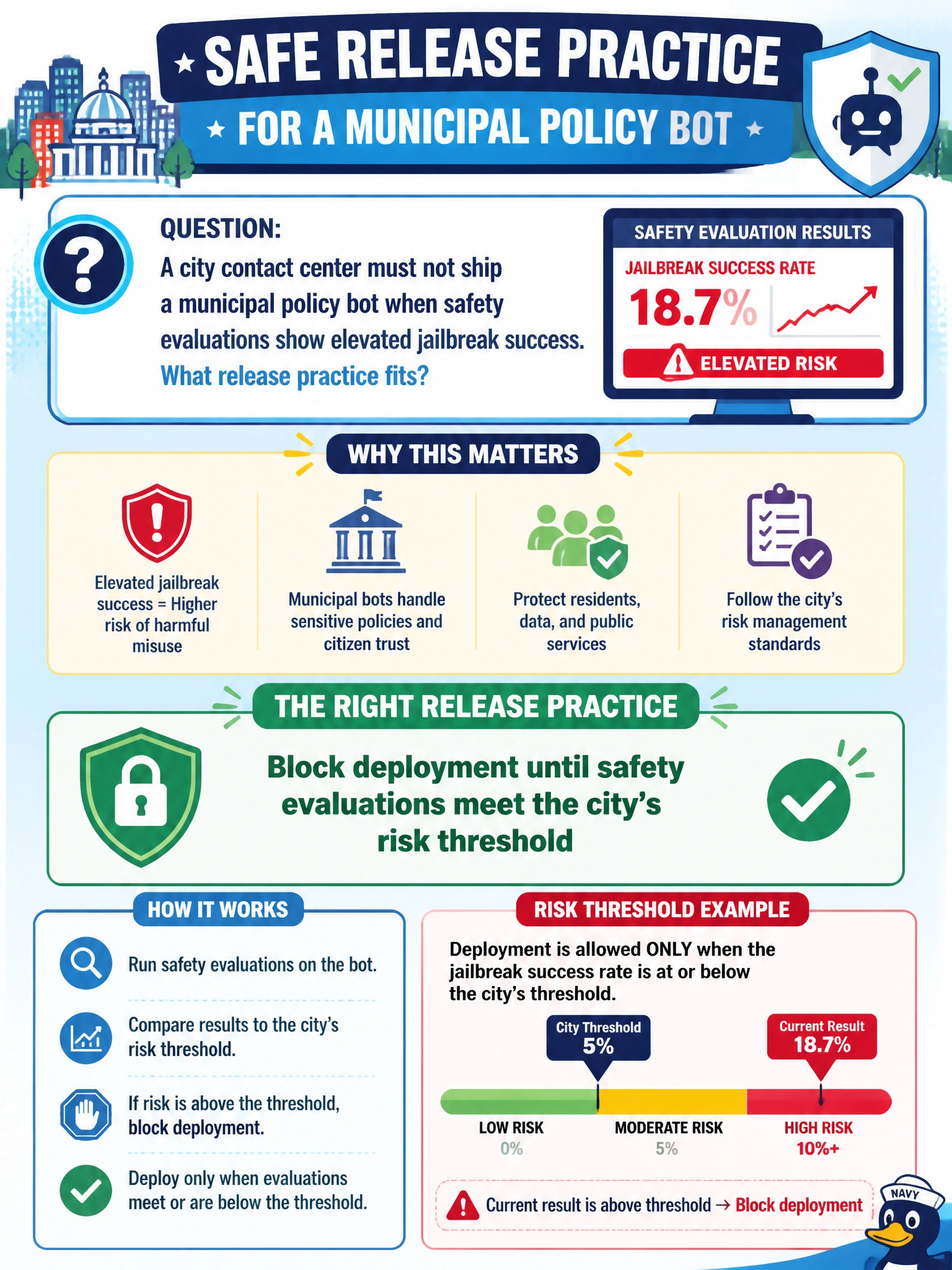
A city contact center must not ship a municipal policy bot when safety evaluations show elevated jailbreak success. What release practice fits?
Select an answer to reveal the explanation.
Short Explanation
If safety evals say jailbreaks are succeeding too often, you've got to stop the release. You don't clear that gate with high accuracy scores, logged reports, or pilot satisfaction ratings when jailbreaks are still succeeding.
Full Explanation
Blocking deployment until safety evaluations meet the city’s risk threshold is correct because risk and safety evaluations exist to stop harmful or policy-bypassing GenAI behavior before civic systems go live. When a city contact-center municipal policy bot shows elevated jailbreak success, the release practice that fits GenAIOps governance is a hard gate: do not promote until jailbreak, harmful-content, and policy-bypass rates fall within the documented municipal risk appetite. Meeting capability benchmarks for service accuracy does not cancel elevated jailbreak success in a public-facing policy assistant that residents and staff may trust with sensitive guidance.
Blocking deployment until capability benchmarks meet the service accuracy target fails because accuracy measures service quality, not safety; passing capability scores does not remove the hard-gate requirement, and elevated jailbreak success must be fixed before any deployment, not offset by high accuracy. Blocking deployment until red-team reports are logged in the evaluation archive fails because archiving is not a safety gate—logging elevated jailbreak reports does not remediate them, and filing paperwork still leaves known risk before evaluations pass the city’s threshold. Blocking deployment until human feedback ratings meet the pilot satisfaction goal fails because satisfaction is a usability signal, not a substitute for the hard gate; high pilot ratings still leave the bot with elevated jailbreak success, and residual risk may only be accepted through the formal AI review board, not by default.
Exam caveat: treat safety evaluation outcomes as release gates, not accuracy milestones or archive filing tasks. Elevated jailbreak success is a stop-ship signal for municipal policy bots; capability benchmarks, archived red-team reports, or pilot satisfaction ratings cannot override it unless the risk board formally accepts residual risk with compensating controls.
Operational check: record the city’s jailbreak-success threshold in the go-live checklist, wire Foundry or equivalent safety evals into CI/CD so the pipeline fails when rates exceed the threshold, require signed residual-risk acceptance only through the AI review board if shipping with exceptions, and re-run the safety suite after every prompt, tool, or model change that affects the policy bot.
Prefer to study offline? Printable PDF study book + test engine ($7.50, unofficial). These questions stay free here.