
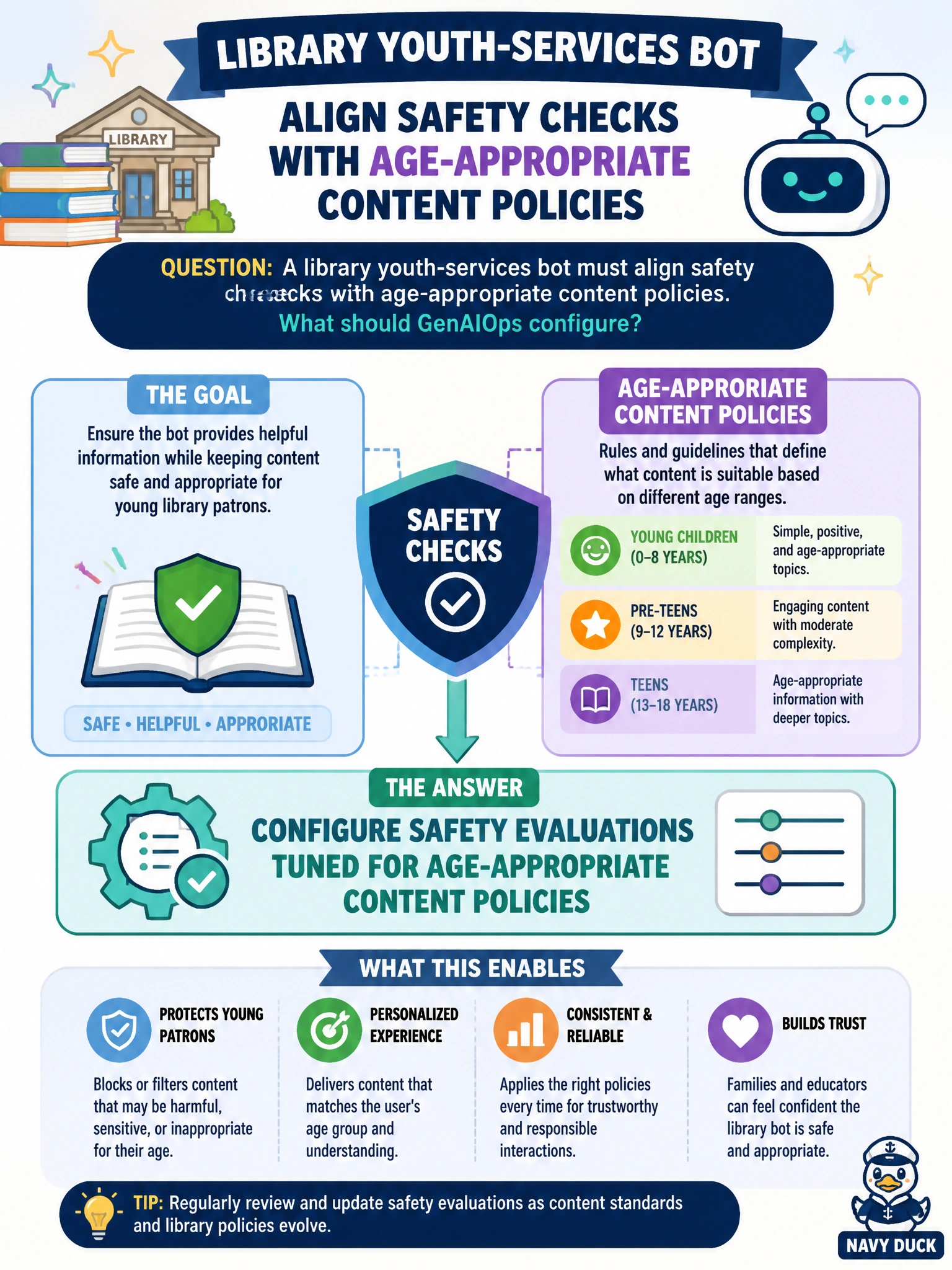
A library youth-services bot must align safety checks with age-appropriate content policies. What should GenAIOps configure?
Select an answer to reveal the explanation.
Short Explanation
Kids' library bots need stricter fences than general FAQ bots. You'll tune the safety evaluations to the youth content policy because it's about harmful content. Circulation, facility access, and vocabulary tuning cover different rules, so you'd miss what matters.
Full Explanation
Configuring safety evaluations tuned for age-appropriate content policies aligns a library youth-services bot with stricter civic standards than a general adult FAQ. Youth channels require tighter filters on sexual content, violence, self-harm, and other categories defined by library policy and applicable law. GenAIOps configures safety evaluations with thresholds and categories that match that policy so releases are graded against the audience the bot actually serves—not against a permissive adult baseline.
Configuring safety evaluations tuned for age-appropriate circulation policies fails because circulation policies govern borrowing and lending rules, not safety filters for sexual content, violence, self-harm, and other categories defined by content policies — it evaluates the wrong policy domain for the risk in the stem. Configuring safety evaluations tuned for age-appropriate facility access rules fails because facility access rules govern physical-space use like children's areas and supervision, not whether bot output avoids sexual content, violence, self-harm, and other categories — it targets the wrong policy domain for youth content safety. Configuring safety evaluations tuned for age-appropriate vocabulary coverage fails because vocabulary coverage is about reading level and word simplicity, not whether content avoids sexual content, violence, self-harm, and other categories that content-policy safety checks enforce — it measures word choice, not content safety.
Exam caveat: Age-appropriate tuning can increase false positives on legitimate homework topics; maintain educator/librarian review of blocked examples and document overrides. Safety config must stay synchronized with the written youth content policy version, and must not be confused with safety evaluations tuned for circulation policies, facility access rules, or vocabulary coverage that target a different policy domain.
Operational check: Load youth-policy-aligned safety eval suites into the release pipeline; verify adult and youth channels use distinct safety profiles where required; red-team with age-inappropriate prompts and expect blocks; review false-positive queues with youth-services librarians; and re-validate after model upgrades.
Prefer to study offline? Printable PDF study book + test engine ($7.50, unofficial). These questions stay free here.