
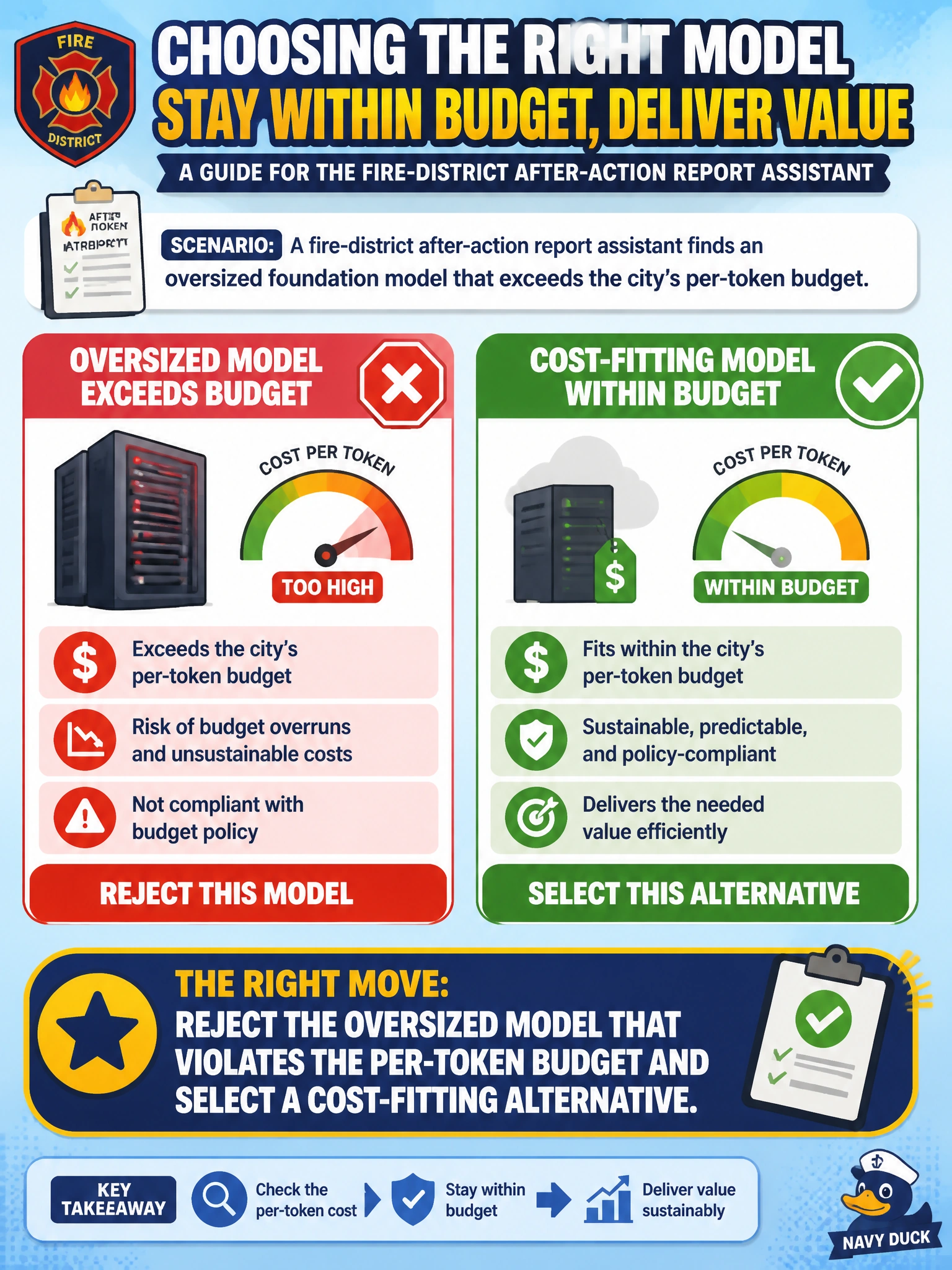
A fire-district after-action report assistant finds an oversized foundation model that exceeds the city’s per-token budget. What should the team do?
Select an answer to reveal the explanation.
Short Explanation
Switching to a provisioned throughput deployment still leaves you over budget, so it’s a no. A fine-tuned version or a long-context variant won’t save you either since you’ll still pay too much per token. You should reject it and pick something that fits the city’s wallet.
Full Explanation
Rejecting the oversized model that violates the city’s per-token budget and selecting a cost-fitting alternative is the correct response for a fire-district after-action report assistant. Municipal model selection is a constrained optimization across quality, latency, and appropriations: an FM that exceeds the per-token budget is out of policy even if marketing claims are attractive. Teams should choose a smaller or differently priced model that still meets after-action summarization quality bars within the authorized spend. Rejecting the oversized model that violates the per-token budget and selecting a provisioned throughput deployment fails because provisioned throughput changes hosting capacity, not the per-token rate; it does not guarantee a cost-fitting alternative and can add fixed capacity cost while remaining out of policy for civic GenAIOps. Rejecting the oversized model that violates the per-token budget and selecting a fine-tuned version fails because fine-tuning improves accuracy but does not lower the per-token rate; the fine-tuned variant remains over budget and adds training cost without providing an evaluated cost-fitting alternative. Rejecting the oversized model that violates the per-token budget and selecting a long-context variant fails because long-context variants typically carry equal or higher per-token rates; it does not solve the budget exceedance and the team has not evaluated a cheaper cost-fitting alternative. Exam caveat: cost ceilings are legitimate rejection criteria on exam scenarios. When a stem states a per-token budget is exceeded, the correct action is reject-and-select-alternative, not “quality at any price.” Operational check: estimate tokens per after-action report times expected volume, compare candidate models to the city rate card, reject those above budget, and document the selected cost-fitting model with eval evidence.
Prefer to study offline? Printable PDF study book + test engine ($7.50, unofficial). These questions stay free here.