
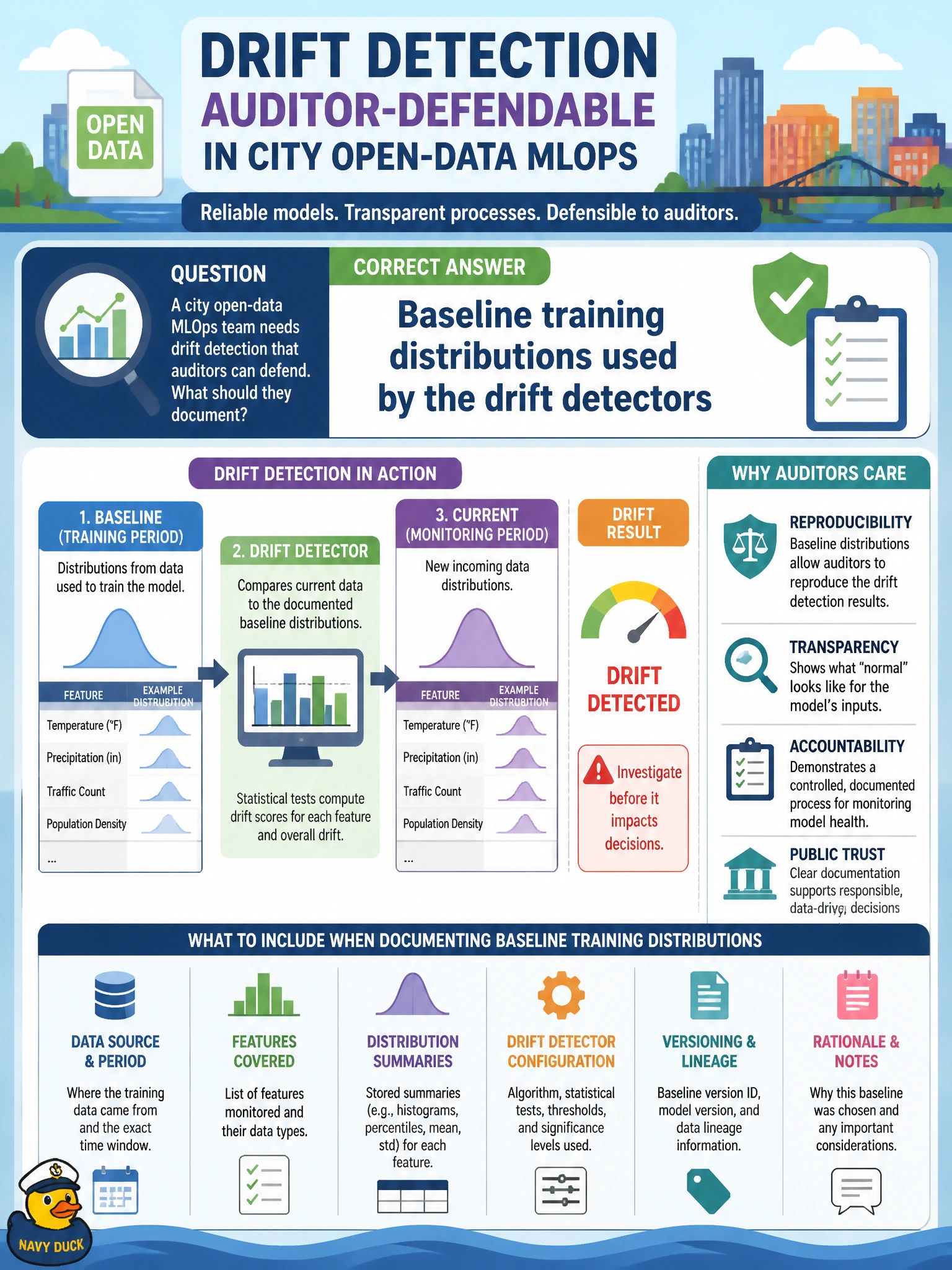
A city open-data MLOps team needs drift detection that auditors can defend. What should they document?
Select an answer to reveal the explanation.
Short Explanation
Auditors will ask what “normal” looked like. Document the training baselines the drift detectors compare against so the story holds up.
Full Explanation
Documenting baseline training distributions used by the drift detectors is correct because auditors defending civic drift detection will ask what “normal” was. Baseline feature (and sometimes prediction) distributions from the training or reference window are the auditable reference that makes production distance metrics meaningful. Without documented baselines, drift claims lack a defensible anchor and municipal open-data or compliance reviews will reject the monitoring story.
Documenting only model feature importance scores used by the drift detectors fails because importance scores describe which features influenced the model, not the reference distribution; they do not establish what ‘normal’ feature distributions looked like before deployment, so an auditor cannot verify a drift calculation against a pre-deployment baseline. Documenting endpoint inference latency metrics used by the drift detectors fails as a drift baseline—latency is a performance metric, not a feature distribution, and says nothing about the actual data an auditor would need to verify a drift calculation. Documenting retraining cluster capacity used by the drift detectors fails because infrastructure capacity does not define the data reference for drift; it tells an auditor nothing about the feature distributions the monitor is comparing against.
Exam caveat: auditor-ready drift detection implies documented training/reference baselines, thresholds, and monitor configuration—not decorative or infrastructure-only artifacts.
Operational check: store baseline distribution summaries (and versioned dataset references) alongside the drift monitor config in the city MLOps repo or workspace, show an auditor how a live distance is computed against that baseline, and re-baseline under change control when the reference population intentionally changes.
Prefer to study offline? Printable PDF study book + test engine ($7.50, unofficial). These questions stay free here.