
A school-district MLOps runbook needs batch scoring to stay consistent with training features for an enrollment model. How should artifacts be packaged?
Select an answer to reveal the explanation.
Short Explanation
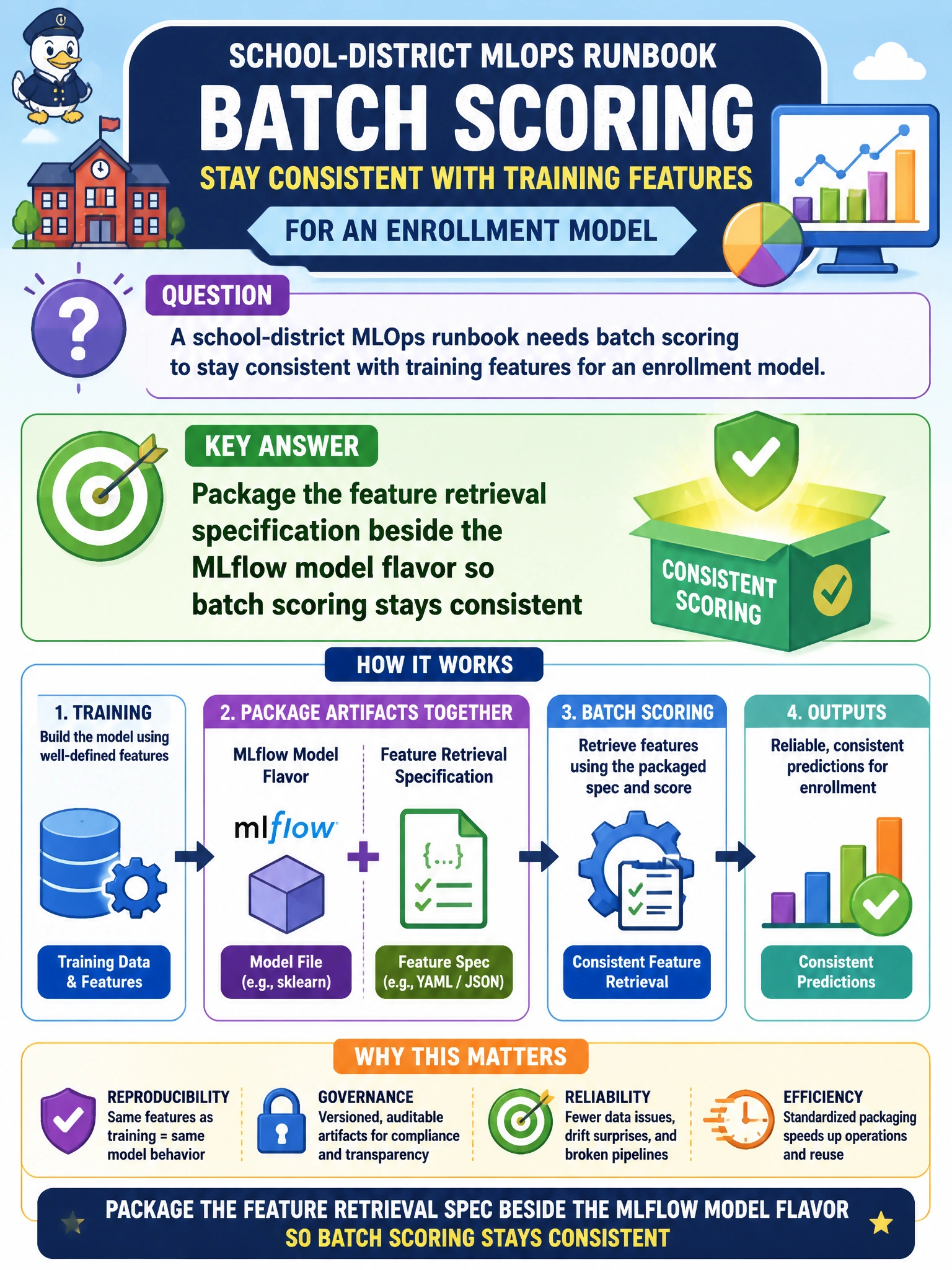
You can't reuse a training notebook execution snapshot for batch scoring and expect consistent features since it captures the old run, not live retrieval logic. Put the feature retrieval spec next to the MLflow flavor so enrollment scoring uses the same features the model learned on.
Full Explanation
Packaging the feature retrieval specification beside the MLflow model flavor so batch scoring stays consistent is correct for school-district enrollment batch jobs. Batch scoring still suffers training–serving skew if each run reinvents feature columns; the retrieval spec traveling with the MLflow artifact keeps overnight enrollment scores aligned with the features the model learned. Azure ML packaging patterns expect the scoring contract to accompany the model, not be locked inside a training notebook execution snapshot that demands reproducing the notebook run for batch scoring. Packaging the MLflow model flavor with the training notebook execution snapshot to keep batch scoring reproducible fails because notebook execution snapshots are not executable scoring contracts and reproducing the notebook run lets operators drift from the model's training features. Packaging the MLflow model flavor with a materialized training feature table snapshot to keep batch scoring consistent fails because a static snapshot cannot resolve current enrollment features at batch time and silently drifts from the live feature schema. Versioning the MLflow model flavor with the batch scoring output schema definition to keep batch scoring consistent fails because an output schema only defines scoring outputs and carries no input feature retrieval logic, so training and batch scoring can silently diverge. Exam caveat: batch schedules must retrieve features at the correct as-of timestamps for enrollment decisions—using future leakage or stale extracts both corrupt results. Keep spec and model versions coupled in the registry. Operational check: include the feature retrieval specification with the registered MLflow package, run the nightly batch against a sealed test cohort, and verify feature vectors and score distributions match the training evaluation contract before district use.
Prefer to study offline? Printable PDF study book + test engine ($7.50, unofficial). These questions stay free here.