
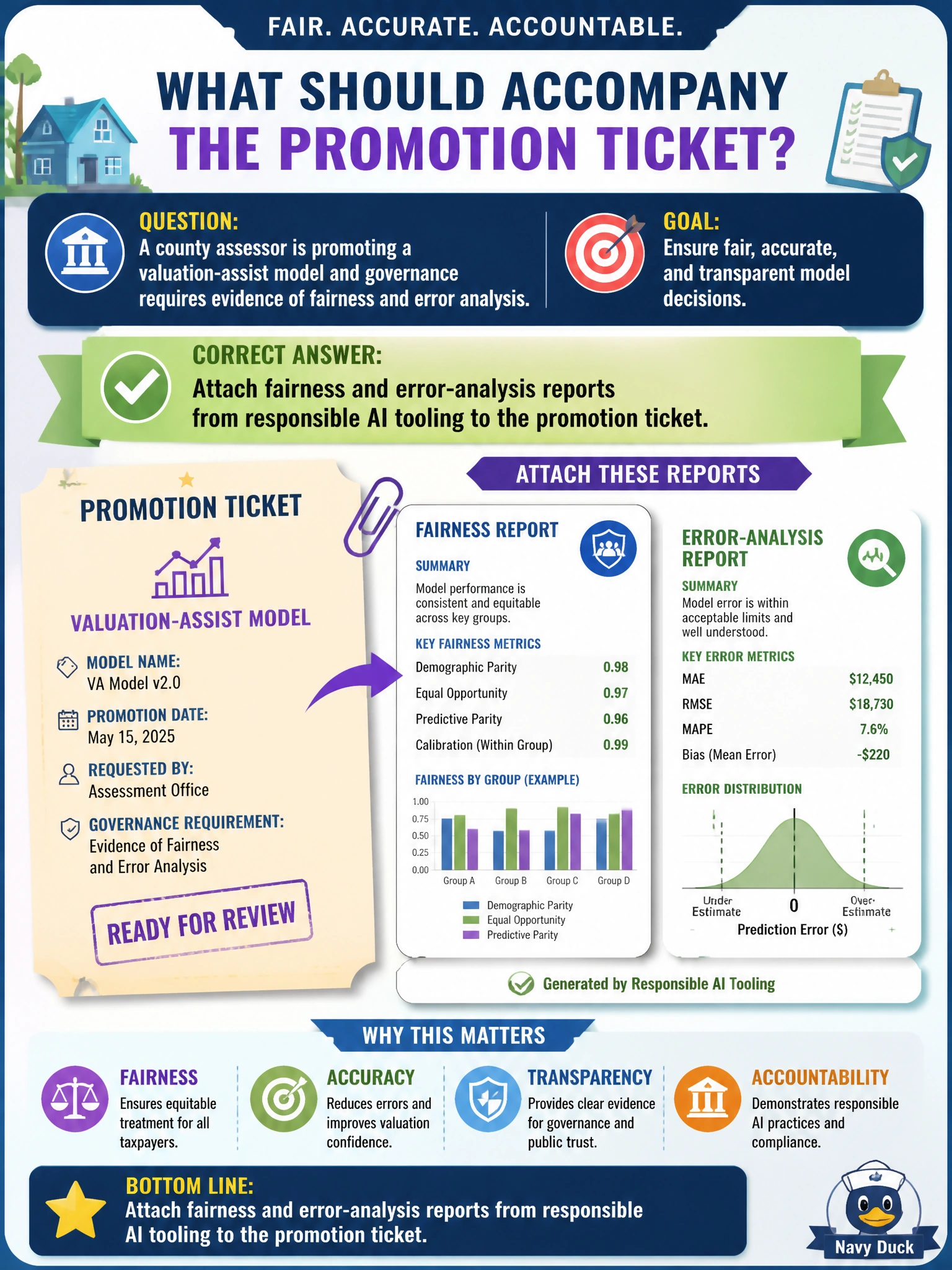
A county assessor is promoting a valuation-assist model and governance requires evidence of fairness and error analysis. What should accompany the promotion ticket?
Select an answer to reveal the explanation.
Short Explanation
Governance loves receipts. You need fresh fairness and error-analysis reports on the promotion ticket — don't submit training reports, deployed reports, or baseline reports.
Full Explanation
Attaching fairness and error-analysis reports from responsible AI tooling to the promotion ticket is correct because county assessor governance requires evidence, not slogans, when promoting a valuation-assist model. Responsible AI reports document disparate error patterns, residual analysis, and related findings that reviewers can challenge before the model influences valuation workflows. The promotion ticket is the control point where those artifacts must appear beside accuracy and lineage. Attaching training fairness and error-analysis reports from responsible AI tooling to the promotion ticket fails because training-data metrics can look optimistic and do not reveal how the candidate model performs on unseen, jurisdiction-relevant slices where valuation errors may concentrate. Attaching deployed fairness and error-analysis reports from responsible AI tooling to the promotion ticket fails conceptually because the promotion ticket concerns the candidate model, and the deployed model's past artifacts do not demonstrate that the current candidate meets the fairness bar. Attaching baseline fairness and error-analysis reports from responsible AI tooling to the promotion ticket fails because baseline artifacts describe a prior reference point, not the candidate model, and do not show whether the candidate model's valuation errors are equitable across slices. Exam caveat: reports must be generated on appropriate evaluation data and slices relevant to the assessor’s jurisdiction; a generic demo report is insufficient. Fairness findings may block promotion even when overall MAE looks acceptable. Operational check: generate fairness and error-analysis outputs from responsible AI tooling on the candidate model, attach them to the promotion ticket, require documented remediation or acceptance of residual risk, and only then advance the registry stage.
Prefer to study offline? Printable PDF study book + test engine ($7.50, unofficial). These questions stay free here.