
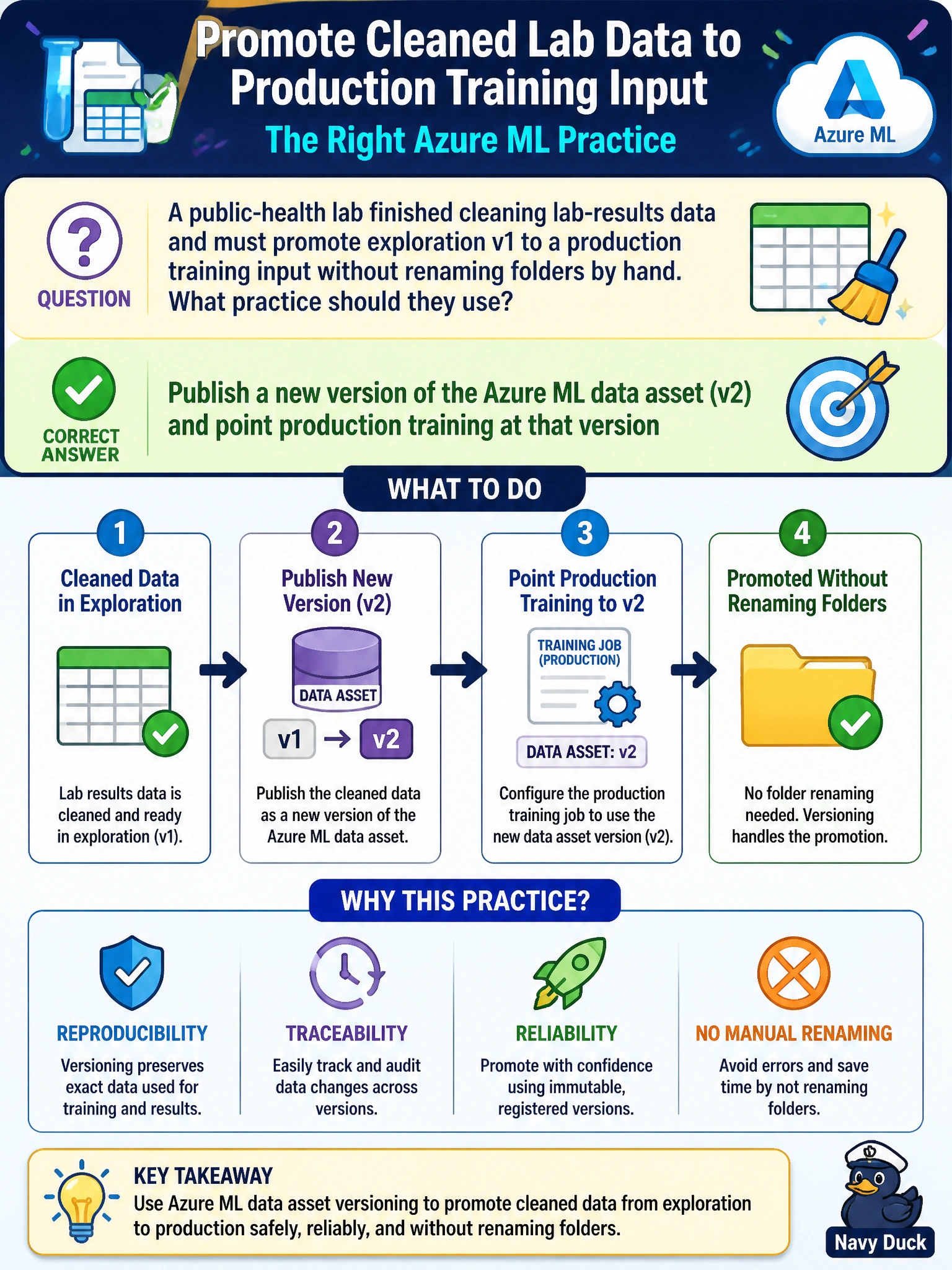
A public-health lab finished cleaning lab-results data and must promote exploration v1 to a production training input without renaming folders by hand. What practice should they use?
Select an answer to reveal the explanation.
Short Explanation
Promotion shouldn't mean erasing the old lab binder. Cut a new data-asset version (v2) and aim production training at it while v1 remains for lineage. Don't overwrite v1, leave production stuck on v1 after you publish v2, or spin up a separate cleaned-results asset — you'll either erase lineage, keep training on dirty data, or break the v1-to-v2 promotion chain you need.
Full Explanation
Publishing a new version of the Azure ML data asset (v2) and pointing production training at that version is the correct promotion practice because cleaned lab-results data should advance through immutable versions rather than destructive renames. Exploration v1 remains available for lineage and comparison while production training explicitly consumes v2. Public-health labs gain a clear promotion gate without hand-editing folder names or losing history.
Overwriting the v1 Azure ML data asset with the cleaned results and keeping production training pointed at v1 destroys immutability: it erases the exploration snapshot, so you lose the v1-to-v2 lineage, audit trail, and rollback safety this scenario requires. Publishing a new version of the Azure ML data asset (v2) and keeping production training pointed at the v1 version creates the right version but fails the promotion: production training would still consume the uncleaned exploration data instead of the cleaned v2 input. Creating a separate Azure ML data asset named cleaned-results v1 and pointing production training at that asset fragments lineage into a disconnected asset name instead of advancing the same asset from v1 to v2, so you lose the explicit promotion gate and version history without avoiding manual renaming.
Exam caveat: promotion means a new data-asset version plus updating the consumer pointer—not publishing v2 while leaving production training pointed at v1.
Operational check: publish v2 from the cleaned lab-results set, update the production training job or pipeline parameter to data asset v2, re-run a validation job, and verify v1 still exists for audit and comparison.
Prefer to study offline? Printable PDF study book + test engine ($7.50, unofficial). These questions stay free here.