
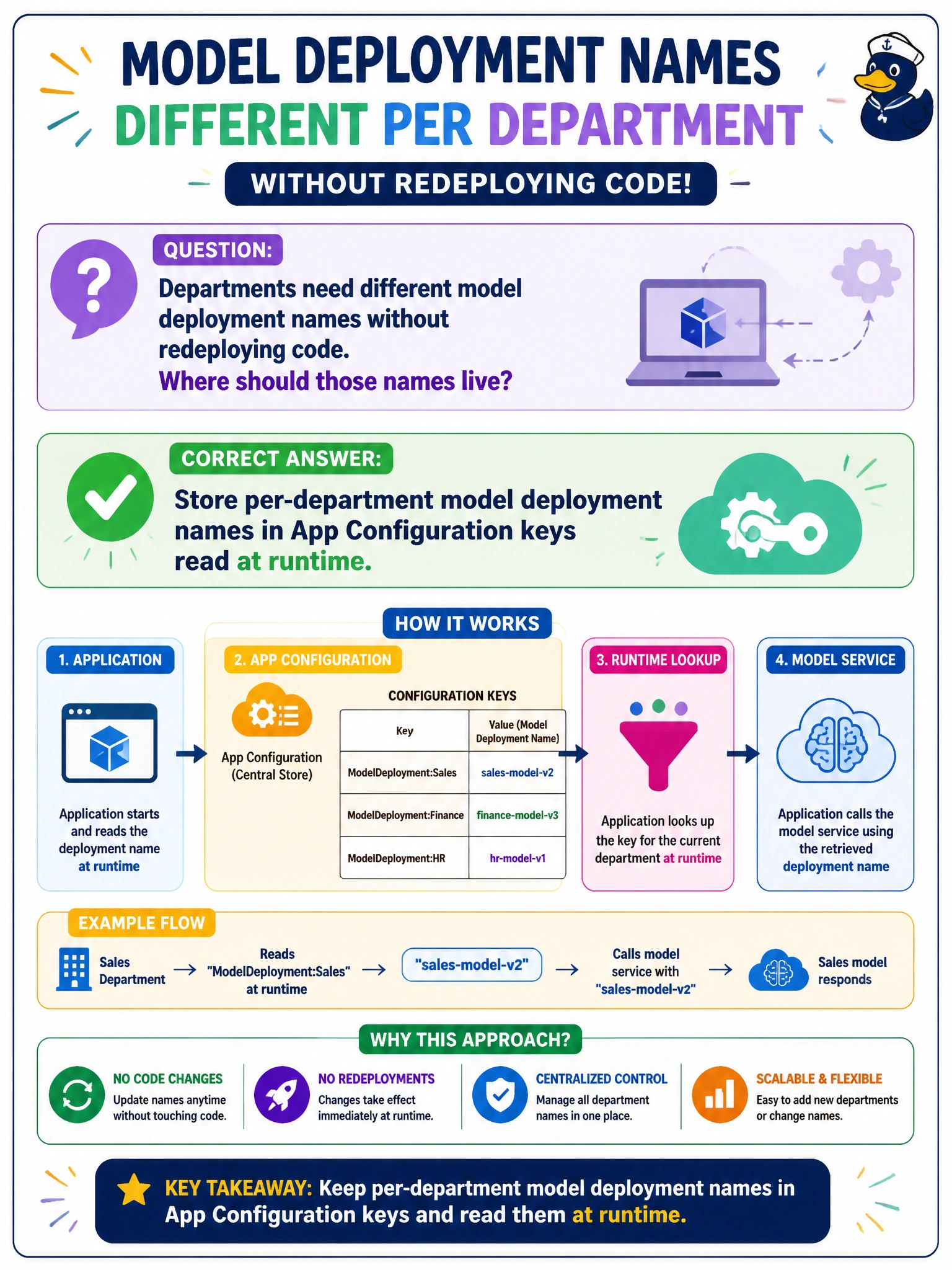
Departments need different model deployment names without redeploying code. Where should those names live?
Select an answer to reveal the explanation.
Short Explanation
App Configuration keys for model names are like a switchboard listing—change the listing without rebuilding the building.
Full Explanation
When departments need different model deployment names without redeploying code, store those per-department model deployment names in App Configuration keys read at runtime. The civic AI platform can then resolve Parks vs Housing vs Clerk model deployment identifiers from configuration (often with labels), enabling department-specific Azure OpenAI deployments while one codebase serves many agencies. Runtime reads avoid rebuilding and redistributing containers for every naming change.
Baking every department's deployment name into separate container images only multiplies image sprawl and forces redeploys for simple naming updates. Hard-coding one global deployment name and refusing departmental overrides blocks legitimate multi-tenant municipal routing. Putting deployment names in client-side JavaScript visible to residents leaks internal routing details and lets clients target backends inappropriately.
Exam caveat: Deployment names are configuration, not secrets—but they can still reveal internal topology, so protect the App Configuration store with RBAC and private networking. Cache refresh and failure modes matter: decide how the app behaves if App Configuration is briefly unavailable. Pair deployment name keys with region/endpoint settings consistently per department label.
Operational check: Place department model deployment keys in App Configuration, confirm each department's runtime read resolves correctly without redeploy, change a nonprod department's deployment name and verify traffic moves on refresh, and monitor configuration read failures. Keep a documented mapping of department label → deployment name for ops and change control.