
After tuning KEDA for a housing caseworker queue, how should the team verify queue latency improved?
Select an answer to reveal the explanation.
Short Explanation
Before/after traces are like stopwatch runs on the same bus route—you prove the schedule actually got faster.
Full Explanation
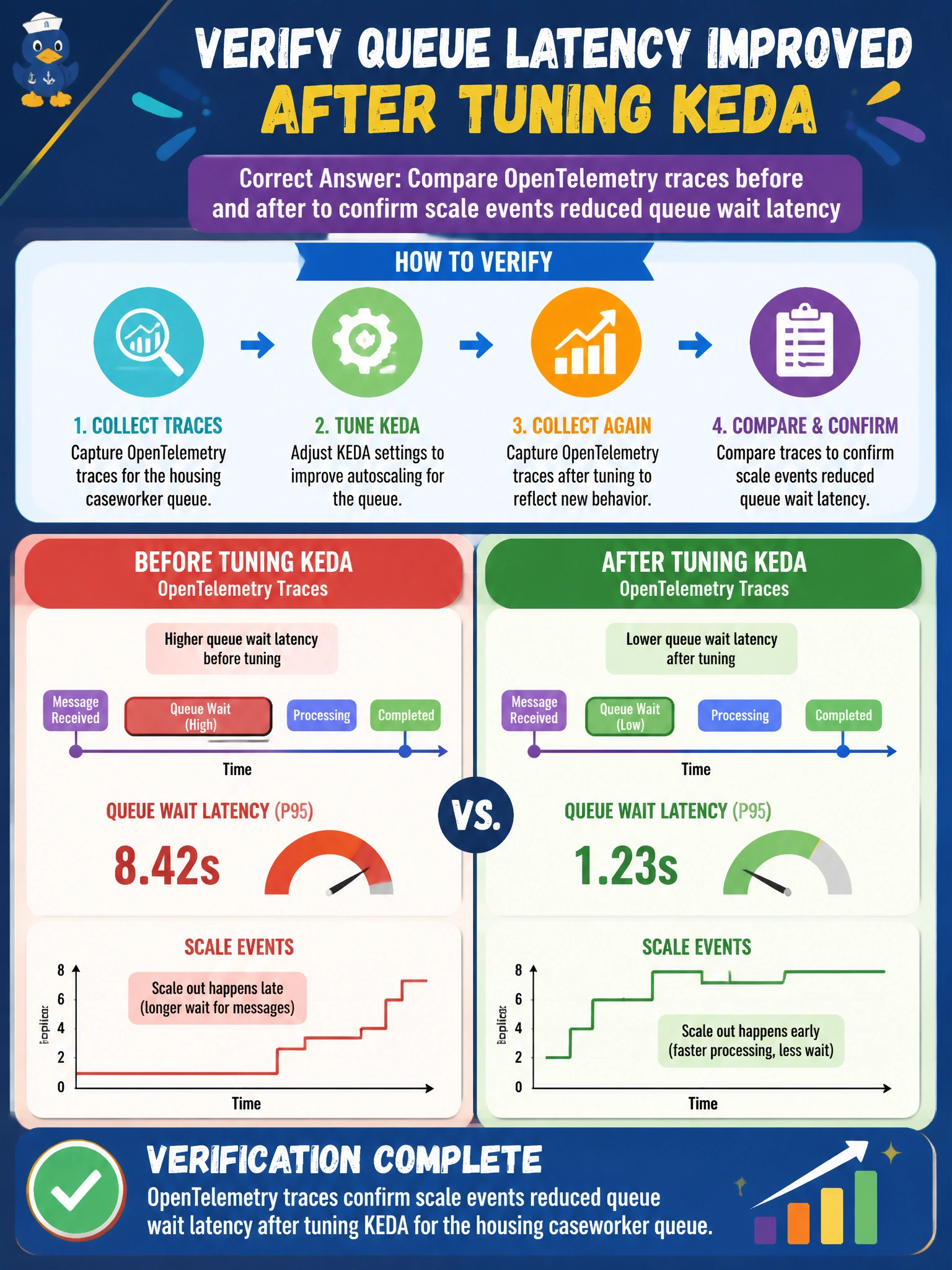
After tuning KEDA for a housing caseworker queue, verification must prove that scale events actually reduced queue wait latency—not that the day felt quieter. Comparing OpenTelemetry traces before and after the change shows whether consumer scale-out shortened the time work items spent waiting before processing, and whether new pods or jobs correlate with improved end-to-end spans for caseworker job handling. Trace-backed before/after comparison is objective evidence for municipal housing ops.
Assuming KEDA worked if no one filed a help-desk ticket that day is anecdotal and misses silent latency regressions that still delay casework. Disabling tracing for a week and relying only on staff feedback removes the measurement system needed to validate autoscaling. Deleting historical traces so only the new baseline exists destroys the control period required for a fair comparison and weakens incident learning.
Exam caveat: KEDA scales on triggers such as queue length or lag; improved scale does not automatically fix poison messages, slow downstream dependencies, or insufficient per-replica capacity. OpenTelemetry latency includes queue wait plus processing; separate those spans or attributes so you do not credit KEDA for unrelated app speedups. Clock skew and missing context propagation can distort before/after comparisons.
Operational check: Capture a pre-change window of queue wait and processing spans for the housing jobs, deploy the KEDA tuning, capture a comparable post-change window under similar load, and compare p50/p95 wait latency alongside scale-event timestamps. Confirm max-replica limits and cooldown settings behave as intended, and retain both trace windows in the change ticket for audit.