
Functions that call internal RAG data services must avoid public internet exposure of those stores. What networking approach fits?
Select an answer to reveal the explanation.
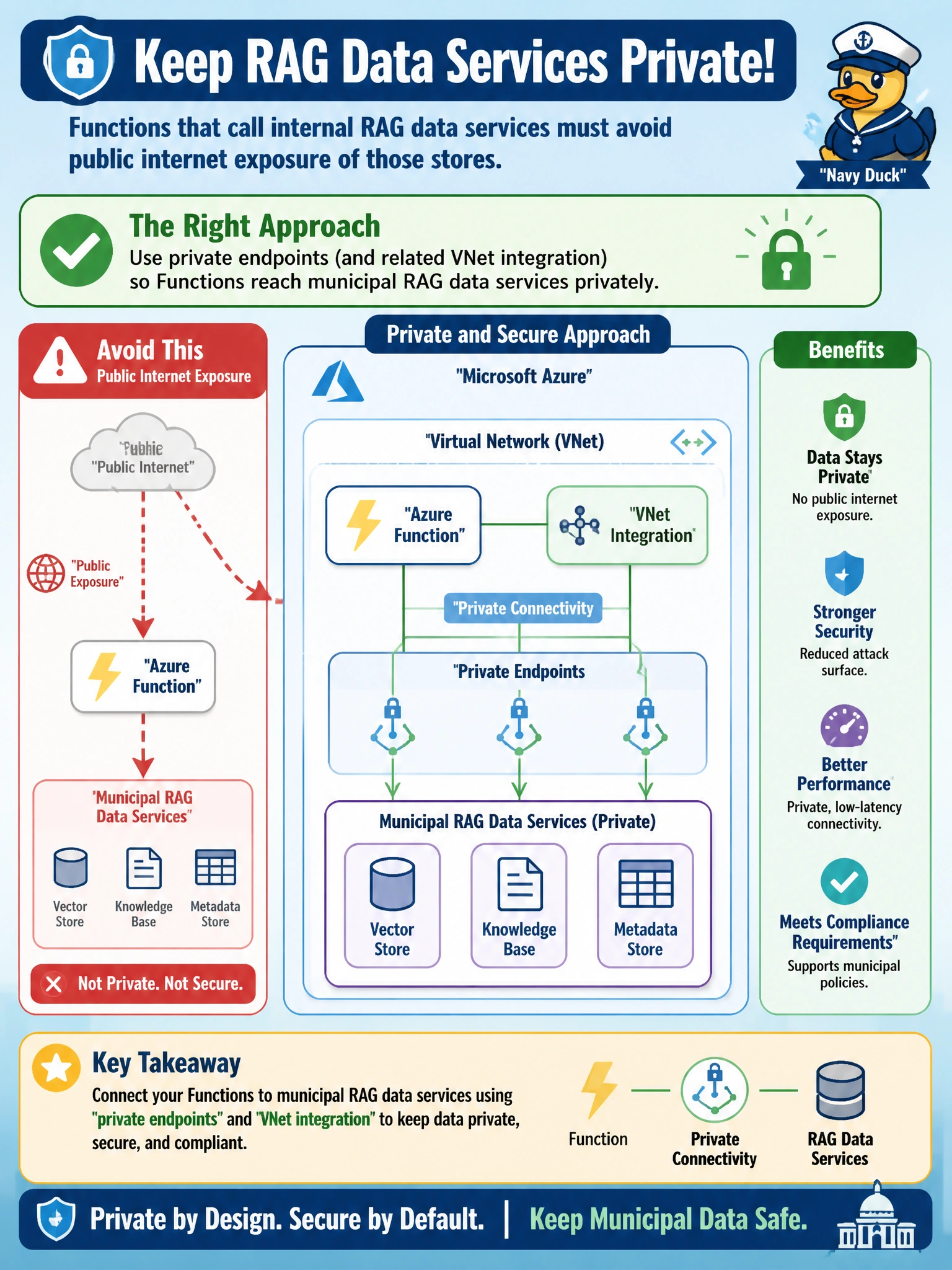
Short Explanation
Private endpoints are the locked service corridor from Functions to the RAG vault—no need to stroll those databases across the public sidewalk.
Full Explanation
Functions that call internal RAG data services (Cosmos, PostgreSQL, Azure AI Search admin endpoints, etc.) should reach them over private endpoints and related VNet integration so municipal knowledge stores are not exposed on the public internet. Private networking keeps embeddings, resident-adjacent documents, and connection surfaces on the locked service corridor between the Function app and data plane.
Exposing Cosmos and PostgreSQL on public endpoints "for convenience" expands blast radius for RAG stores. Disabling network controls for anonymous public reads is incompatible with civic data protection. Moving RAG data only to personal laptops abandons Azure controls, HA, and shared municipal operations.
Exam caveat: secure AI architectures combine identity (Entra/RBAC) with network isolation (private endpoints, VNet integration, possibly private DNS). Public exposure of vector or document stores is a common anti-pattern on design questions.
Operational check: disable public network access on the RAG data services, attach private endpoints, integrate the Function app with the VNet, resolve private DNS, and confirm the Function retrieves chunks successfully while public internet attempts to the data plane fail.