
High-volume water-meter alert paraphrasing needs more Service Bus throughput than a single non-partitioned queue provides. What helps?
Select an answer to reveal the explanation.
Short Explanation
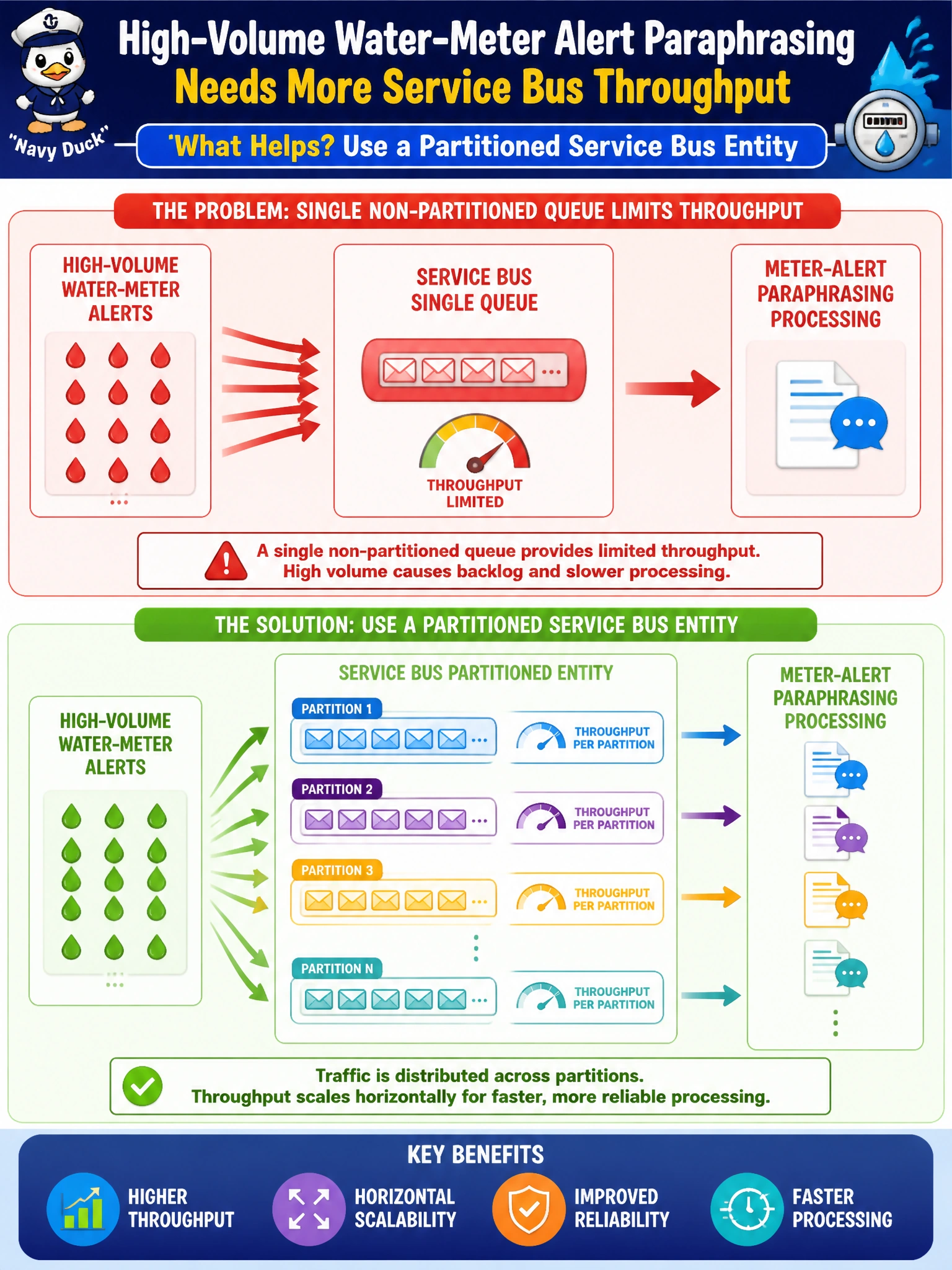
Partitioned queues are like opening more teller windows at the water desk—meter-alert paraphrases can fan across lanes instead of one jammed line.
Full Explanation
High-volume water-meter alert paraphrasing can exceed what a single non-partitioned Service Bus queue comfortably sustains. A partitioned Service Bus entity spreads messages across multiple broker partitions so publishers and competing paraphrasing consumers scale horizontally while preserving Service Bus semantics for the municipal alert lane.
Keeping one non-partitioned queue and rejecting additional meter-alert publishers artificially throttles telemetry the water desk depends on. Serializing all alerts through a single HTTP Function with no queue couples producers to one endpoint and loses asynchronous buffering during meter storms. Storing every alert only in a local desktop folder abandons cloud messaging, HA, and competing consumers entirely.
Exam caveat: partitioned entities improve throughput and availability for high-volume AI job queues; know trade-offs (for example, sessions and some ordering/transaction scenarios differ versus non-partitioned). AI-200 expects Service Bus—not ad-hoc HTTP or desktop folders—as the primary messaging skill for such scale questions.
Operational check: migrate the meter-alert paraphrasing queue to a partitioned entity in a test namespace, publish at peak synthetic rates from multiple publishers, scale Function consumers, and confirm higher sustained throughput with stable lock loss rates and successful paraphrase writes.