
The library wants bulk re-embed jobs to start overnight without staff starting workers at midnight. How should Service Bus schedule that work?
Select an answer to reveal the explanation.
Short Explanation
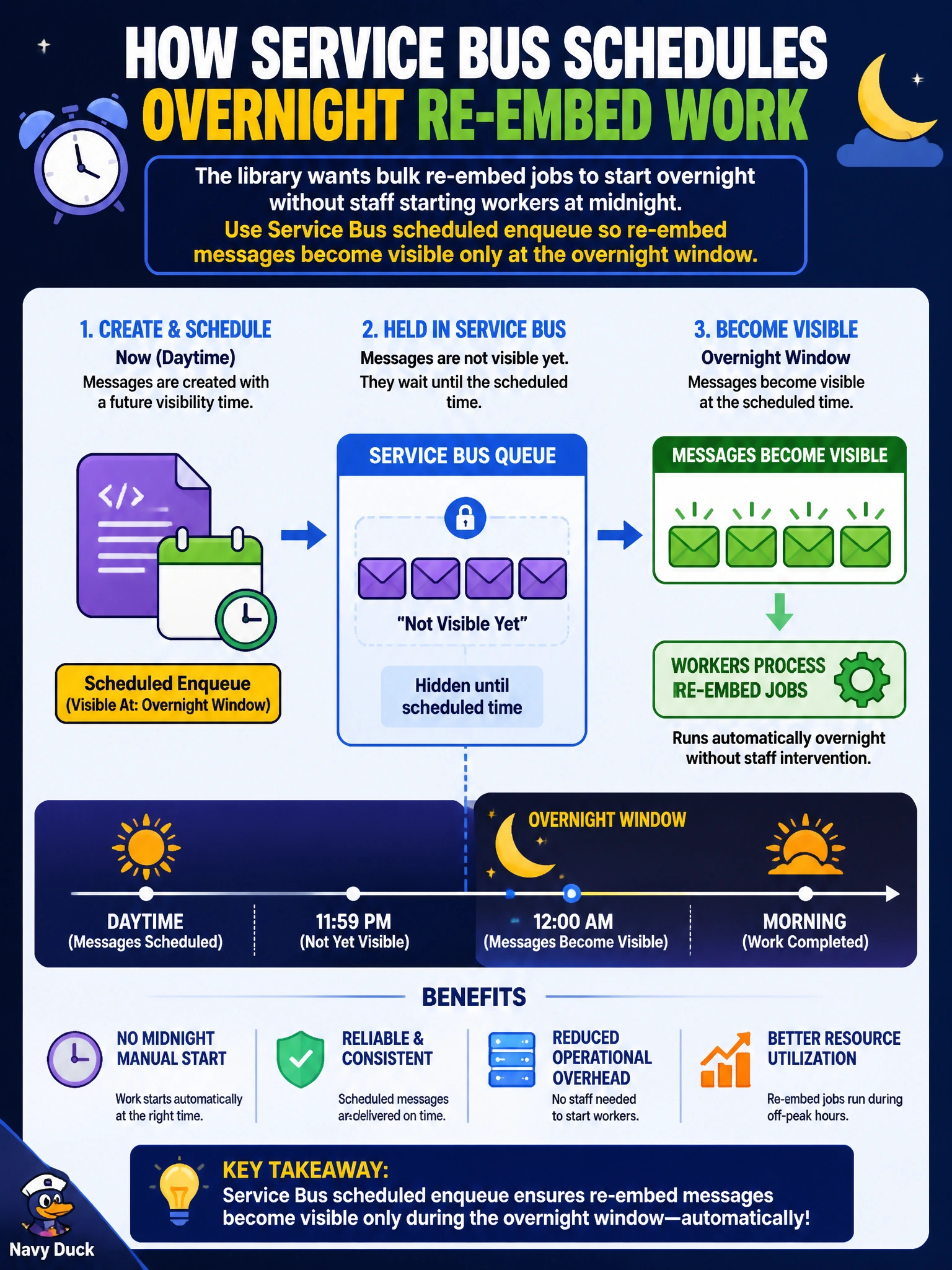
You can use scheduled enqueue like a night-drop slot set for 1 a.m.—your re-embed messages stay invisible until the overnight window. That way, workers can pick them up when the batch is due, without staff starting them at midnight.
Full Explanation
Overnight library corpus re-embeds should become visible to workers only when the batch window opens. Service Bus scheduled enqueue lets the job publisher submit messages during business hours while delaying their visibility until the overnight UTC or local window. Workers that already run on a timer or an always-on scale rule can then receive a surge of newly visible messages without staff manually starting processors at midnight or flooding daytime AI capacity. Leaving messages immediately visible at noon and hoping overnight workers claim them later fails because daytime competing consumers or autoscaled capacity may drain the queue early, competing with interactive library workloads. Disabling the queue overnight and recreating it each morning is operationally brittle: configuration, authorization, and dead-letter history may be lost, and each cycle risks deployment mistakes. Blob Storage lifecycle rules manage blob tiers and retention; they do not replace a scheduled work queue for AI workers with locks, sessions, and dead-letter queue semantics. Exam caveat: scheduled messages still count toward entity quotas and require the correct enqueue-time APIs. Logic Apps recurrence or Functions timers can also start work, but the question asks how Service Bus itself defers message visibility. Practical check: schedule a test re-embed a few minutes ahead, confirm it cannot be received before that time, verify overnight workers process it, and alert if scheduled message counts remain stuck past the window.