
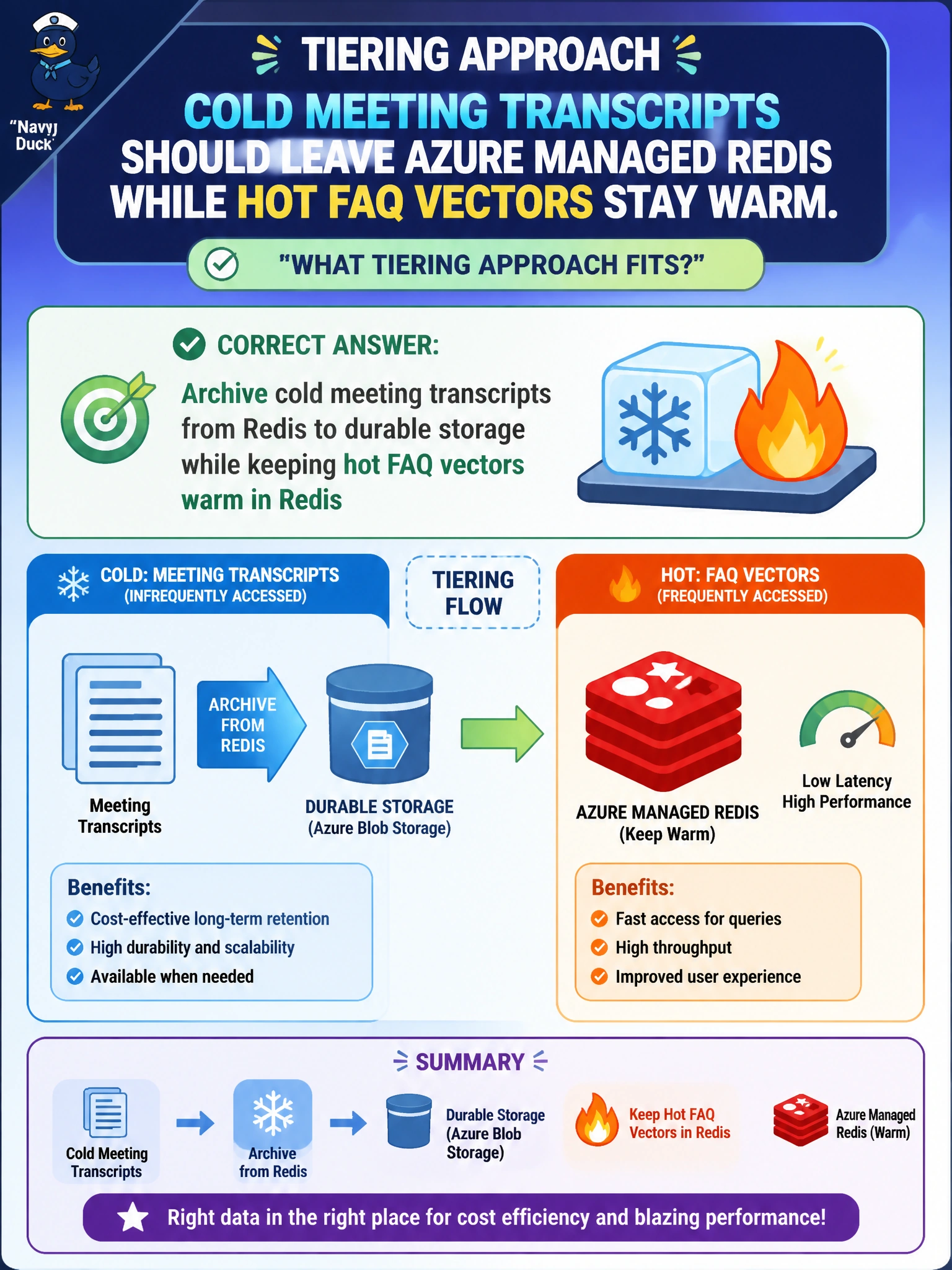
Cold meeting transcripts should leave Azure Managed Redis while hot FAQ vectors stay warm. What tiering approach fits?
Select an answer to reveal the explanation.
Short Explanation
Tiering is moving last year’s meeting boxes to the archive warehouse while the busy FAQ pamphlets stay on the Redis front counter—hot stays hot, cold gets shelved durably.
Full Explanation
Cold meeting transcripts should leave Azure Managed Redis while hot FAQ vectors stay warm, which means archiving cold transcripts from Redis into durable storage while retaining hot FAQ vectors in Redis for low-latency similarity. That tiering matches civic access patterns: historical transcripts are durable but rarely hit; FAQ vectors need memory-speed ANN for resident and staff bots. Keeping every historical transcript permanently in Redis with no archival tier inflates memory cost for cold municipal data that should live in Blob or another durable store. Evicting hot FAQ vectors first while retaining only cold transcripts in memory inverts priority and harms the interactive FAQ path residents use during peak events. Deleting both hot and cold municipal AI data whenever Redis memory rises slightly destroys useful cache and archive candidates instead of tiering by temperature. Exam caveat: tiering is about temperature and durability—eviction policy alone is not a durable archive for meeting records. Operationally, classify keys by temperature, schedule archive jobs from Redis to Blob or PostgreSQL for cold transcripts, keep hot FAQ vectors with appropriate TTL and eviction, and verify FAQ latency after archive runs.