
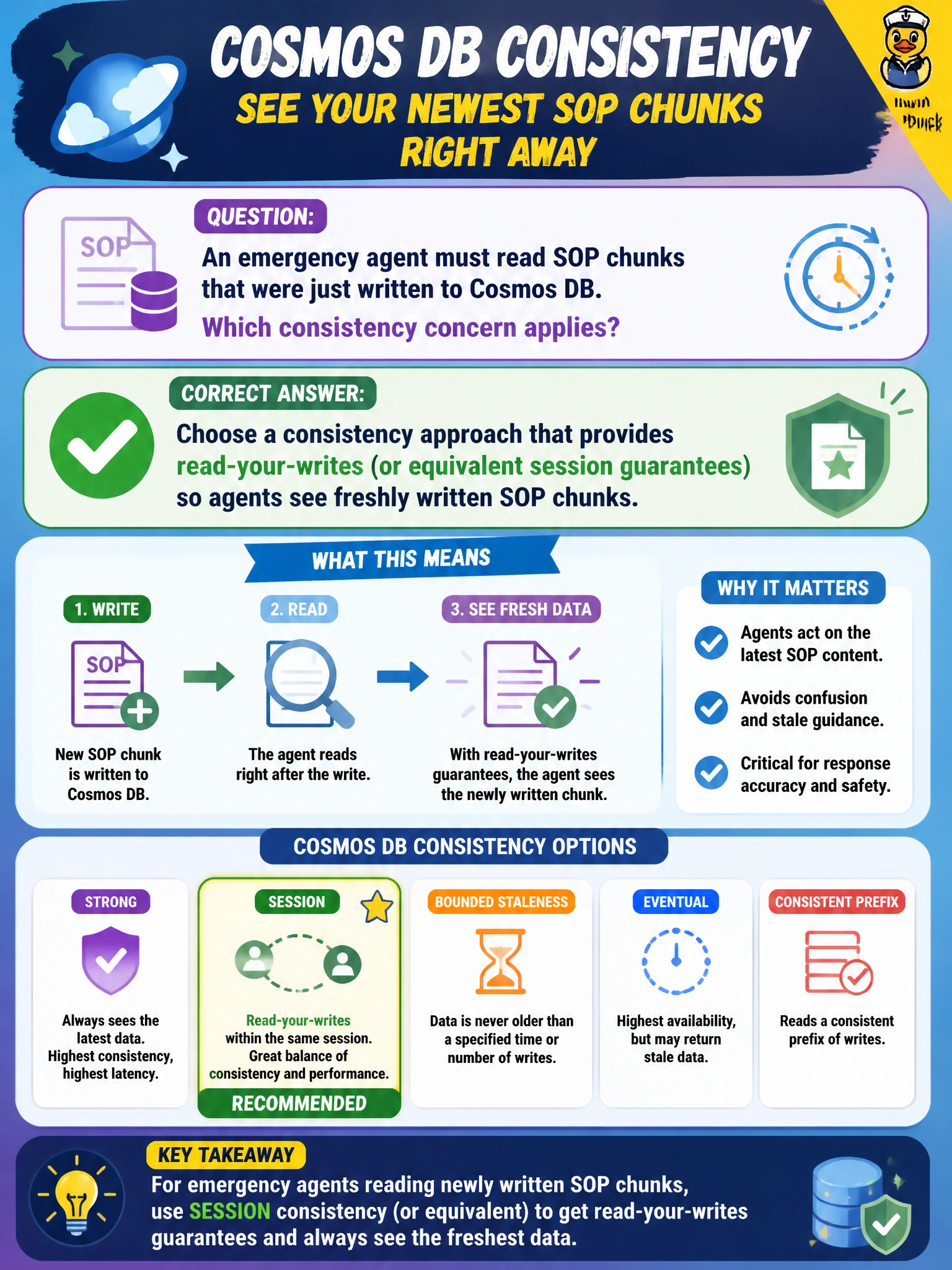
An emergency agent must read SOP chunks that were just written to Cosmos DB. Which consistency concern applies?
Select an answer to reveal the explanation.
Short Explanation
Read-your-writes is the ‘I just filed the new SOP, hand it back to me now’ promise—session-style consistency so the emergency agent isn’t stuck on yesterday’s binder.
Full Explanation
An emergency agent that must read SOP chunks just written to Cosmos DB needs a consistency approach that provides read-your-writes or equivalent session guarantees so the agent observes fresh municipal SOP content on the next read during an incident. Always using the weakest eventual reads even when agents must see just-written emergency SOP updates risks acting on stale procedures when seconds matter for public safety workflows. Writing SOPs only to Redis with no durable Cosmos copy for emergencies sacrifices the durable store the scenario depends on for authoritative SOP text after cache loss or restart. Delaying all emergency reads by several hours to guarantee staleness is the opposite of operational safety for emergency agents and municipal responders who need current playbooks. Exam caveat: stronger consistency or session tokens have latency and availability tradeoffs; apply them on the write-then-read emergency path rather than globally maximizing every query in the account. Operationally, configure session or stronger consistency for the SOP write/read path, verify the agent reads the same session after write, and test regional failover so emergency SOP updates remain visible under load.