
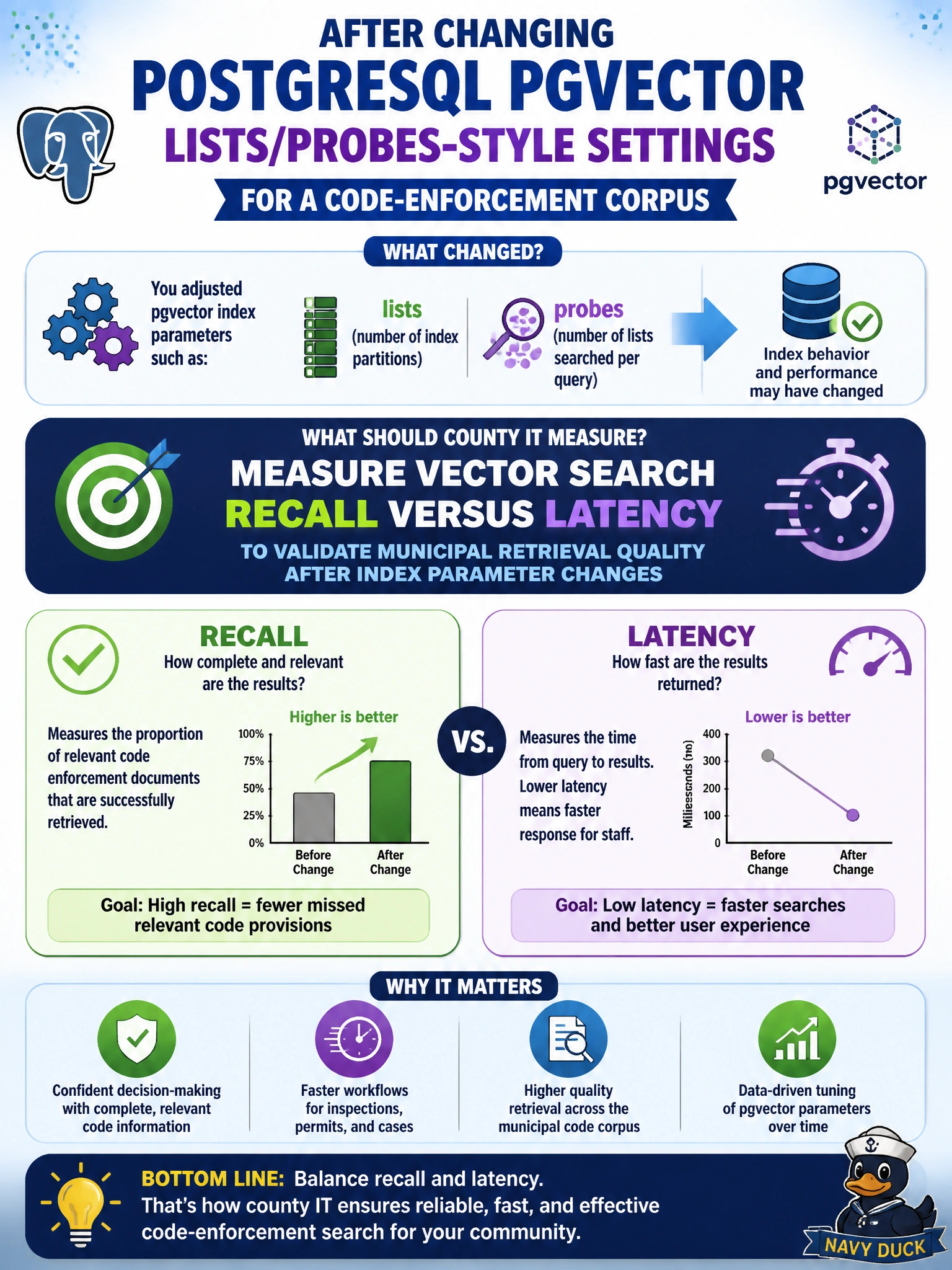
After changing PostgreSQL pgvector lists/probes-style settings for a code-enforcement corpus, what should county IT measure?
Select an answer to reveal the explanation.
Short Explanation
Tweaking lists/probes without measuring is like retuning a radio and never checking if you still get the station—score recall against latency so the code-enforcement RAG still finds the right cases fast enough.
Full Explanation
After changing PostgreSQL pgvector lists/probes-style settings for a code-enforcement corpus, county IT must validate retrieval quality, not assume improvement. Measuring vector search recall versus latency confirms that municipal retrieval still finds the right ordinance and case chunks within acceptable response times after index parameter changes that trade approximation for speed. Only increasing RU on an unused Cosmos container and skipping PostgreSQL measurements tunes the wrong service and leaves pgvector behavior unverified for the enforcement RAG path. Assuming recall and latency are unchanged and skipping evaluation after tuning risks silent quality regressions that send inspectors or residents to the wrong guidance. Deleting the vector index whenever latency improves slightly destroys the ANN structure needed for scalable search and confuses latency wins with correctness. Exam caveat: lists/probes (and similar) trade recall for speed; the exam expects explicit measurement of that tradeoff on the municipal corpus rather than set-and-forget. Operationally, hold out labeled queries for code-enforcement scenarios, record recall@k and p95 latency before and after parameter changes, and promote settings only when both meet published civic service targets.