
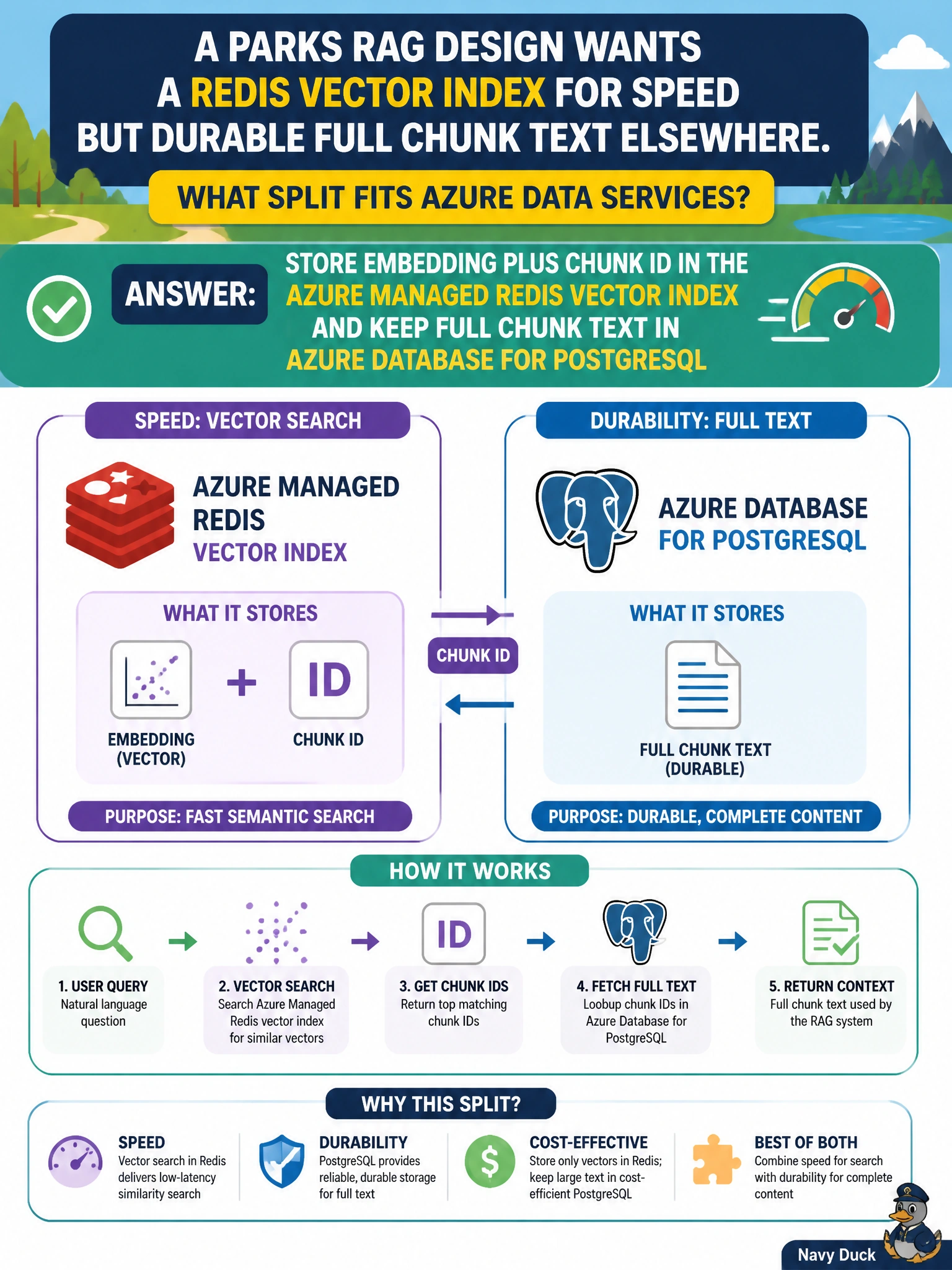
A parks RAG design wants a Redis vector index for speed but durable full chunk text elsewhere. What split fits Azure data services?
Select an answer to reveal the explanation.
Short Explanation
Redis holds the speedy ‘where is this vibe?’ map (embedding + id), while PostgreSQL keeps the actual park brochure text—best of both shelves without stuffing whole PDFs into the cache.
Full Explanation
A parks RAG design that wants Redis-speed similarity with durable full chunk text elsewhere should split responsibilities across Azure data services. Storing the embedding plus a chunk id in an Azure Managed Redis vector index while keeping full chunk text in Azure Database for PostgreSQL gives fast ANN lookup without stuffing large payloads into the cache tier that parks staff and residents hit. Duplicating entire multi-megabyte PDFs into every Redis vector key and deleting PostgreSQL bloats memory, loses relational durability, and is a poor fit for Redis working-set economics on a citywide parks corpus. Keeping vectors only in browser localStorage and never using Redis or PostgreSQL provides no shared municipal index and no durable corpus operators can rebuild from. Storing full text exclusively in Redis and discarding durable relational storage for parks content risks data loss on eviction and complicates structured joins and audits. Exam caveat: Redis holds hot vectors and ids; PostgreSQL (or another durable store) remains authoritative for chunk text the generator cites. Operationally, index embedding+id in Redis, resolve ids to text in PostgreSQL on hit, measure Redis memory versus retrieval quality for the parks corpus, and alert when eviction policies threaten hot park FAQ vectors.