
A city must re-embed outdated rows when the embedding model changes. What should be stored with each vector?
Select an answer to reveal the explanation.
Short Explanation
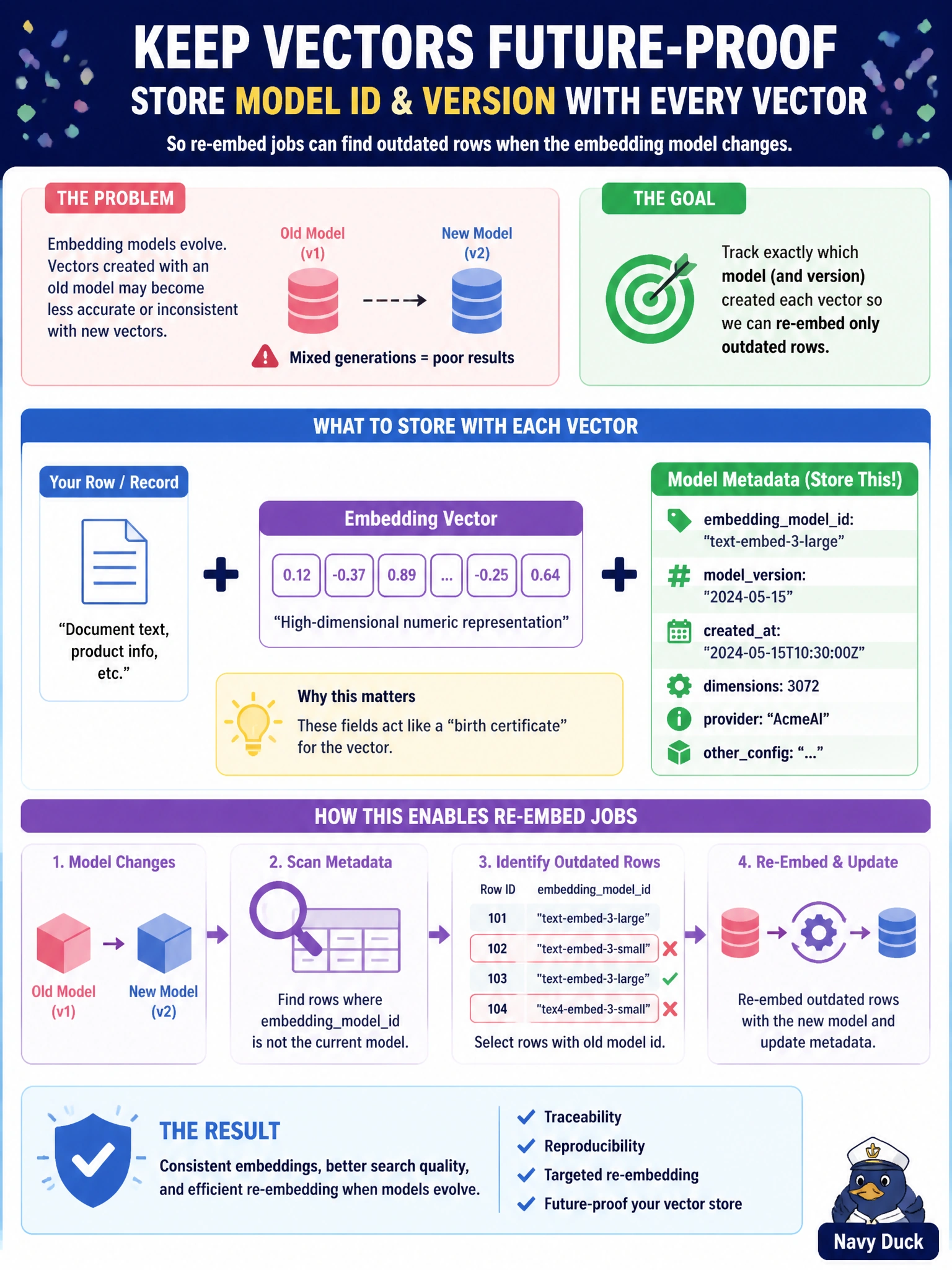
Store a consistent embedding model id and related version metadata with each vector. When you upgrade models, your re-embed job can find rows made with the old recipe instead of guessing.
Full Explanation
When your city changes embedding models, re-embed jobs need to identify rows produced by the old model. Storing a consistent embedding model id and related version metadata alongside each vector makes those rows selectable, so you can target outdated embeddings rather than reprocess everything. If you store no model identity and keep only floating-point vector values, you cannot reliably distinguish current embeddings from outdated ones, leaving you to do blind full re-embeds or guess. A rotating random UUID unrelated to the embedding model does not tell your pipeline which model produced a vector, so it cannot guide re-embedding. The name of the developer who last opened the spreadsheet provides no machine-readable model lineage for an automated job. Exam caveat: carry the model id and version with vectors through ingest and cache layers; vector dimension alone is insufficient because different models can share a dimension. Practical check: add model_id and version fields, backfill existing rows where the information is known, then filter an upgrade re-embed job by the prior model id and sample the results to verify that newly created vectors carry the new model id before cutover.