
A city wants to cut token spend on repeated 311 FAQ answers. Which Azure Managed Redis use fits?
Select an answer to reveal the explanation.
Short Explanation
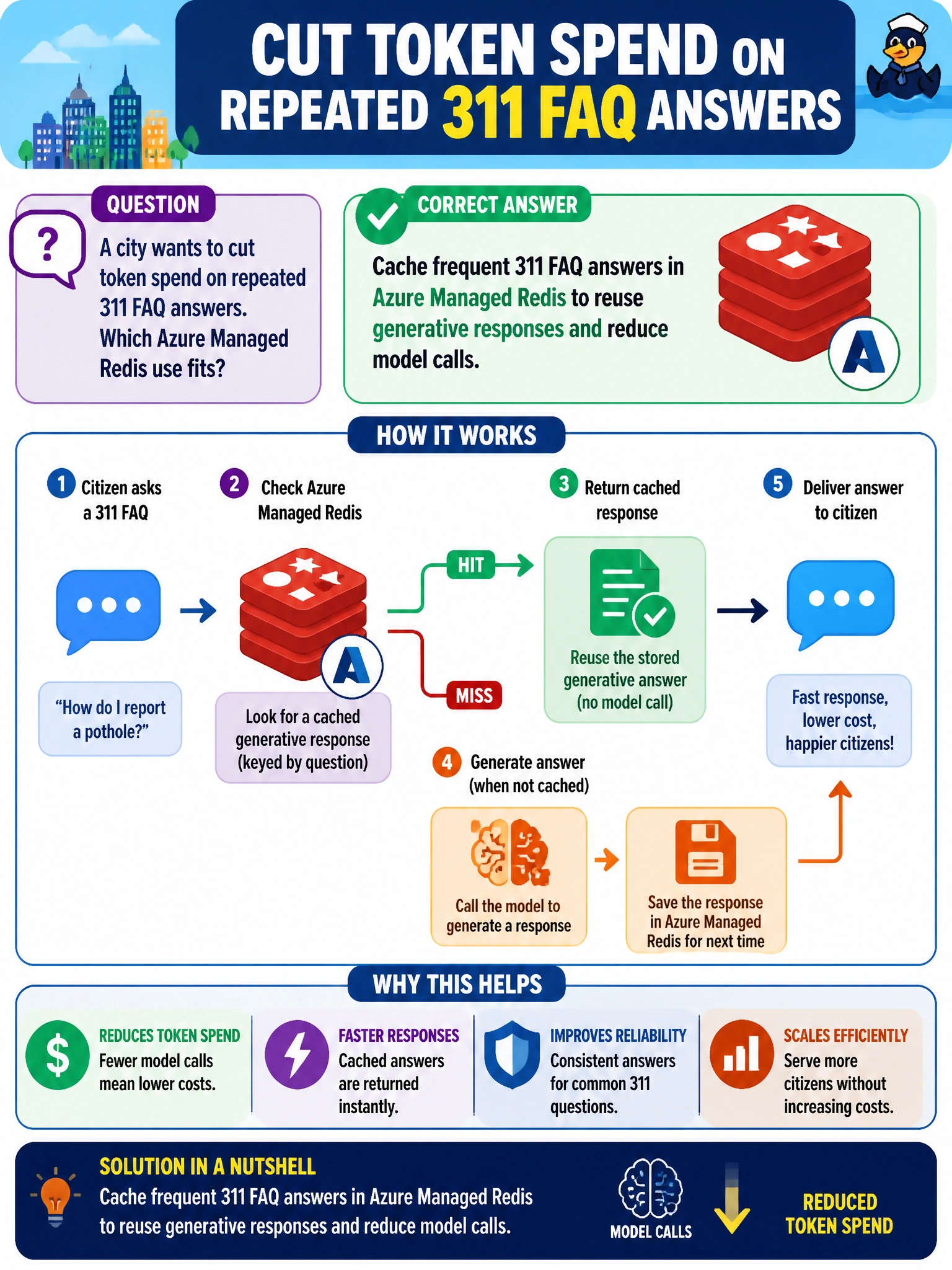
If the same 311 FAQ keeps coming up, Redis is the sticky note on the monitor—serve the cached answer and stop burning tokens on the encore.
Full Explanation
Azure Managed Redis is an appropriate cache for frequent 311 FAQ generative answers so the city can reuse responses, cut model token spend, and reduce latency for repeated resident questions. Cache hits avoid re-invoking the LLM for identical or normalized FAQ prompts, which is a common cost-control pattern for municipal contact-center and chatbot workloads. Keeping hot FAQ answers in Redis also shields upstream Cosmos or PostgreSQL knowledge stores from redundant read spikes when the same questions recur during seasonal intake surges.
Caching nothing and calling the model for every identical 311 FAQ maximizes token cost and latency with no benefit. Storing raw model API keys in Redis values returned to anonymous callers is a secret-handling violation, not an answer-cache pattern. Replacing Redis with printing FAQ answers on paper for each call center shift does not provide a low-latency shared cache for digital channels.
Exam caveat: Redis caches derived answers—it does not replace the system of record for policy; pair caching with TTL or versioned keys so guidance stays current when ordinances or scripts change. Operational check: measure cache hit ratio on top 311 FAQs, track model-call reduction and token spend before versus after Redis, set TTLs aligned to FAQ change cadence, ensure cached payloads exclude secrets and unnecessary PII, and alert when hit ratio collapses after a content publish.