
County IT must support vector index builds on a large code-enforcement corpus in Azure Database for PostgreSQL. What should sizing prioritize?
Select an answer to reveal the explanation.
Short Explanation
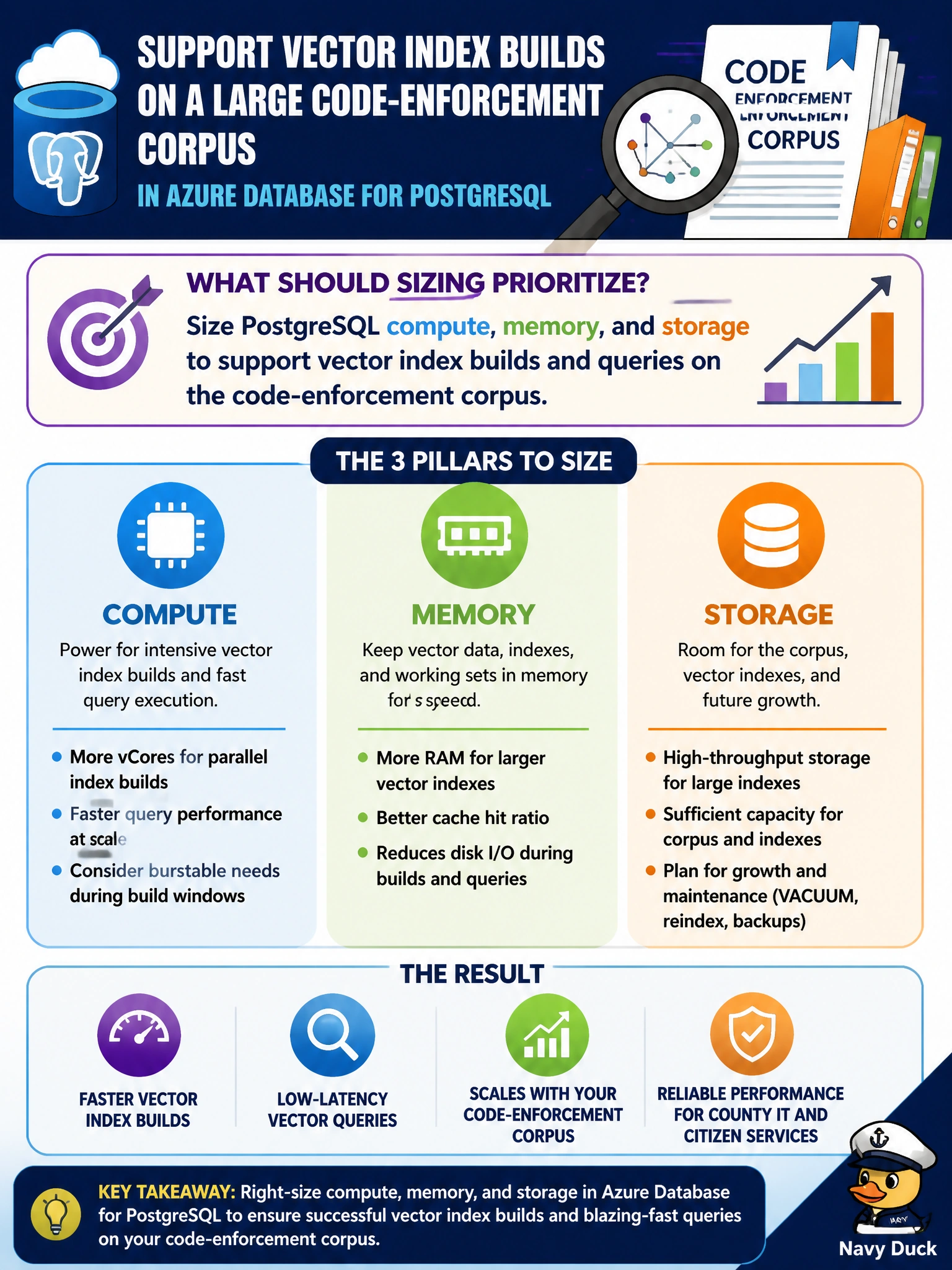
Building a vector index on a huge code-enforcement pile is heavy lifting—give PostgreSQL enough compute, memory, and disk so the county’s AI search doesn’t choke mid-build.
Full Explanation
Vector index builds and similarity queries on a large code-enforcement corpus are memory- and CPU-intensive. County IT should size Azure Database for PostgreSQL compute, memory, and storage to support both index construction and steady-state query load. Adequate resources prevent failed builds, excessive I/O, and latency spikes when enforcement officers and AI services search the corpus.
Using the smallest burstable SKU with near-zero memory regardless of corpus size under-provisions for index build working sets and will stall or thrash. Hosting the vector index only on developer laptops outside Azure breaks availability, security baselines, and municipal production architecture. Removing all indexes so builds never consume CPU or memory avoids build cost by destroying query performance—the wrong tradeoff for a large corpus.
Exam caveat: vector indexes (IVFFlat, HNSW-style, and similar) have distinct build-time and memory profiles; sizing must consider build peaks, not only idle query averages. Operational check: estimate corpus rows and dimensions, run a representative index build in a nonprod SKU, capture peak memory and duration, then select a production tier with headroom and storage growth for ongoing code-enforcement ingest.