
An assessor’s RAG assistant must join parcel attributes to embedding rows in Azure Database for PostgreSQL. What schema approach fits?
Select an answer to reveal the explanation.
Short Explanation
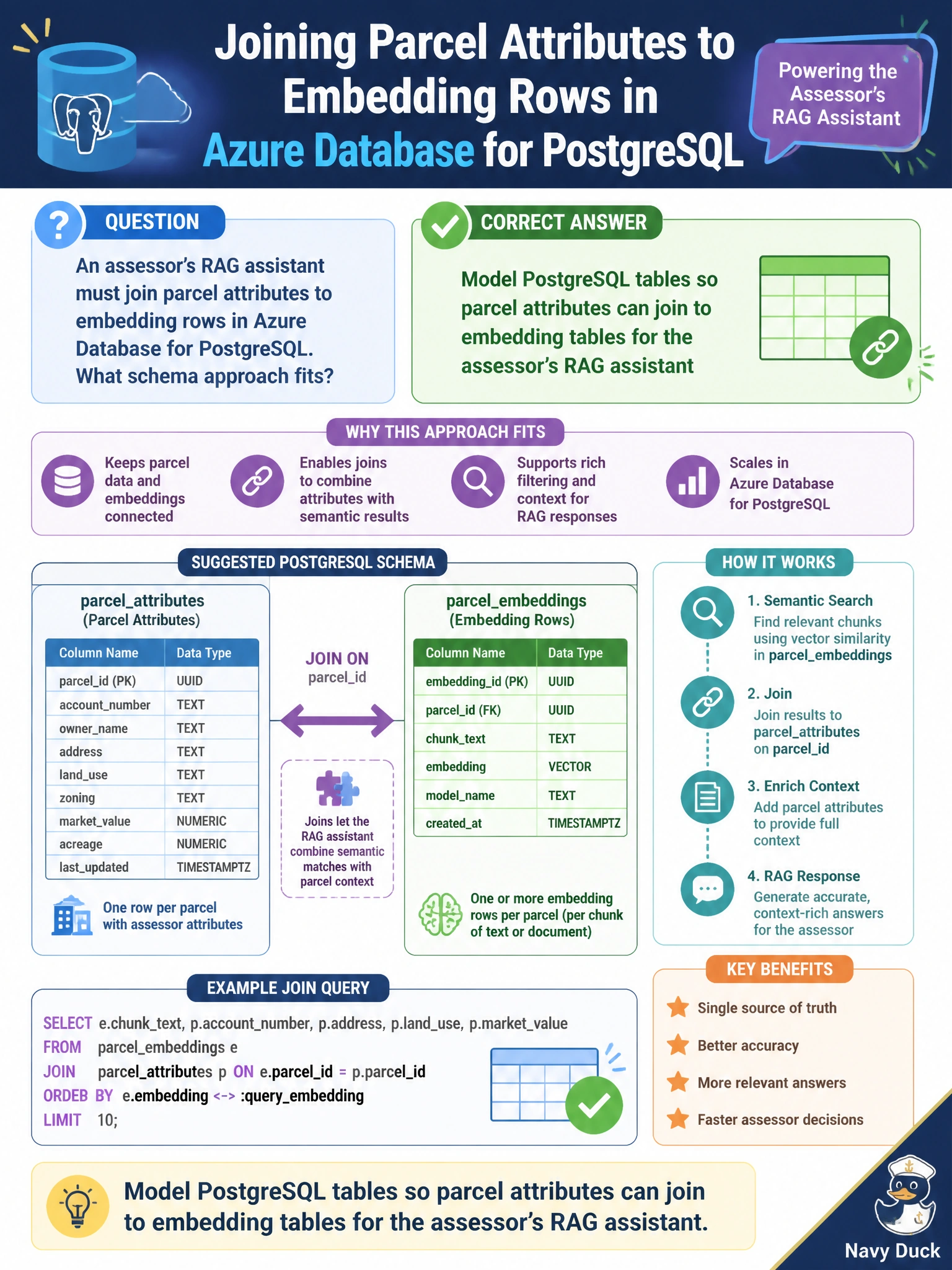
Parcel facts and their embeddings need a clean join key—like matching the tax map number to the right card—so the assessor’s assistant can filter and ground answers in PostgreSQL.
Full Explanation
Azure Database for PostgreSQL RAG designs for an assessor’s assistant should model relational tables so parcel attributes can join to embedding tables. Parcel keys, zoning, and assessment metadata act as filters and grounding context, while embedding rows support semantic similarity. Clean joins let the assistant retrieve candidates that both match meaning and satisfy parcel-scoped constraints residents and staff expect.
Storing only free-text blobs with no parcel keys or relational metadata removes the ability to filter or join on assessor attributes. Putting embeddings in a spreadsheet email attachment outside the database abandons transactional integrity, concurrent access, and Azure Database for PostgreSQL vector tooling. Dropping all foreign keys and relying on unordered CSV dumps for every question destroys referential structure needed for trustworthy municipal answers.
Exam caveat: associate scenarios emphasize relational modeling plus vectors—not choosing between “only SQL” or “only embeddings”; hybrid structured-plus-vector designs are expected for parcel RAG. Operational check: verify foreign keys (or explicit join keys) between parcel attribute and embedding tables, run an explain plan on a filtered similarity query, and confirm returned rows include both parcel identifiers and chunk text suitable for citation.